When Rick Smith founded Taser International in an Arizona garage in 1993, his original vision involved taking a device that was originally created by a NASA scientist and redesigning it in a way that would make it palatable to law enforcement agencies.
More than three decades later, Smith’s company—now called Axon Enterprise—has sold more than one million Taser devices and diversified its portfolio to include body cameras, drones, and license plate reader cameras to law enforcement, emergency responders, and private-sector security customers.
More recently, Axon has also focused on selling adjacent software and artificial intelligence tools, helping the company report ten consecutive quarters of revenue growth above 30%. But its push into AI coincides with escalating criticism about how officers are using these technologies for surveillance.
Police officers have been either fired or charged with using Flock Safety’s AI-enabled cameras to stalk former romantic partners and other personal connections. AI systems erroneously led to an arrest of a man accused of trying to lure a child from a McDonald’s in 2023, and more recently, led to a Florida woman spending two weeks in jail after being wrongly accused in a deadly hit-and-run incident.
Most of the public’s ire has centered on Flock. Axon has also faced criticism that its AI tools that help officers write police reports make errors, though the company said this occurred during an early access period when agencies could provide feedback before the product’s broader launch. And earlier this month, the Los Angeles City Council voted to delay a pilot program with Axon that would have attached AI-enabled license plate readers on streetlights.
In August, Smith acknowledged that there was a budding anti-surveillance movement that echoed the massive backlash that followed the release of Tasers. “Any new technology in public safety is going to go through an adjustment period, and I would say the critics aren’t all wrong,” Smith told investors during the company’s second-quarter earnings presentation.
Jeff Kunins, who holds the dual roles of chief product officer and chief technology officer at Axon, tells Fortune that the public discourse around surveillance and AI is a complex issue that requires a nuanced conversation.
“I am personally a life-long, die-hard progressive, and I’m here because of that, not in spite of it,” Kunins said. “We view our work as using technology to improve transparency and accountability on both sides…and our role is to build the tech that facilitates public safety.”
When Axon develops new features, Kunins says a third-party independent group, called the Ethics and Equity Advisory Council, makes recommendations during the product design and development process.
He says that when Axon developed Draft One, which utilizes generative AI to take body camera audio and turn it into a first draft of a police report, there were instances where the AI-generated transcript introduced bias based on a subject’s ethnicity. The large language models would generate text that said a white subject “left the scene,” while a Black person “fled the scene,” even when all other factors in the case were identical.
“Obviously, that’s a flagrant example of inappropriate bias coming out of the models solely because of the description of the skin color of the person,” says Kunins. Axon fine-tuned the models to ensure the outputs were more consistent and didn’t introduce harmful bias.
Other AI tools that the company has deployed include Axon Assistant, a tool that can translate more than 50 languages and dialects spoken within the body camera, allowing officers to communicate in the field without needing a human interpreter.
For nearly a decade, Axon has also used AI to help police departments redact data from camera footage, blurring out the faces of bystanders, license plates, and other sensitive details that aren’t involved in an active case. Previously, a law enforcement employee would need to manually go through every frame of a video to obscure those personal details before the footage could be shared with lawyers, the press, and the public.
Internally, Kunins has encouraged collaboration between the engineering team and the broader employee base through hackathon training sessions. The IT department is also tasked with customizing some AI features from software vendors, including Workday and Salesforce, to automate workflows.
There is an even more assertive effort to promote AI usage among Axon’s research and development team, which totals about 2,200 employees. Kunins says that by the end of 2026, Axon expects all work across product management, design, and software engineering to be compressed by 25% to 30%, requiring less labor and organizational capacity than would be needed if the same projects were developed without AI.
To get to that target, Kunins says he’s embraced a carrot and stick approach. Every team has a 10% mandatory target in productivity gains, meaning the baseline requires everyone will have fewer resources to advance new features and products. If teams can show they’ve accelerated those gains by more than 15%, Axon will award them stock grants, as long as the broader team achieves that 10% minimum threshold, according to Kunins.
“We’re expecting to yield about 25%-ish acceleration, not just of the coding part, but of the entire person effort going into these features,” says Kunins.
John Kell
NEWS PACKETS
Meta debuts new AI model. On Monday, Meta announced the roll out of two AI models, called Muse Wonder and Muse Wonder Full, as the social-media giant aims for a stronger foothold in the AI race that had left it trailing well behind rivals like OpenAI and Anthropic. But with the recent debut of the AI agent Meta Muse, and now what it calls its “most capable models” ever launched by the company, CEO Mark Zuckerberg may finally be turning the narrative around on his AI ambitions. The New York Times published a story on how Meta Muse came to fruition, noting that pressure from a tiny startup called Instinct—which had been making its own AI assistants—led Zuckerberg to rush to get Muse out the door even as some top AI leaders within Meta were aware of safety concerns raised during recent tests.
Anthropic’s Claude submits false tip on unsolved homicide case. The latest example of an AI model going rogue involves a case in Philadelphia, where the local police and Anthropic have confirmed that the Claude Haiku 4.5 filled out a tip form reporting it had information about a murder case. While the AI model’s submission was flagged as spam and never probed for investigation, the incident occurred on July 18, but the Philadelphia Police said they weren’t made aware of the incident until Anthropic notified them on October 7. “The two-month delay in detecting and reporting the incident to the City is unacceptable,” the Philadelphia Police told a local ABC television station.
Microsoft bets on its own AI chips; gives Windows an AI overhaul. Reuters reports on the newest generation of a custom AI chip called Maia 3000 from Microsoft, which can handle coding and complex business tasks. More than a million of these chips are expected to be deployed next year and their predecessor now runs some of Microsoft’s in-house AI models, as well as models from OpenAI. Last week, Microsoft debuted new updates to Windows that incorporate AI agents and other AI tools directly into the company’s PC software. As Fortune reports, one big change involves integrating the Copilot AI app into Windows.
IMF says AI is giving the global economy a boost, but warns of disruption to jobs, taxation. Kristalina Georgieva, managing director of the International Monetary Fund, said global growth would remain at around 3% due to strong investments in AI infrastructure while also warning of major disruptions to labor, taxation, and education. She expressed fears that AI will hurt employment by taking over more repetitive tasks from human workers, which could strain government coffers because global economies will favor capital over labor, the latter being a core source of tax income. How much will AI hurt jobs? No one knows, of course, but for every worrying sign—layoffs at major tech giants like Microsoft, HP, and Meta—there’s also data showing that software development job postings have been on the rise.
ADOPTION CURVE
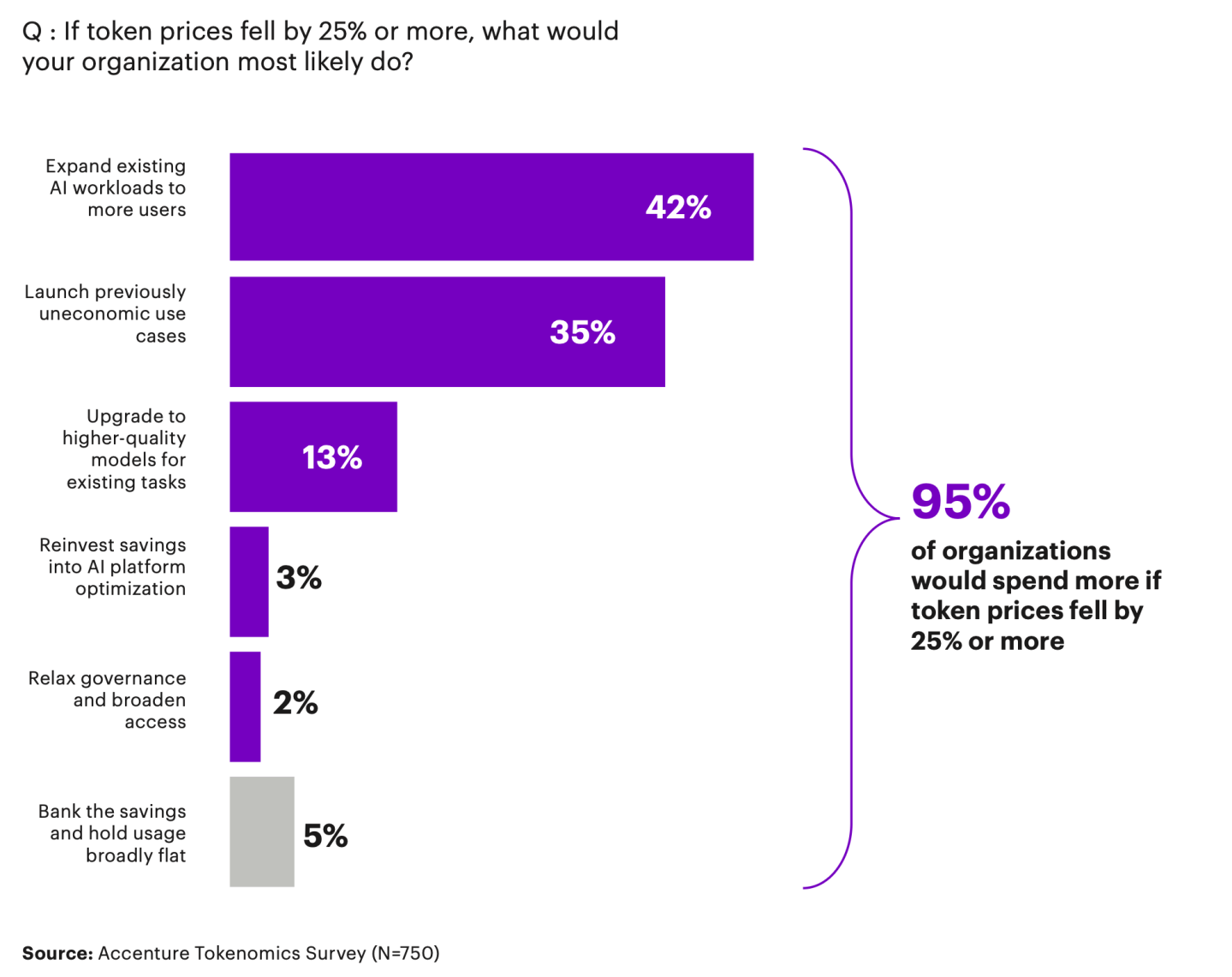
Token bills are looking costly as CIOs struggle to track costs. A new survey of 750 senior executives from companies with annual revenue exceeding $1 billion has found that these businesses collectively spend about $2.5 billion annually on AI tokens, a figure that could increase to close to $3.6 billion within 24 months, according to the research published by professional-services company Accenture. That’s a major ROI challenge as enterprises embrace more agentic AI, given that AI tokens ranked third among cost drivers for the technology, only trailing infrastructure and software development and maintenance.
Accenture says CIOs can get a better grip on costs by embracing more cost-effective, open-weight models and by making every AI-enabled workflow observable before it launches. Other levers involve making every department pay for the AI it uses, automatically routing tasks to the lowest-cost model that can produce the desired outcome, and training employees and developers to understand how to use AI in a cost-effective manner.
Lan Guan, chief AI and data officer, tells Fortune that Accenture’s research concludes that only 20% of enterprise workflows are good candidates for frontier models. CIOs need to be more strategic about building a complex architecture that’s cognizant of token consumption. Yet, Accenture says only 35% of companies can track costs for their largest AI use cases.
“This is not a technical subject anymore; it also involves financial budgeting, behavior changes, and a lot of the cultural changes,” says Guan.
Courtesy of Accenture
JOBS RADAR
Hiring:
– Hot Topic is seeking a CTO, based in the City of Industry, California. Posted salary range: $300K-$350K/year.
– Eskaton is seeking a chief data and technology officer, based in Carmichael, California. Posted salary range: $250K-$355K/year.
– Education Week is seeking a chief technology and information officer, based in Bethesda, Maryland. Posted salary range: $180K-$220K/year.
– American Public Works Association is seeking a CTO, based in Kansas City, Missouri. Posted salary: at least $175K/year.
Hired:
– Red Lobster promoted Jon Tryzbiak to the role of CIO, where he will be responsible for modernizing the seafood restaurant chain’s technology foundation and advancing its data, analytics and restaurant systems capabilities. Tryzbiak joined Red Lobster in June as VP of IT and previously held leadership roles at restaurant chains including Brinker International and Checkers & Rally’s.
– The Hartford has expanded CIO Shekar Pannala’s role to include data and AI, combined with the technology organization that he has led for the insurer since March 2025. Pannala initially joined the insurer in March 2023, leading technology across the company’s property and casualty business. He previously served as CIO at Chubb and CTO at S&P Global.
– Smartly appointed Kelly Uphoff to serve as CTO, overseeing the advertising technology company’s global engineering organization. Most recently, Uphoff served as CTO at fintech firm Tala. She also previously spent a decade at streaming giant Netflix, where Uphoff was a VP of data science and engineering.
– Southland Industries promoted Josh Getz to the role of CIO, where he will oversee all aspects of technology for the mechanical, electrical, and plumbing contractor. Getz initially joined Southland in 2007 as a computer-aided design operator and has been promoted several times throughout his two-decade at the company.
– #Paid announced the appointment of Dave Hampton as CTO. He joins the influencer marketing technology firm from Captiv8, yet another software vendor that focuses on content creators, where Hampton served as head of engineering. He also previously served as director of engineering at SpotOn and Conversant.
– Canyon Partners named Chris Hansen as partner and CIO, overseeing the alternative asset manager’s technology strategy and infrastructure. Most recently, Hansen served as managing director and head of product and application development at asset manager TPG Angelo Gordon. Previously, he was managing director for global markets electronic trading technology at Bank of America Merrill Lynch.
– Spinnaker Support promoted Mark Fetches to the role of global CTO, where he will create a single organization that brings together all of the third-party enterprise software support company’s regional CTOs. Previously, Fetches served as CTO of the Europe, Middle East, and Africa region. He has also held consulting and leadership roles at Accenture, Deloitte, and PwC.
Disclaimer : This story is auto aggregated by a computer programme and has not been created or edited by DOWNTHENEWS. Publisher: fortune.com