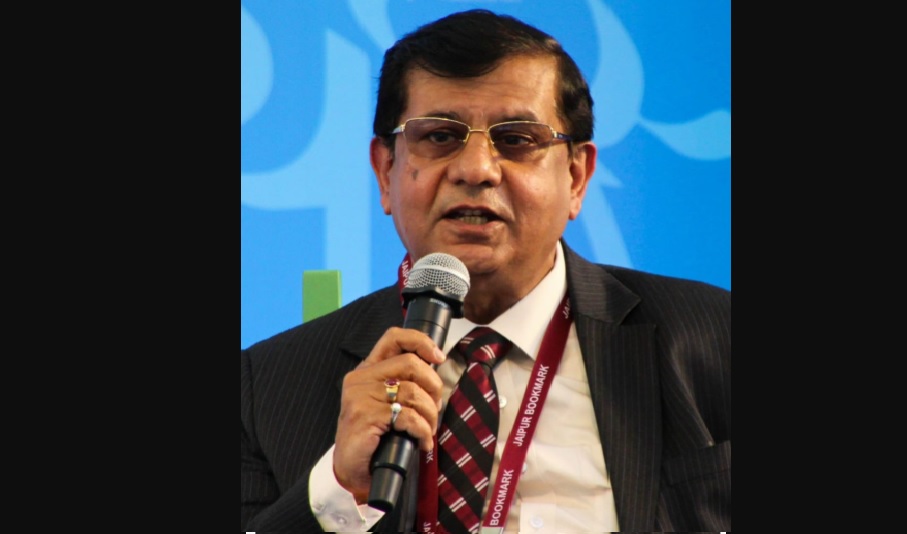
Bhubaneswar: Former Chief Justice of the Uttarakhand and Telangana High Courts Justice R.S. Chauhan has strongly questioned the arbitral award in the Tata Power–Kleros Capital dispute, describing its assessment of damages as “speculative” and “conjectural”.
Justice Chauhan also expressed concern over the handling of allegations of apparent bias and potential conflicts of interest involving members of the arbitral tribunal.
The dispute resulted in Kleros Capital Partners being awarded US$490.32 million (approximately Rs 4,558 crore), besides interest and costs, for the alleged loss of an opportunity to participate in a proposed Russian coal-mining project. With accumulated interest and other amounts, Kleros has claimed that Tata Power’s total exposure exceeds US$650 million (approximately Rs 6,043 crore).
Speaking on NewsX’s legal show Legally Speaking, Justice Chauhan questioned how such substantial damages could be awarded for a project that never became operational and failed to secure the required mining licence.
“Not a single brick was laid,” he observed, questioning the basis for projecting future earnings from an unrealised commercial venture.
“To extrapolate everything seems to be a figment of imagination rather than a legal finding. The entire award seems to be very speculative. It is conjectural,” he said.
How did $13.5 million become $490.32 million?
The sharp divergence between the majority and dissenting opinions in the three-member arbitral tribunal lies at the heart of the controversy.
While the tribunal unanimously found Tata Power liable for breaches of non-disclosure agreements, its members differed substantially over the calculation of damages.
The majority awarded Kleros US$490.32 million, assessing its alleged loss of an opportunity to participate in and profit from the proposed project.
However, the dissenting Indian arbitrator, Justice A.K. Ganguly, reportedly concluded that the evidence did not establish that Tata Power had deprived Kleros of such an opportunity. He assessed negotiating damages at US$13.5 million (approximately Rs 126 crore).
The majority award was thus more than 36 times the dissenting assessment.
The minority adopted a different approach, calculating what Kleros might reasonably have charged Tata Power in a hypothetical negotiation to release it from its obligations under the agreements.
Justice Chauhan questioned the reliance on projected profits when the project had neither been constructed nor generated commercial revenue.
Concerns over alleged bias
Justice Chauhan also questioned the treatment of Tata Power’s objections concerning alleged relationships and potential conflicts involving tribunal members and Omni Bridgeway, the third-party funder financing Kleros’s claim.
He said the challenge appeared to have been dismissed in an overly “mechanical and technical” manner, despite the principle that justice must not only be done but must also be seen to be done.
The Singapore International Commercial Court (SICC), however, rejected Tata Power’s applications to set aside the majority award, holding that the company had not established violations of natural justice, procedural failures or apparent bias. It also found the alleged connections insufficient to establish apparent bias.
The matter is currently under appeal before the Singapore Court of Appeal.
Saran, Rohatgi also raise concerns
Justice Chauhan’s observations echo concerns expressed earlier by former Supreme Court judge Justice Vineet Saran and former Attorney General Mukul Rohatgi.
Justice Saran questioned how Kleros, which had reportedly neither executed the proposed project nor made any substantial investment in it, could receive compensation running into hundreds of millions of dollars. Referring to it as a “letterbox company”, he had pointed out that “not a single brick was laid” and “not a single rupee was invested”.
Rohatgi, meanwhile, questioned the legal and commercial basis of the loss-of-chance calculation, particularly when the underlying project never materialised.
He also emphasised the importance of disclosure of relevant professional relationships and potential conflicts of interest involving arbitrators, parties and third-party funders.
Their observations have added to the wider debate over India’s limited representation in international arbitration, following Supreme Court Justice Manmohan’s concerns over the disproportionately low presence of Indian arbitrators in disputes involving Indian parties.
The controversy ultimately raises questions about the proportionality of damages, the valuation of unrealised commercial opportunities and transparency in international arbitration.
While the majority award has survived Tata Power’s challenge before the SICC, the sharp dissenting assessment and concerns expressed by senior legal figures have intensified scrutiny of the case.
Disclaimer : This story is auto aggregated by a computer programme and has not been created or edited by DOWNTHENEWS. Publisher: deccanchronicle.com