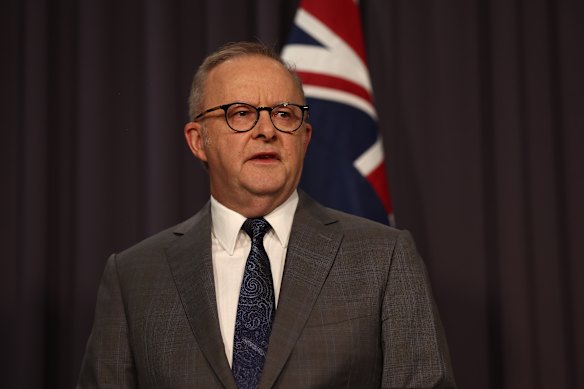

Anthony Albanese is facing fresh pressure from within the Labor movement to impose a multibillion-dollar tax on Australia’s gas exporters, with an influential party-aligned think tank urging the government to use the proceeds to combat the rise of One Nation and rebuild support in the bush for the clean energy transition.
The John Curtin Research Centre has thrown its weight behind a 25 per cent gas export levy – the subject of a concerted campaign by independent senator David Pocock, union leaders and Labor rank-and-file members – estimating it would boost the federal budget bottom line by $73.6 billion over a decade.
Under the proposal, half-a-million regional households would be given free electric appliances to replace expensive bottled gas, with half also receiving rooftop solar, reducing their annual energy bills by between $490 and $1580.
The centre has also backed a crackdown on fuel tax rebates claimed by the country’s biggest mining companies, which, combined with the gas levy and proposed new spending, would leave the federal budget an estimated $87.2 billion better off over 10 years.
The intervention comes as Treasurer Jim Chalmers faces pressure to rein in government spending in his Mid-Year Economic and Fiscal Outlook and tackle inflation as Labor confronts the political threat posed by Pauline Hanson’s One Nation in traditional working-class communities.
The report, Bottled Off, to be released on Tuesday, warns the collapse of bipartisan support for net zero and the prospect of a Coalition government reliant on One Nation after the 2028 election threatens to derail Australia’s efforts to curb greenhouse gas emissions.
“Working-class voters will not respond well to moral lectures from the same business and policy establishment who, in their eyes, have presided over their communities’ long-term economic decline,” the report says.
The gas tax has become a lingering source of tension between the government and its grassroots membership, with the Australian Council of Trade Unions backing a 25 per cent levy and former cabinet minister Ed Husic and Australian Workers’ Union national secretary Paul Farrow agitating for reform ahead of Labor’s national conference in July.
While an anticipated floor fight over the tax failed to materialise, delegates backed a commitment to securing a fairer return from the nation’s natural resources through taxation. More than 350 Labor branches have also backed reforms to the diesel fuel tax credit scheme.
Pocock’s campaign, which gained viral traction through a comparison of the revenue raised by the Petroleum Resource Rent Tax and the excise on beer, prompted a multimillion-dollar advertising counteroffensive from the gas industry and forced the government to consider its options ahead of the May budget.
Albanese ultimately rejected increasing taxes on exporters, arguing that jeopardising relationships with Australia’s Asian trading partners during a global fuel crisis would threaten the nation’s energy security.
On Monday, more than 50 economists, including Nobel laureate Joseph Stiglitz and former Australian Competition and Consumer Commission chairs Allan Fels and Rod Sims, also urged the Albanese government to adopt the measure. In an open letter, they argued Australia exports 80 per cent of its gas but collects far less revenue than rivals such as Norway and Qatar, short-changing taxpayers and starving public services of funding.
The Curtin centre’s report argues that the government’s gas reservation scheme, which would require exporters to supply the equivalent of up to 20 per cent of their export volumes to the domestic market from 2028, should be complemented by a tax that would provide both a financial incentive to sell gas domestically and a substantial new source of government revenue. The government is poised to strike a deal to pass the scheme this week.
Australia exported almost three-quarters of the gas it produced in 2024-25, including $64.6 billion worth of liquefied natural gas, while the Petroleum Resource Rent Tax raised just $1.42 billion. The industry also pays company tax and royalties.
An estimated 544,000 regional households remain dependent on bottled gas for cooking, heating or hot water, paying more than four times the wholesale price of mains gas for fuel delivered by truck.
“Regional Australians live closest to our gas wealth, yet around half-a-million regional homes still rely on expensive LPG,” said the centre’s deputy director and chief economist, Lachlan Kerwood-McCall. “A fairer return on our gas exports can get those homes off bottled gas for good, and cut their bills every year after that.”
The report proposes providing heat-pump water heaters, induction cooktops and reverse-cycle air conditioners to 50,000 regional households annually for a decade from July next year, without means testing or upfront costs.
Minerals Council of Australia chief executive Tania Constable said the country could not tax its way to prosperity.
“The fuel tax credit system is not a subsidy; it is a credit to industries that are using diesel and other products off-road,” she said.
Cut through the noise of federal politics with news, views and expert analysis. Subscribers can sign up to our weekly Inside Politics newsletter.
 Rob Harris is the national correspondent for The Sydney Morning Herald and The Age based in Canberra. He is a former Europe correspondent.Connect via email.
From our partners
Disclaimer : This story is auto aggregated by a computer programme and has not been created or edited by DOWNTHENEWS. Publisher: www.smh.com.au