
Abortion, euthanasia and religious conflict are typically avoided by public school teachers, but in studies of religion, entire lessons are dedicated to these contentious topics.
When 7940 students sat the HSC studies of religion II exam on Thursday, almost all came from non-government (Catholic and independent) schools rather than public high schools.
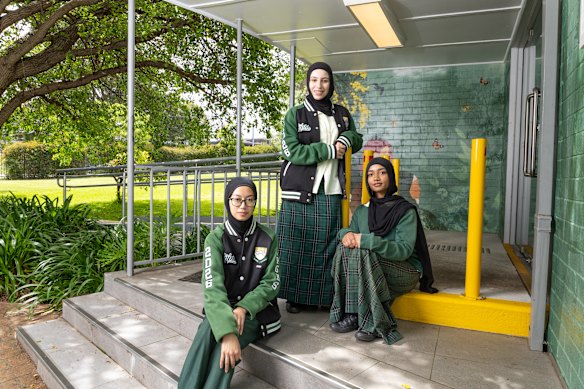
But at Wiley Park Girls High, a public school with a predominantly Islamic demographic, the subject is in high demand. The school consistently has enough students for two classes, and this year 30 students enrolled in the course.
Their secret lies in early scouting. When year 10 students learn about the Holocaust and the stolen generations, teachers identify teens who ask curly questions as prime candidates for the subject.
Teacher Domou Ahmad said: “A lot of our students don’t have the opportunity to be exposed to other world religions. This is a subject for curious minds and anyone who is willing to step out of their comfort zone.”
She has watched the subject dismantle prejudices and break down barriers between religions. “To be a student of studies of religion, you must be open to new ideas … it does promote, in the long run, tolerance and that for us is massive,” Ahmad said.
“They leave the classroom with a better idea of ‘well, people are different, and I can respect that’.”
Three religious traditions are studied in depth – many choose Judaism, Christianity and Islam due to their Abrahamic roots – alongside Australian Aboriginal spirituality, post-1945 religion in Australia, non-religion, and religion and peace.
For 18-year-old Muslim student Rayann Hadid, from Lebanon, learning about Judaism proved unexpectedly transformative.
“We share the majority of the same values and beliefs,” Hadid said. “I definitely do not regret choosing it because it’s opened my eyes to the wider world in a way better perspective.”
This year’s exam asked students to explain how dispossession during the stolen generations continued to affect Aboriginal spiritualities, and ended with an essay asking how religious traditions motivated adherents to create and share peace.
Nourkar Hani said she liked knowing that when she spoke to someone from another religious perspective, she was educated on their beliefs. “I can be respectful and talk to them about it,” she said. She enjoyed learning about Indigenous Australian spirituality.
“I never knew anything about Aboriginal religion, the dreaming, spiritual connection [to the land] until we learnt it,” Hani said.
“Europeans took [Aboriginal people] to teach them the white way was the right way. When in reality, they didn’t do anything but steal their land and steal their heritage. They lost so much … there’s so many people who say ‘I still can’t find that connection to the land or to my kingship group any more’.”
The three-hour exam also included multiple choice questions, one asking which region contained the largest population of Muslims (Asia-Pacific). Comparing notes, Indonesian student Aulia Harianti laughed when she realised she got the answer wrong. “I failed my own country!”
Start the day with a summary of the day’s most important and interesting stories, analysis and insights. Sign up for our Morning Edition newsletter.
 Emily Kowal is a Walkley award-winning education reporter for The Sydney Morning Herald.Connect via email.
From our partners
Disclaimer : This story is auto aggregated by a computer programme and has not been created or edited by DOWNTHENEWS. Publisher: www.smh.com.au