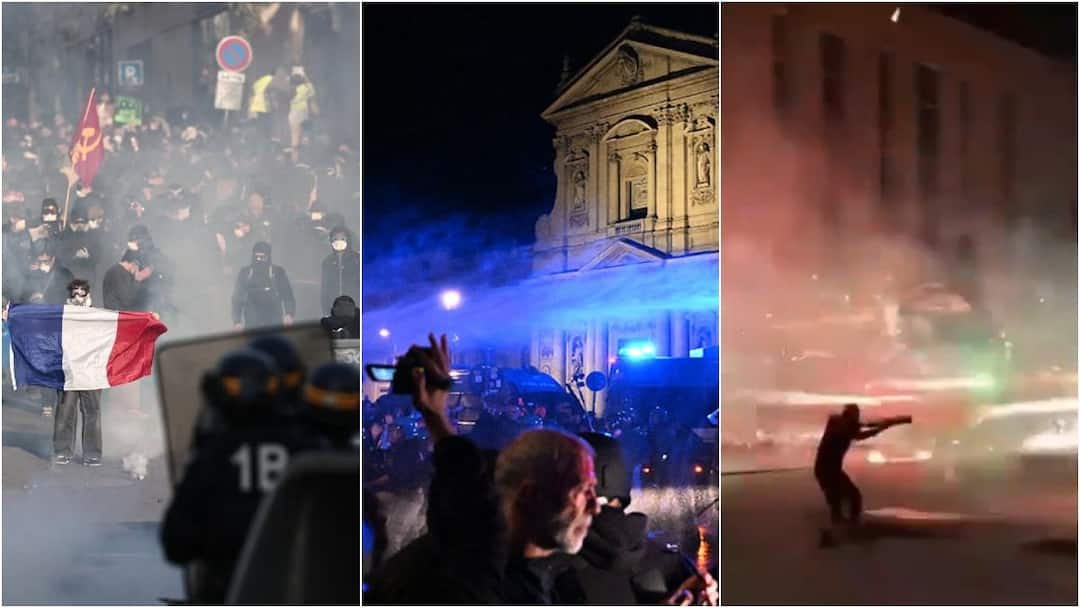
- Europe faced widespread protests over living costs, housing, corruption.
- France, Albania experienced clashes, numerous arrests, police intervention.
- Italy deployed soldiers; Spain, Portugal focused on housing crises.
Protests swept across several European countries over the weekend, with demonstrators taking to the streets over rising living costs, housing affordability, pensions, education, alleged corruption and opposition to war. Rallies were held in France, Albania, Italy, Spain and Portugal, with clashes breaking out between protesters and police in several cities.
Authorities stepped up security following violence during earlier demonstrations, deploying thousands of police personnel and, in some areas, soldiers. While many protesters raised social and political demands, some demonstrations descended into confrontations involving projectiles, fireworks, fires and damage to property.
France Sees Clashes As Arrests Mount
In France, nearly 1,000 people had been arrested during Saturday’s demonstrations, Interior Minister Laurent Nuñez said, adding that the number was likely to rise further.
The government estimated that around 410,000 people had participated in protests nationwide, including 110,000 in Paris. The CGT union, one of the organisers, put the nationwide turnout at nearly 800,000, including 250,000 in the capital.
Clashes were reported in Paris, Lyon, Lille, Marseille, Montpellier, Nantes and Toulouse. In Paris, police said more than 3,000 people were stopped and checked, while 65 people were arrested during the demonstration.
Authorities said the march along Cours de Vincennes had been dispersed following confrontations between protesters and law enforcement personnel. Police used tear gas and water cannons after projectiles were thrown at officers. A gendarmerie helicopter was also deployed to assist ground units in locating groups of suspected rioters.
French left-wing leader and presidential candidate Jean-Luc Mélenchon criticised the police response, accusing officers of using force to portray the protest movement negatively. He also alleged that media coverage focused on confrontations rather than peaceful demonstrations.
US President Donald Trump weighed in on the unrest during a campaign rally in Perry, Georgia, on Saturday, blaming France’s immigration policies for the situation.
Albania Protests Turn Violent, Police Use Tear Gas
Thousands of people gathered in Albania’s capital, Tirana, on Saturday for another anti-government demonstration amid days of unrest. Police used tear gas, water cannons and rubber bullets to disperse crowds, while some protesters threw rocks and launched fireworks at security forces.
Government buildings and banks were targeted, shop windows were smashed, and protesters set a fire at the entrance to the agriculture ministry. Authorities said more than 300 protesters and police personnel had been injured, while dozens of demonstrators had been detained.
The demonstrations have been fuelled by anger over alleged government corruption, unemployment and poor education standards. Students have demanded lower tuition fees, greater state investment in education and action against corruption in the education system. Some have joined a broader movement calling for the resignation of Prime Minister Edi Rama.
The unrest follows months of largely peaceful protests against a luxury coastal development linked to the family of US President Donald Trump. The project has also drawn criticism over its environmental impact.
Authorities deployed around 2,500 police officers in Tirana on Saturday amid fears of further violence.
Italy Deploys Additional Soldiers Amid Protests
Thousands of people took to the streets in Milan, Rome, Turin, Naples, Bologna and Florence, demonstrating over a range of social and political concerns. Some protesters threw bottles, stones and firecrackers during confrontations.
Italian police said nine people had been arrested and 371 others had been briefly detained during demonstrations in eight cities on Saturday. Of those taken to police stations, 110 were minors.
In Milan, authorities deployed police personnel and soldiers as luxury shops boarded up their windows in anticipation of unrest. Most shops had reopened by late afternoon.
Prime Minister Giorgia Meloni announced that an additional 500 soldiers would be sent to Milan and said tougher penalties would be introduced for minors involved in violence. Hundreds of soldiers were already stationed in the city alongside around 5,000 police and other security personnel.
Meloni thanked law enforcement officers for maintaining public safety while protecting the right to peaceful protest. She said demonstrations must be allowed, while citizens must also be able to live safely in their cities.
In Rome, a small group of protesters attempted to enter the Colosseum but were escorted out by guards. A separate anti-war march briefly clashed with police near Piazza della Repubblica, with demonstrators retreating after officers deployed a water cannon.
The latest rallies followed violent clashes and looting during protests the previous weekend. Demonstrations have involved students, truck drivers and farmers, with grievances including housing costs, fuel prices and wider cost-of-living pressures.
Spain Protests Focus On Pensions And Housing
In Madrid, thousands of retirees and other demonstrators marched to demand stronger protections for the public pension system and increases linked to actual inflation.
Their demands included raising minimum pensions to match the minimum wage, narrowing the gender pension gap and preventing the privatisation of public pensions.
Housing affordability has also emerged as a major source of public discontent in Spain, where rents and property prices have risen beyond the reach of many households.
A separate housing protest movement has gained momentum in Madrid, where a camp in Puerta del Sol has grown to accommodate hundreds of people, with facilities including a canteen, clinic and meeting spaces.
The movement began on September 26 after police evicted an 87-year-old pensioner from her longtime home following a sharp rent increase by the property’s owner. The incident sparked wider demonstrations over rising housing costs and weak tenant protections.
Prime Minister Pedro Sánchez’s Socialist government introduced two urgent housing bills aimed at limiting evictions and providing indefinite tenant contracts. However, the minority government failed to secure parliamentary approval, prompting Sánchez to call an early general election for November 29.
Lisbon Housing Protest Camp Cleared By Police
In Portugal, thousands marched through Lisbon on Saturday to protest against rising rents and the cost of living, with affordable housing a central demand.
After the demonstration, protesters erected more than 100 tents in Rossio Square. Police moved in shortly after 2 am on Sunday to dismantle the encampment, making several arrests. Minor injuries were reported, although the exact number was not immediately available.
Dozens of officers, some accompanied by police dogs, entered the camp after warning demonstrators to remove their tents or face charges related to disobedience. Hundreds had gathered to defend the encampment after police dismantled a similar camp at the same location earlier in the week.
Protesters have called on the government to withdraw legislation that would make evictions easier and remove rent caps on new leases. The bill has passed its first parliamentary reading.
Portugal is facing a severe housing affordability crisis. House prices have more than doubled since 2017, while rents for new leases have nearly doubled over the same period. The Bank of Portugal estimates that the country faces a shortage of 300,000 homes.
The demonstrations underscore the range of economic and political grievances driving protests across Europe. While demands vary from country to country, concerns over housing, living costs, public services and government policies have brought thousands onto the streets, while violent clashes in several cities have prompted authorities to strengthen security.
Disclaimer : This story is auto aggregated by a computer programme and has not been created or edited by DOWNTHENEWS. Publisher: abplive.com