
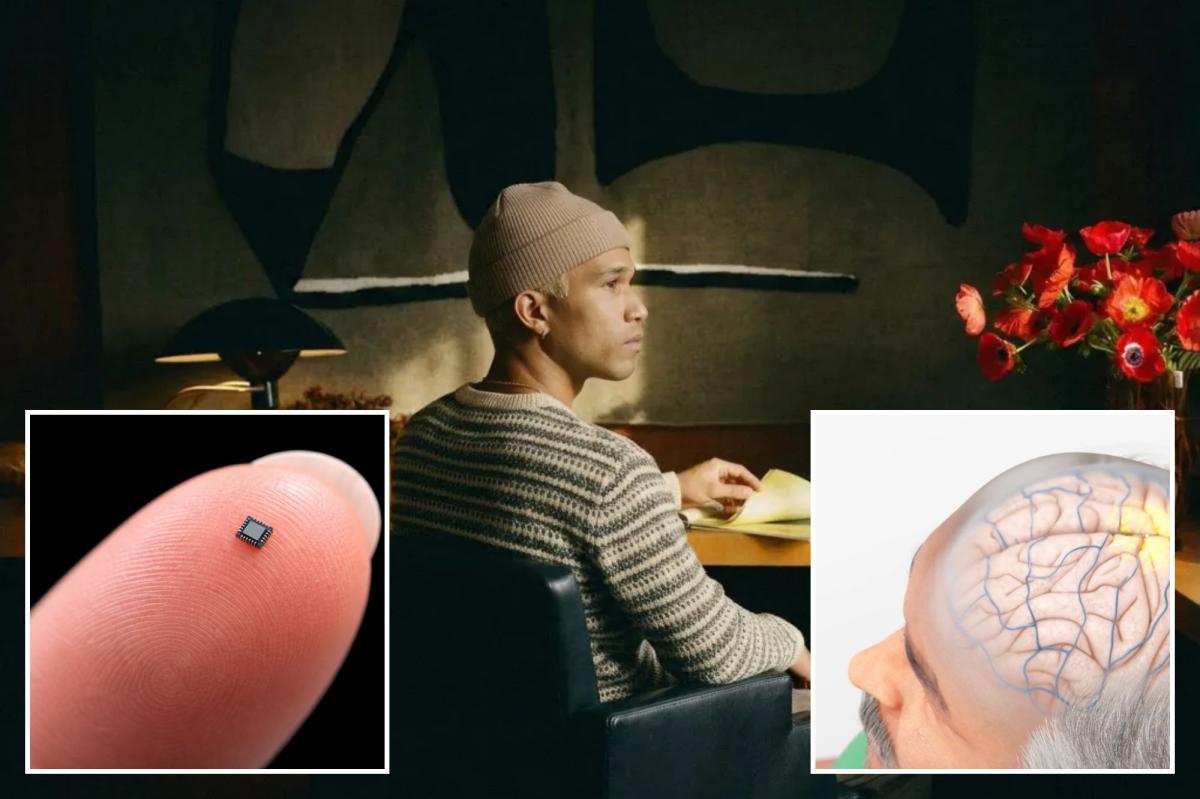
A new tech company claims it has developed a hat that can literally read your mind — then translate it onto a computer.
Much has been discussed about brain implants which require cracking open a person’s skull and putting microchips directly onto your grey matter, but new company Sabi says that’s not necessary for its beanies and caps.
They have 70,000 to 100,000 sensors built in them which can “pinpoint exactly what and where neural activity is happening … to decode what a person is thinking,” then translate it to a computer command, according to CEO Rahul Chhabra.
Sabi’s caps currently focus on text, with the idea being you can think the words you want to type and they will show up on the screen, taking away the need to hunt and peck with your fingers.
However, although Sabi confidently says its product — scientifically known as a Brain Computer Interface, or BCI — will be on the market by the end of the year, few people have tested them out.
A company insider told The Post it has made them available to its investors and they have been very happy with the results, but no independent tests were available.
Those who have worked in the BCI industry, which is around 20 years old, are eager to try it.
JoJo Platt, a neurotechnology consultant in Silicon Valley told The Post: “If it works, I’d say that is pretty incredible.”
Platt, who has not seen Sabi’s device firsthand, points to its 100,000 sensors as key, as previous external brain readers have used only hundreds.
“The way I understand it, they are looking at motor intention and using a massive amount of sensors to try and read intent and then extrapolate those neural signals and put them to text cognition,” said Platt.
“They have a great demo where you can see someone with ALS [Amyotrophic lateral sclerosis, aka Lou Gehrig’s disease], or something similar, actually engaging with the device. Wow!”
Sabi CEO Chahabra did not respond to questions sent by The Post, but if his company’s device works as claimed, it would be a massive leap forward.
Most current brain tech developed by companies involving the likes of Elon Musk or Apple require implants in or near the brain.
That technology is surprisingly advanced and has already changed many lives — mainly of those who have been severely injured in accidents or suffer degenerative diseases.
Brain implants typically use what is known as intracranial EEG (electroencephalography) sensors to translate internal speech into words on a computer screen. In the case of people who can’t speak, that can then be merged with AI voice technology to turn the words into audio, which can replicate the person’s real speaking voice from old audio clips.
Ian Burkhart, founder of the Ian Burkhart Foundation, was an early recipient of a chip on his brain to help him move his fingers again following a diving accident.
He still works closely with the technology and has seen firsthand the impact of a person who goes from not being able to express themselves verbally to doing it convincingly: “They’re thrilled. Some of these people, as well as their loved ones, haven’t heard their voices for years.”
“People’s lives are utterly changed,” Rob Franklin, senior vice president of BCI for Blackrock Neurotech (not affiliated with the investment company), told The Post. His company were the first company to implant a BCI device.
As an example of Blackrock technology, he referred to Casey Harrell, who was diagnosed with debilitating ALS in 2020, and now has four devices, known as Utah Arrays, implanted in what one of his doctors called the “speechiest part of his brain.”
Harrell can now speak with 97.5 percent accuracy thanks to the technology and, Franklin says, “He’s talking to his wife and daughter!”
The most talked-about brain implant of the last few years has been from Elon Musk’s company Neuralink, which has developed PRIME, or Precise Robotically Implanted Brain-Computer Interface, which uses the help of robots alongside surgeons to implant chips in people’s brains.
All of Neuralink’s patients are paralyzed from a spinal cord injury or ALS, and the five which have been reported on have all responded positively to the chips. Patients who have lost the use of their limbs have been able to turn on TVs, move computer cursors on a screen and even play online chess, simply using their minds.
The chip contains 1,000 electrodes programmed to gather data about the brain’s neural activity.
“We’re hoping later this year to do our first device implant for a human, enabling someone who is completely blind to see,” Musk said during an event in Wisconsin in March.
Meanwhile, Merge Labs — a company co-founded by Sam Altman and his OpenAI Ventures — is working on a technique to use ultrasound to decipher brain waves, without the need to put implants in brain tissue, which would be, well, less of a headache than drilling your skull.
Placing a chip in a person’s brain is an inherently risky proposition. Brains are one of the least understood parts of our body, and by far the most complex, meaning any implant comes with major risks.
So far, the people with BCIs number in the hundreds and the technology remains in the experimental stage in the US.
To have a non-invasive solution which reads brainwaves from outside the skull sounds almost too good to be true, according to some in the industry.
“For a true BCI, you need real-time, high-quality signal capture and the ability to translate that into immediate, reliable action, what we call real-time inference,” Tom Oxley, the CEO and founder of Synchron, told The Post.
“In simple terms, the system has to understand what you’re trying to do from your brain signals and respond instantly, such as moving a cursor or sending a message.”
His company is working in the same field as Neuralink, trying to give severely disabled patients the ability to communicate through their brainwaves. The company are partnered with Apple and their chips are implanted through an injection into the jugular vein in the neck, then the chip moves up a blood vessel near the brain’s motor cortex in order to read brainwaves.
“Non-invasive wearables sit outside the skull, so the signals they pick up are much weaker and less precise. That makes it very difficult to achieve the kind of speed and accuracy needed for real-time control, especially for clinical applications like restoring function in paralysis,” said Oxley.
There’s also one other big thing getting in the way of the sensors for some people — hair.
“[Outside the skull] EEG is not as straightforward as it sounds,” said Platt. “You have to connect with the scalp … and hair type will make a difference.”
She explains people of various ethnicities or races have hair-types that need to be managed differently. “I haven’t heard how [Sabi] will address those issues. That may be why they are throwing so many sensors at the problem.”
So until Sabi’s tech arrives and revolutionizes our brainwaves, we’ll be stuck behind the keyboard in the near future, at least in America.
“It’s worth noting that China has recently approved their first implanted brain computer interface for commercial use. So that is the equivalent of going to the FDA and the FDA saying, ‘Yes, you are free and clear to implant this into human beings at scale,’” Platt pointed out.
So, somebody can go to China and have a brain implant if they want to?
“I would not want to do it,” said Platt. “But if you want to, you can.”
Disclaimer : This story is auto aggregated by a computer programme and has not been created or edited by DOWNTHENEWS. Publisher: nypost.com



