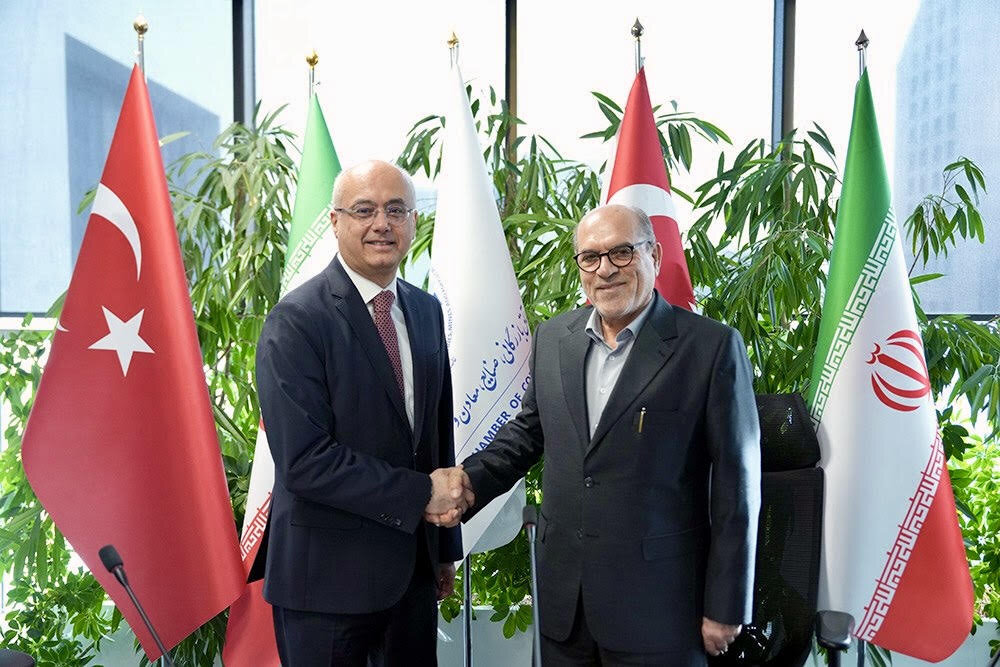
TEHRAN- During a meeting between Ahmet Aydin Dogan, Turkey’s new ambassador in Iran, and Mahmoud Najafi Arab, head of the Tehran Chamber of Commerce, Industries, Mines and Agriculture, the two sides explained measures taken to facilitate trade exchanges and smooth road transport between the two countries, and examined solutions for developing Iran-Turkey trade and economic relations with a focus on strengthening transit corridors, joint production and investment, expanding exhibition interactions, and sending trade delegations.
In the continuation of diplomatic exchanges with the Tehran Chamber, Turkey’s new ambassador, accompanied by the embassy’s commercial counselor, also attended the private sector parliament of the capital and, in a meeting with the head of the Tehran Chamber, the secretary-general, and the deputy for international affairs and trade development, emphasized his embassy’s readiness to strengthen economic and trade cooperation with Iran’s private sector.
At the beginning of the meeting, the head of the Tehran Chamber referred to the good relations between Iran and Turkey, described Turkey’s role in the resilience of Iran’s economy during the eight-year imposed war as significant, and spoke of the need to strengthen trade relations between the two countries.
He then referred to the capacity of the shared borders between Iran and Turkey, described long truck queues at the borders as an obstacle to the development of trade between the two countries, and added: Given the restrictions created at Iran’s southern ports, Turkish ports can be an alternative route for the import of part of goods by Iranian traders.
Najafi Arab, referring to the slowness of customs and border procedures, including at the Bazargan border, proposed that reciprocal passage of Iranian and Turkish road transport fleets be made possible. He also emphasized the need for expert examination of transport and logistics obstacles with the aim of speeding up the movement of goods between the two countries, and noted that currently only a limited part of the road transport fleet passage capacity at the Bazargan border is being used.
The head of the Tehran Chamber also listed facilitating the movement of goods at border crossings, examining the possibility of using other Turkish ports for trade by Iranian traders, resolving the problem of long truck queues at the borders, and determining the status of goods stockpiled in port warehouses as among the issues that can be pursued.
Najafi Arab, announcing the Tehran Chamber’s readiness to pursue these issues with the participation of relevant ministries, emphasized the need to strengthen communication between specialized associations and relevant institutions of the two countries with the aim of facilitating transport and making better use of border capacities.
In another part of the meeting, Najafi Arab referred to opportunities for investment and joint production, and described the capacity of free and special economic zones and the availability of a 25-year tax exemption as a platform for developing cooperation between Iranian and Turkish companies. He proposed using this capacity in economic areas of interest to the parties to form joint cooperation in the production and supply of products.
Removing obstacles to goods transport on the agenda
Ahmet Aydin Dogan, Turkey’s new ambassador in Iran, referring to the history of economic cooperation between the two countries, described Iran-Turkey relations, especially in industrial and trade areas, as extensive and developed. Stating that “Turkish companies have been cooperating with Iranian traders for years,” he added: A number of Turkish companies are active in various economic fields in Iran. Also, the significant population of Iranians residing in Turkey, a major part of whom are economic actors, helps develop exchanges between the two countries.
Referring to the effective role of chambers of commerce in developing economic relations between the two countries, the Turkish ambassador expressed satisfaction with the Tehran Chamber’s interactions with Turkish private sector associations and institutions and described these chambers as drivers of economic cooperation.
He also stated: Meetings have been held by my colleagues with Iranian officials, and while visiting some border crossings, measures have been pursued to improve customs and border procedures. Consultations have also been held with Iranian executive bodies to facilitate and accelerate road transport between the two countries.
Referring to the poor condition of some roads as one of the factors slowing transport, the Turkish ambassador reported that technical problems at border crossings are being examined and pursued by his colleagues. He described restrictions on fuel purchases, the lack of cargo on trucks’ return routes, and taxes imposed on trucks with Turkish plates as other issues requiring examination and follow-up by the Iranian side.
In another part of his remarks, welcoming the Tehran Chamber’s proposals on joint cooperation and benefiting from the capacities of free and special economic zones, he described removing obstacles to the activity of Turkish companies in Iran and providing support mechanisms for these companies as among solutions for developing trade relations between the two countries.
Aydin Dogan also announced planning for meetings with the participation of Turkish companies aimed at expanding trade cooperation with Iranian firms in the near future, and declared the Turkish Embassy’s readiness to facilitate and strengthen economic interactions with Iran’s public and private sectors.
Need to strengthen dispatch of trade delegations from Turkey to Iran
Fereydoun Vardi-Nejad, secretary-general of the Tehran Chamber, referring to the chamber’s continuous interactions with the commercial counselor of the Turkish Embassy, announced the signing of memorandums of understanding with the Istanbul Chamber of Commerce and the Istanbul Chamber of Industry on the exchange and dispatch of trade delegations. He said: Despite these agreements, the presence of Turkish trade delegations in Tehran has been limited, and so far the major part of the executive measures under these memorandums has been pursued by the Tehran Chamber.
Emphasizing the need to strengthen mutual cooperation, he called for a greater presence of trade delegations from Turkey in Iran and added: The exchange of experiences, technical knowledge, and up-to-date achievements between Iranian and Turkish traders can help complete the economic capacities of the two countries and expand joint cooperation.
The secretary-general of the Tehran Chamber, stating that “Iran’s private sector continuously participates in specialized exhibitions in Turkey,” invited Turkish traders to attend the Iran Expo exhibition, which will be held in early next year.
Continuation of specialized meetings
Bigle Donmez, commercial counselor of the Turkish Embassy in Iran, referring to the continuous holding of bilateral trade meetings between economic firms of the two countries, announced consultations for developing cooperation in the health and treatment sector and expressed hope that these interactions would lead to practical results in the medicine and medical equipment sector.
The commercial counselor of the Turkish Embassy in Iran described using the capacity of digital tools in developing trade exchanges, creating joint investment opportunities, and continuously holding trade meetings between Iranian and Turkish traders and businessmen as among solutions for developing trade between the two sides.
MA
Disclaimer : This story is auto aggregated by a computer programme and has not been created or edited by DOWNTHENEWS. Publisher: tehrantimes.com