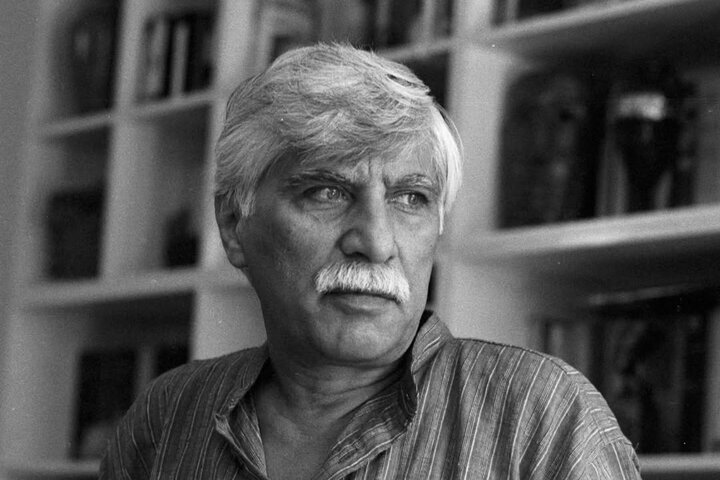
TEHRAN- The first day of “Beyzaie Week” opened at the City Theater Complex in Tehran on Sunday with staged readings of two plays by the late Iranian playwright, director and researcher Bahram Beyzaie.
The program, organized in cooperation with the City Theater Complex, runs from November 8 to 12 at the Mashahir Hall of the complex, featuring six plays presented by theater students and members of an independent theater group, Mehr reported.
The opening session featured “The Feast” (Ziafat), directed by Roham Amin. This was followed by “The Chronicle of Bondar Bidakhsh”, directed by Zohreh Sadeqian.
The program will continue on Monday, November 9, with “The Shore of Salvation” (Sahel-e Nejat), directed by Mani Nouri, scheduled for 5 p.m. On Tuesday, “Four Boxes” (Chahar Sanduq), directed by Zahra Tat, will be presented at the same time.
On Wednesday, November 11, the series will feature “Azhdahak”, directed by Sediqeh Hamrahi. The final session, on Thursday, November 12, will present “Arash”, directed by Ardeshir Sheibani. Both readings are scheduled to begin at 5 p.m.
“The Feast” is a symbolic play that draws on ancient rituals and mythology to explore violence, sacrifice and the destructive mechanisms of social order. The story centers on a shepherd, who is assigned the role of protecting a flock against a wolf. However, instead of completing the traditional journey of a hero, he becomes a victim of the very forces he is expected to confront. Through the characters of the shepherd and Dehbashi, Beyzaie examines a society that demands heroes but ultimately sacrifices them to preserve its established order. The play also draws on the biblical story of Cain and Abel, blending mythological references with ritualistic theatrical elements to question the recurring cycle of violence and victimization.
“The Chronicle of Bondar Bidakhsh” tells the story of Bondar, a learned man and inventor who creates the legendary world-revealing cup for King Jamshid and serves as his trusted adviser. Bondar shares his knowledge and scientific discoveries with the king, enabling him to rule the world. However, as Jamshid grows increasingly consumed by power, he comes to regard Bondar merely as a means to strengthen his authority.
Fearing that the scholar might one day pass his knowledge on to an enemy, the king imprisons him in Ruineh Dej, an impregnable fortress built through Bondar’s own knowledge and expertise. Reflecting on his fate in prison, Bondar regrets his unquestioning trust in the king and his failure to provide himself with a secret escape route. Through this tragic relationship, Beyzaie explores the conflict between knowledge and power, betrayal, and the vulnerability of intellectuals under authoritarian rule.
“The Shore of Salvation” revolves around a young girl, her parents, her little brother and two suitors, one bald and the other mustachioed. As the story unfolds, the parents die, while the younger brother repeatedly ventures into the sea in search of bottles carrying messages from those who have drowned. Meanwhile, the two suitors boast about their talents and claim to be expert swimmers, even offering to teach the girl how to swim through what they describe as a scientific method. However, when the girl prepares to enter the water, their claims are exposed as empty bravado: neither man actually knows how to swim. The play ends with the siblings’ cries for help as they drown, revealing the tragic gap between the suitors’ claims and their actual abilities. Through absurdist situations and symbolic imagery, Beyzaie explores false heroism, hollow promises and the failure of those who present themselves as capable of rescuing others.
“Four Boxes” uses a symbolic dramatic framework to explore social structures, power relations and the restrictions imposed on individuals. The work reflects Beyzaie’s characteristic use of allegory and theatrical devices to address broader social and political questions.
“Azhdahak” draws on ancient Iranian mythology and legendary narratives. By reinterpreting mythological material through a modern dramatic perspective, Beyzaie explores the nature of power, tyranny and the struggle between oppression and resistance.
“Arash” revisits the legendary Iranian archer whose sacrifice, according to the national myth, established the boundaries of the country. The play draws on one of the most enduring figures in Iranian mythology to explore sacrifice, national identity and the relationship between individual destiny and collective survival.
Born in Tehran in 1939, Bahram Beyzaie was one of the most influential figures in modern Iranian theater and cinema. A playwright, theater and film director, screenwriter and researcher, he played a major role in drawing on Iran’s literary, historical and mythological heritage to develop a distinctive contemporary dramatic language.
His extensive body of work includes plays, films and scholarly studies of Iranian theater, mythology and traditional performing arts. Beyzaie directed acclaimed films such as “Bashu, the Little Stranger” and “The Travelers”, while his theatrical works, including “Death of Yazdgerd” and “The Eighth Voyage of Sinbad”, remain important contributions to Iranian dramatic literature.
Through his innovative approach to storytelling, symbolism and historical narratives, Beyzaie left a lasting mark on Iranian cultural life, influencing generations of theater practitioners and filmmakers. The week-long program offers an opportunity for younger theater artists to revisit his dramatic legacy and introduce his works to a new generation of audiences.
SAB/
Disclaimer : This story is auto aggregated by a computer programme and has not been created or edited by DOWNTHENEWS. Publisher: tehrantimes.com