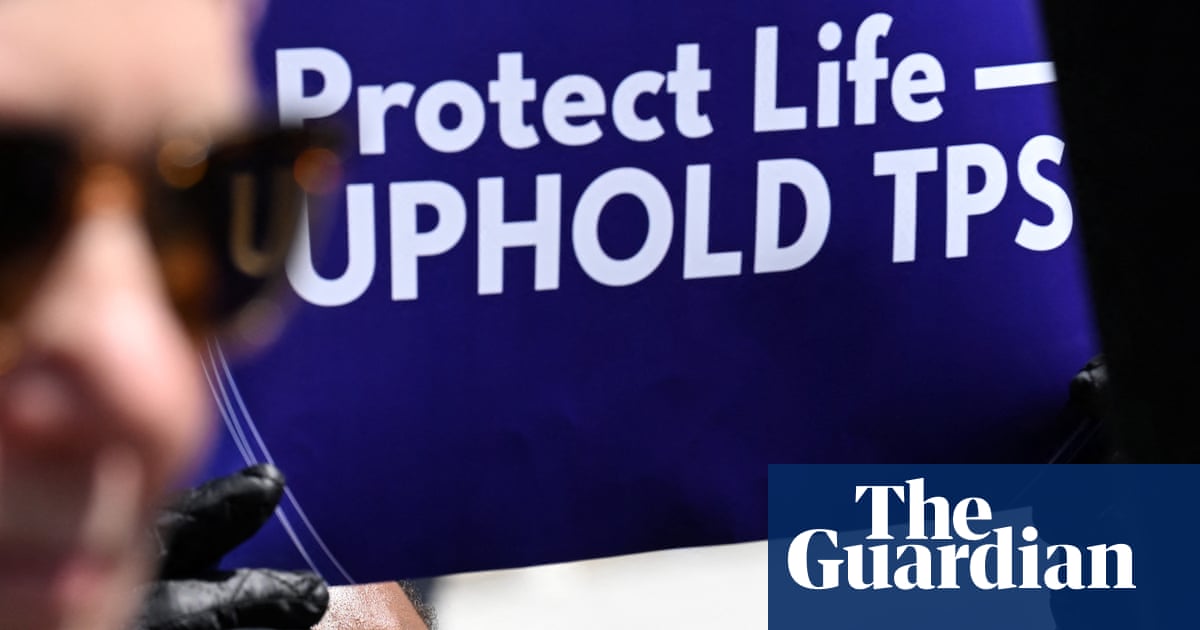
Temporary protected status (TPS) holders, who have historically been protected from deportation due to safety concerns in their home countries, contribute around $29bn every year to the US economy, according to a new report published this week.
The findings from this report, which comes from FWD.us, have emerged one week before the supreme court is set to hear arguments challenging the Trump administration’s attempts to strip TPS status from Syrians and Haitians. It also comes nearly one week since the House passed legislation to protect Haitian immigrants, whose protected status is at risk.
People with TPS are given the permission to live in the US after the government has deemed their home countries to be unsafe due to war, political instability or even natural disasters. In the past year, the Trump administration has attempted to slash the program for various countries.
Around 800,000 US citizens live with TPS holders throughout the country, per the report. Estimates show that nearly 1.3 million people were TPS holders at the start of the second Trump administration.
The report also found that TPS holders pay nearly $8bn in combined federal, payroll, state and local taxes.
“Despite these deep ties, the Trump administration has moved to terminate protections for a large share of TPS holders, including more than 600,000 Venezuelans and roughly 330,000 Haitians,” FWD.us said in a statement. “Not only do the conditions in these countries threaten the ability for people to safely return, but these families are now embedded into communities across the country.”
The report’s release also comes after the House of Representatives passed legislation last week that extends the temporary protections for Haitian immigrants. The bill was pushed forward by Democrats and received unusual support from a small group of Republicans, who defied their party’s leadership.
“I know firsthand how important our Haitian neighbors are to our communities, to our civic life, to our culture, to our workforce, to our economy,” said Ayanna Pressley, a House representative of Massachusetts, who sponsored the bill, according to the Associated Press.
The supreme court is set to hear arguments on 29 April on the administration’s efforts to end TPS for Syrians and Haitians living in the US. Lower courts previously ruled against the Trump administration, delaying the administration’s attempts to end the program. Two separate cases, one for Syrians and the other for Haitians, are being consolidated for the supreme court to review. Advocates and immigration experts have pointed to dangerous conditions in both countries as reasoning for why the program should continue.
In the past year, the Trump administration has aggressively attacked the program, revoking the legal immigration status for around 1 million people and placing them at risk of removal. In total, the administration has attempted to remove protections for people from 13 different TPS-designated countries. The anti-TPS maneuvers are part of the administration’s broader attempts to undermine immigrants legally present in the US.
The TPS program, established more than 30 years ago, does not offer a pathway to citizenship, but it does give holders work authorization. Some of the TPS designations that have been successfully slashed by the administration include those for Afghanistan, Honduras, Venezuela and Yemen.
Other countries whose TPS designations were cut include Myanmar, Ethiopia, Haiti, South Sudan and Syria, are currently being challenged in courts.
Disclaimer : This story is auto aggregated by a computer programme and has not been created or edited by DOWNTHENEWS. Publisher: theguardian.com