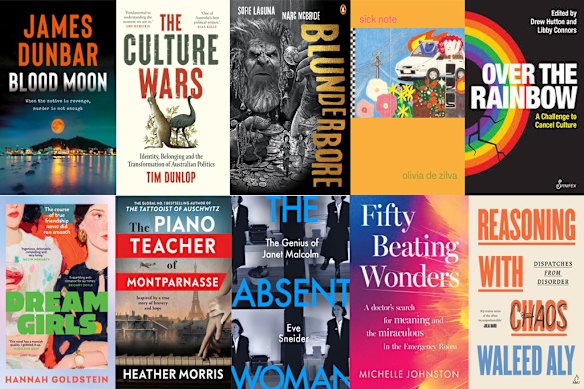
From terrifying fairytale giants to the horrors of the modern workplace, there is plenty to keep readers on their toes this week. Our reviewers cast their eyes over 10 new releases, taking in wartime heroics, literary mysteries and the culture wars along the way.
Fiction
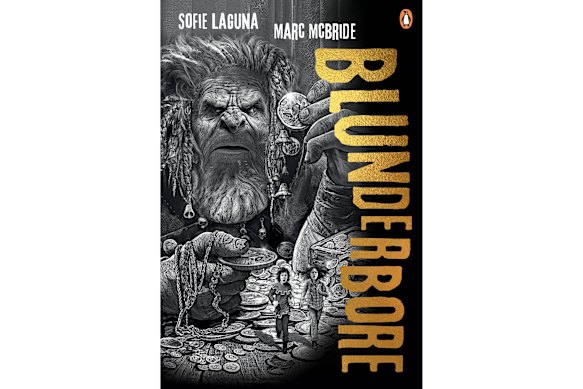
Blunderbore by Sofie Laguna, illustrated by Marc McBride (Penguin, $30)
A revisionist take on Jack and the Beanstalk, this handsome hardback graphic novel combines the words of Sofie Laguna and the black-and-white drawings of her husband, the illustrator Marc McBride, to impressive effect. McBride’s giant is a scary beast indeed: a dreadlocked hulk of a creature who’s been terrorising the village. With only their cow left, Jack’s mother sends him to market to see if he can fetch a good price for it. The magic beans he receives in return promptly grow into a beanstalk reaching into the heavens.
So far, so old fairytale. But Laguna has a few twists in mind for this story within a story. Instead of going it alone as a single hero, Jack has a team behind him to help save their home and livestock, including Gemma, the character who truly steers the adventure. While the words, though well-chosen – are minimal – it’s the finely detailed illustrations that will make you gasp. The book pulses with energy as McBride works from every perspective, zooming in and out for close-ups and panoramic wide shots.
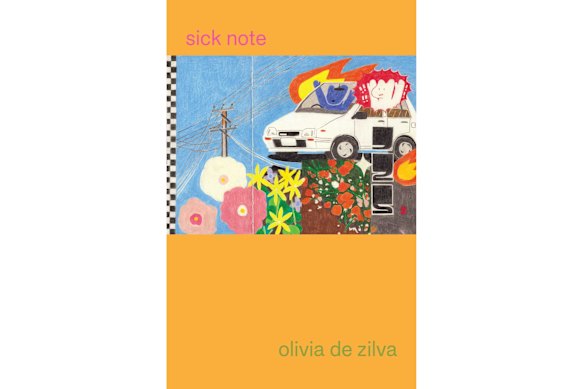
Sick Note by Olivia de Ziliva (Pink Shorts Press, $33)
This poetry collection is Olivia de Zilva’s debut, although she’s written fiction previously. Sick Note is a playful melange of the effects of 21st-century living, where our worth is measured by the rules of dehumanising capitalism: how good are we as busy little worker bees? From the perspective of a jaded young woman, de Zilva lambasts how cringe it is to be a “girlboss” and how employees are expected to wear “the plastic smile of productivity” as she wonders what actually constitutes a “girl dinner”. The alternative, being unemployed, is not much better.
Spam text-message threads, internet slang, online quizzes, a Google search history, and workplace questionnaires are all integrated into her poetry. Stylistically, she favours slabs of text with little or no punctuation. These unbroken blocks of words give her work a breathless quality, as though we are eavesdropping on her inner monologue. Whether it’s time wasted in bouts of non-employment or work stress (hence the title), the book is fun and spiky – though it helps if you recognise the pop culture references littered throughout, from Fleabag to Chappell Roan to Reverend Lovejoy.
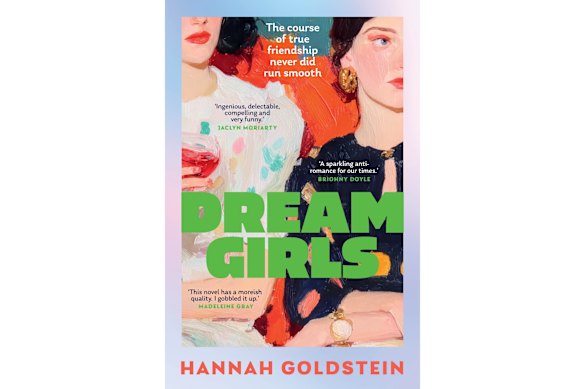
Dream Girls by Hannah Goldstein (Allen & Unwin, $35)
Dream Girls is all about the bonds of friendship, and how easily they can fray and rupture. It begins with Helena being pushed into a lake by Ruthie at a Byron Bay wedding, before moving back in time to explain the circumstances that led them there. Both socially awkward, they were drawn to each other in high school, as neither was acceptable to the cool kids.
Over the course of the next few decades, Hannah Goldstein shows how Helena and Ruthie flit in and out of each other’s lives: besties one moment, frenemies the next, quite often “twisted together like the gnarled roots of a tree”. The novel is particularly good at portraying the confusion and intensity of adolescence and early adulthood as both characters grapple with identity and belonging.
A Midsummer Night’s Dream provides the loose inspiration for this debut, and there is indeed a lot of dreaming here, particularly from drama queen Helena, whose imagination is set to work creating elaborate scenarios about her ex-boyfriend. Ultimately, though, Dream Girls is about the messy evolution of a friendship between two women.
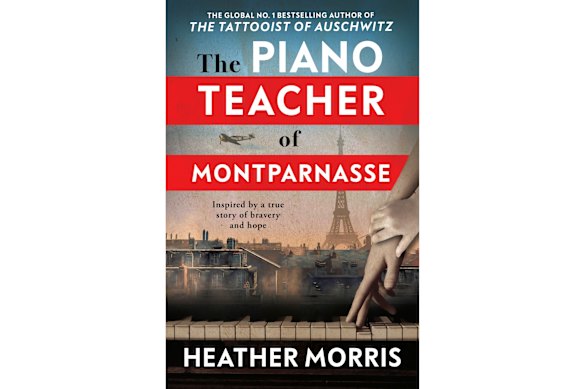
The Piano Teacher of Montparnasse by Heather Morris (Firefinch, $35)
Best known for The Tattooist of Auschwitz, Heather Morris’s latest novel once again combines fact and fiction. The titular piano teacher is Andrée Levallois who, alongside her parents, Louis and Tina, is a member of the French Resistance during the German occupation in 1942. Andrée risks her life by integrating a Jewish girl, Josie, into their household after the child’s brother and mother are taken away by the Gestapo.
Morris’s prose can be mawkish and trite, but the book is filled with daring exploits by the Resistance agents as they fight for the liberation of France. Whether it’s stealing files, transmitting intelligence to London, smuggling in wireless sets by parachute, performing reconnaissance missions, or setting up forgery operations for identity cards, the various ways the operatives strive to fight and sabotage the German regime make for fascinating reading.
Amid wartime horrors, there’s sacrifice, courage and mateship to be found in these ordinary citizens doing all they can to repel the enemy. Fans of that particular subset of historical fiction – WWII stories – will find enough real events here to interest them.
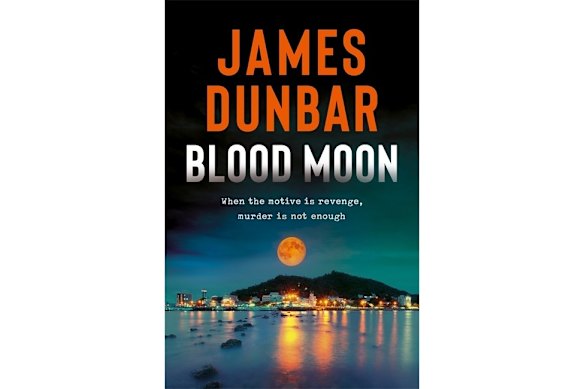
Blood Moon by James Dunbar (Echo, $35)
In Tasmania, Xander, a journalist and true-crime writer, and his mate Lorenzo, a Vietnam veteran, become the targets of a ruthless assassin after inadvertently disrupting a Russian sleeper plot and killing one of its agents. Before she can deploy her weapon on them, however, Lorenzo is called to Vung Tau in Vietnam, at the behest of an old war buddy with PTSD and a secret, while Xander is summoned to Sydney to write a book about the disappearance of a popular artist, presumed drowned.
It’s a credit to James Dunbar that he manages to keep both storylines running at high speed while the two protagonists duck and dodge all manner of violent people and altercations. Xander and Lorenzo first made an appearance in Dunbar’s Mole Creek, so this book is a sequel of sorts, though it can still be read as a standalone. Despite some very grim material involving wartime atrocities, the skirmishes in the art world provide welcome dashes of humour – when Xander sees the price an artwork commands, “he wonders briefly if the artist was actually jailed for daylight robbery”.
Non-fiction
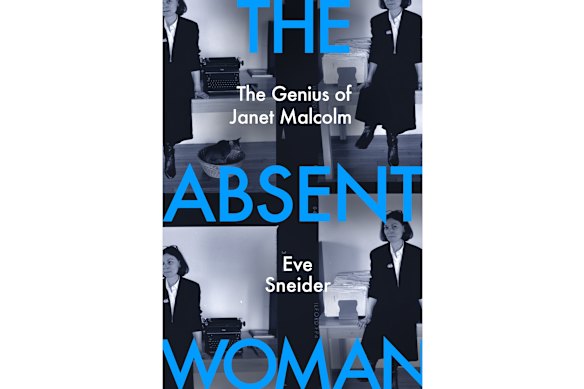
The Absent Woman by Eve Sneider (Atlantic, $35)
Too often biography is a sleight of hand promising more than it can deliver. But here’s one worthy of its subject and her ambivalent, self-reflexive investigations of other people’s lives. A biography that recognises, as New Yorker writer Janet Malcolm did, the limitations of the genre. Eve Sneider puts it in a nutshell: “Our interior lives are our real lives, and no one else can ever truly access them.”
Malcolm guarded her privacy, rarely gave interviews and wanted her work to speak for itself. She well knew the seduction and betrayal built into the relationship between journalist and subject, which she boldly announced in the now-famous opening to The Journalist and the Murderer. She was equally categorical about the shamelessness of biographers, likening them to burglars. Malcolm devoted herself to a profession she felt was “riddled with flaws” because it served as a prism for refracting components of her own identity: the émigré, the “shrink watcher”, the defendant, the writer, the artist. Sneider does exquisite justice to paradoxes of her subject in a portrait permeated by Malcolm’s riveting absence.
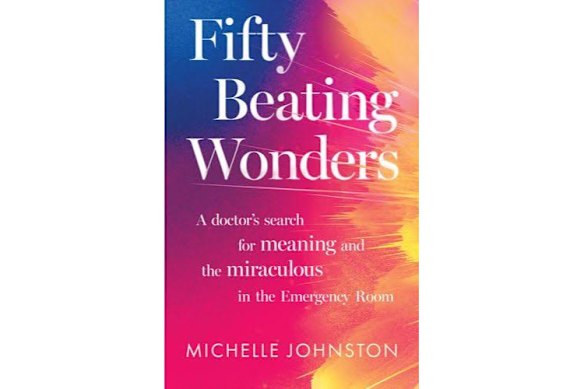
Fifty Beating Wonders by Michelle Johnston (HarperCollins, $37)
Early in her career as an emergency medicine physician, Michelle Johnston sought her purpose in “grand scale heroics”. After 30 years, she sees things differently. This wunderkammer of 50 small wonders gleaned from her experiences in emergency medicine celebrates all that goes unsung: the overlooked bits of the body (the placenta, the diaphragm, the pancreas), the unheralded workers (patient care assistants, the keeper of scrubs in the basement, Servio the mascot pigeon on the balcony), the obscure origins of drugs and treatments (fish play an outsized role). Some of these wonders are more philosophical than physical as she muses on teleology in medicine or how decisions get made in the pressure of the moment.
What she values above all are the interactions with patients and how she has learned the importance of listening, paying attention and respect; of letting them know they matter. Holding these glittering, deeply thoughtful pieces together like connective tissue is an archetypical road accident case that brings home the human drama at the heart of the emergency physician’s work.
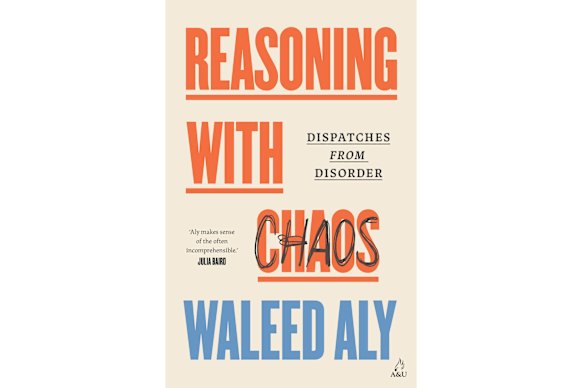
Reasoning With Chaos by Waleed Aly (Allen & Unwin, $35)
Can you reason with chaos? This collection of newspaper columns is a real-time demonstration of one man’s attempt to wrangle meaning out of events that seem to defy reason. Charting a period of just over a year from the eve of Donald Trump’s second victory, these pieces are an implicit plea for reflection over reaction, for humility over outrage, for not letting fundamental principles – the right to protest, the sacred trust between health professionals and patients, the humanity of those we disagree with – be obscured by political righteousness.
Aly has a knack for seeing the bigger picture in the nitty-gritty of the immediate moment. When it emerges that overseas groups are funding criminals to carry out antisemitic attacks on Australian soil, he points to the profound implications for us all if violence is commoditised so that “nations and gangs alike can now, with similar ease, outsource attacks on their foes to something like the gig economy”. Even when the insights are grim or bracing, Aly’s cool-headedness offers a model for how to abide with, and make sense of, these febrile times.
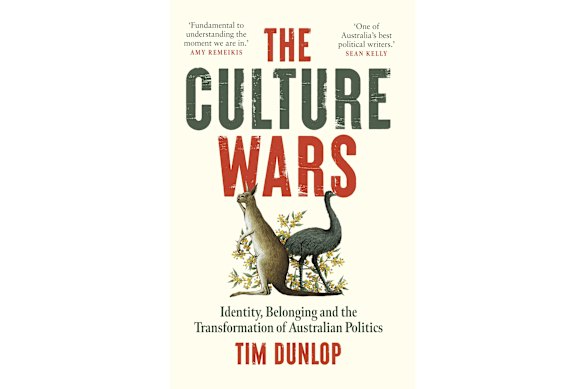
The Culture Wars by Tim Dunlop (MUP, $30)
“Political correctness”, “black armband history”, “woke”, “cancel culture” – these catchy pejoratives are the surface manifestations of what Tim Dunlop identifies as a conscious strategy by politicians since the 1970s to divide and conquer communities rather than bring them together. While all politicians use culture war tactics, he says, the conservative end of the spectrum has driven these debates because it needs to “align working-class voters with elite interests through appeals to shared cultural identity”.
Dunlop argues that debates about race, gender, religion, immigration, class, free trade, Indigenous rights and national identity have been with us since Federation. What has changed is the way they are weaponised. In forensic, snappy prose, he lays bare how political leaders on both sides unleashed neoliberal economics which turbocharged the culture wars. As Labor lost touch with its collectivist roots, Howard drove “a truck through the uncertainties the Hawke-Keating government helped create”. But that truck ultimately backfired on the Coalition and left it at war with itself.
Over the Rainbow edited by Drew Hutton and Libby Connors (Spinifex Press, $39.95)
Does critiquing the ideology behind the transgender rights movement make you a “transphobe”? Does it mean you should be silenced and accused of hate speech? Have public institutions and environmental groups such as the Greens come under the sway of this ideology to the extent that it is deemed acceptable to cancel those who dissent? These questions go to the heart of this collection of essays by left-aligned writers who argue that “the trans industry” has morphed into incontestable group-think.
Susan Hawthorne and Renate Klein, the publishers behind Spinifex Press, say they have been penalised by the book industry for publishing works like this one. Many of the pieces look at how women, lesbians and same-sex-attracted young people have been impacted by the claim that gender trumps biological sex. Is such a debate offensive, damaging or necessary? Decide for yourself.
The Booklist is a weekly newsletter for book lovers from Jason Steger. Get it delivered every Friday.
Disclaimer : This story is auto aggregated by a computer programme and has not been created or edited by DOWNTHENEWS. Publisher: www.smh.com.au