
Curatorial and installation crews race against the clock inside the colossal, column-free exhibition halls of the Moreau Kusunoki and Genton–designed Powerhouse Parramatta.
Amid the tangle of loose cabling, bare walls, empty vitrines and objects under dust covers, it is difficult to imagine that any of the five main galleries will be ready in time for the ribbon-cutting on November 7.
Out on the terrace, an array of cutouts depicting endangered birds sits clustered beside an egg-shaped sound shell, where a tradesman works from a basket on a long crane arm. Ground-floor kitchen staff at the upcoming restaurant, Simara, review freshly printed menus before their first service, while 300 front-of-house recruits move through the corridors for final orientation.
Four days later, the hard hats and hi-vis have vanished. The sound stage backdrop is fully assembled, and members of the choir and dancers are arriving on Saturday for rehearsals. The ladders and scissor lifts are pulled back, though the construction fencing will remain in place for another week.
Guest services’ hosts dressed in coordinated grey uniforms and necklaced with hot pink “how can I help” lanyards wait to greet the first visitors as a digital commission plays on a 24-metre-long screen in an empty lobby.
Some 3000 arrivals are expected over the next several hours; the families and friends of 3000 workers, subcontractors and staff invited for the first dry run of western Sydney’s only designated state-significant cultural institution. A decade of bitter political acrimony that has shadowed the billion-dollar project is all but forgotten in a rush of civic and professional pride by those who have most sweated the outcome.
“A dress rehearsal is critical,” says interim CEO Abbie Galvin. “It allows us the time to put the building through its paces, and weed out all about problem. If anything is going to go wrong, we want it to happen now so we can troubleshoot and resolve it and have it ready for the public.”
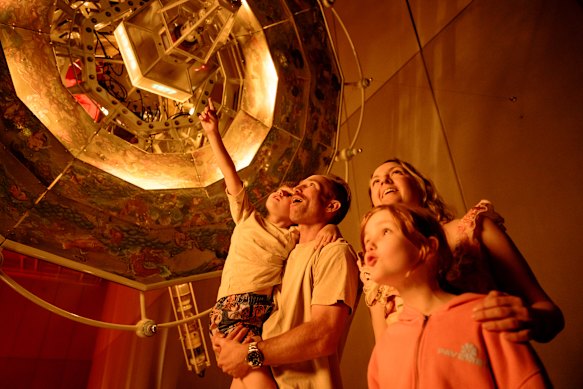
At Saturday’s walk-through, the Beadle-Mandelberg family from Belrose get their first taste of the museum’s marquee aerospace showcase, Task Eternal, an exhibition in four acts which houses the museum’s biggest item a 8400-kilogram F1 rocket from Woomera.
Baxter, 6, gives the rocket-ship playground slide a couple of tries. He’s taken with the stack of planes showing the evolution of flight and the 20 spacesuits and screen-used costumes from Alien, The Martian and Star Trek detailing how our obsession with space and flight has influenced so much in contemporary culture.
He and sister Arabella, 8, linger in the room featuring Thai artist Torlarp Larpjaroensook’s kinetic sculpture inspired by the Voyager 1 space probe. The distortions of reflecting ceiling and floor mirrors fascinate the siblings.
The glass-encased Burramattagal Boomerang, an object created in Parramatta, held by the British Museum in London and returned to Parramatta for this exhibition, is the first and last object visitors will see. The 10 larrakitj (hollow-log coffins) drawn from the Powerhouse Collection, also draws admiration of mum Natalya Mandelberg, whose father was a photographer at the Ultimo museum before it was shuttered in 2024 for rebuilding.
“The scale of it is just impressive,” Matthew Beadle said. “It’s beautifully designed. There are no boring bits. No matter where you look there is an interesting shadow or reflection, or you see an exhibit you’ve just walked through from a different perspective, like the jet engines where you get to see the whole ‘under the hood’, so to speak.”
Spectacle is one thing, says Galvin. The success of these exhibitions will be their resonance. “That will be what makes people return.”
Upstairs of Task Eternal is The Mall, a deep-dive into the phenomenon of the shopping centre and Frank Lowy’s invention of Westfield which is more likely to divide opinions. In the western wing, children venture through tunnels of glowing minerals inside a mock giant meteorite into a recreated childhood bedroom before clambering across a mock windowsill into an indoor Christmas pine forest.
Visitors are asked to surrender their smartphones into pouches upon entry – a strict condition of admission designed to preserve a sense of mystery and purely sensory engagement. The Dark, which turns the idea of darkness as a place of nightmares upside down, is made specifically for children aged four to 12 but will engage young teens.
In the First Nations exhibition Overflow, adults and children are welcome to shuck shoes and socks to paddle through a shallow sandstone pond.
Set within the only gallery offering direct vistas over the Parramatta River and close-up views of the building’s muscular lattice exoskeleton, the space provides rare stillness.
Filmmaker Ivan Sen documented seven communities across NSW as they care for water country, the screen images reflected in pond water with its levels shifting subtlety with the river tides.
The drop from a viewing platform to the floor of Overflow will be closely watched as well as any trails of wet footprints and discarded shoes in case they raise trip or slip hazards. The exhibition’s design versus function has recently been a point of reflection inside the museum, as has the number of collection objects on display.
From the moment of its 2015 announcement 11 years ago, the idea to headquarter the Powerhouse in Parramatta has been squeezed by two opposing forces: the ambitions and cultural claims of Sydney’s second CBD versus the wisdom and expense of splitting it from its repurposed home at Ultimo.
More than 400 museum staff have worked over the past three years developing and delivering the five opening exhibitions. Staff have acutely felt the intense scrutiny. It’s a relief for many to see the finish line so close, but there are nerves, too.
Except for the families’ look and see, no media is permitted inside for the dry run which is a practical test of audio visuals and interactives, installation of labels, signage and way finding.
Given the headlines, and like the new Sydney Metro line, the museum says it wants space to deal with any teething troubles and the staff to enjoy the product of their efforts without scrutiny. The Beadle-Mandelburgs say they haven’t followed the controversies anyway.
The guiding hand behind all this crisp aesthetic and concept – former chief executive Lisa Havilah, who stepped aside from her position on August 27, pending a departmental investigation into “governance and procurement practices” – remains a palpable presence throughout in the intimate, tailored enclosures carved out of cavernous volumes with its high-end industrial finishes.
Only after they open can the public judge if she has found the right balance between embedding western Sydney into the museum and taking its focus international, and in the museum’s delivery of its core charter as a museum of applied arts and sciences and its dedication to its 500,000-strong collection.
British-born artist Es Devlin’s labyrinth of mirrors and light-filled maze will be kept under wraps until opening. Devlin has designed large-scale shows for artists including Beyoncé, Dr Dre, Kendrick Lamar, Eminem and U2. Her commissions replace original plans for a Planetarium, still a sensitive topic for supporters of a dedicated science museum.
“It’s absolutely Lisa’s vision,” Galvin says. “What’s clear, though, is that an entire team helped shape, develop and deliver it – and that’s what really matters. Any great leader builds a strong team, and any great leader is replaceable.”
The museum expects two million visitors in its inaugural year– a figure that once sounded ambitious to Galvin until crowds swarmed the recent four-day Parramatta Lanes festival. More than 20,000 people have registered for opening weekend, with more than 3245 reservations booked across opening program. Tickets for Task Eternal are still available – an entry point to the museum.
The Beadle-Mandelburgs agree that the complex is far too vast to absorb in a single visit. It took them 40 minutes to travel by car, and they easily found street parking, putting to bed early public anxieties around access. They’d be back in a heart-beat, even if they had to travel twice the distance.
Come Monday, staff will be back working up to the last hour to ready the museum for its big ribbon-cutting. It’s director of program, Clare Holland, said the to-do list was getting shorter but was not yet complete. “All the teams are focused on making sure every part is perfect for opening. I love watching people’s faces as they see parts of the building, or exhibitions for the first time.”
Start the day with a summary of the day’s most important and interesting stories, analysis and insights. Sign up for our Morning Edition newsletter.
From our partners
Disclaimer : This story is auto aggregated by a computer programme and has not been created or edited by DOWNTHENEWS. Publisher: www.smh.com.au