

Local councils across NSW are sitting on a $4.2 billion infrastructure war chest that could help unlock thousands of new homes, but the money is not being spent because of rigid spending rules and funding shortfalls on individual projects.
An analysis by the Urban Development Institute of Australia, which represents property developers, shows the value of infrastructure contributions in a series of individual council funds across greater Sydney, the Illawarra and Newcastle has doubled over the past decade.
At the same time, government studies show only a few councils, most in fast-growing areas, hold the bulk of the funds but often feel hamstrung from spending the money because they lack the capital to finish projects.
The funds, which are paid to councils by developers when projects are approved, would help unlock thousands of new homes by providing infrastructure such as roads, parks and drainage.
The size of the funding envelope and its continued growth during a period in which the state Labor government’s push for greater housing supply has been met by concern in some communities about the adequacy of existing infrastructure raises significant questions about whether the contribution plans are fit for purpose.
But rather than criticise councils, which are constrained by policies requiring the contributions to be tied to specific projects, restrictive borrowing practices and rising infrastructure costs, the UDIA says the state government should step in by establishing a $950 million fund councils could use to top up projects.
“A system that accumulates infrastructure funds rather than building infrastructure is a broken one and must change,” UDIA NSW chief executive Stuart Ayres said.
“In the middle of a housing crisis, having four billion lazy dollars doing nothing is unacceptable.”
Despite the growth in local developer contributions, the analysis found that because funding is held across a series of funds, individual councils often lack sufficient capital for specific projects.
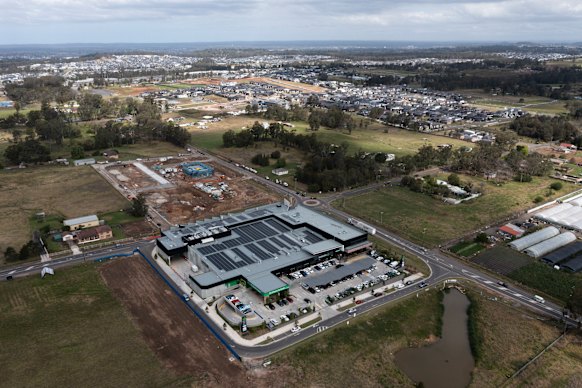
In Camden in Sydney’s south-west, the council estimates up to 4000 new homes could be unlocked for future development with upgrades to the Byron Road corridor near Leppington railway station.
Despite considerable state government investment — including construction of the railway station by the Coalition more than a decade ago — Leppington has struggled to take off in the same way as other neighbouring greenfield developments precincts such as Edmondson Park or Oran Park.
The council holds about $38 million in a contribution fund for the Byron Road corridor, which the UDIA estimates would cost about $47 million to finish.
Camden Council general manager Andrew Carfield said fragmented ownership meant developer contributions were often “piecemeal”, which made delivering enabling works in a “timely way” challenging.
Councils had limited capacity to pool money from contribution plans, he said, because that would affect other parts of the local government area.
“We can’t simply drop the commitment in one plan to solve a problem in another precinct,” he said.
In January, a report from the NSW Auditor-General said councils often lacked funds for specific projects. It said just 14 councils in NSW accounted for almost half of the unspent funds.
While UDIA’s analysis measured only funds held by 43 councils in the greater Sydney “mega-region” — which includes the Central Coast, the lower Hunter and the Illawarra — the NSW Auditor-General found councils across the state held $5.4 billion in infrastructure funds.
The auditor’s report found that of the 14 councils which held substantial funds, 10 spent less than 20 per cent of their overall contributions balance in the 2024-25 financial year.
Councils with high balances but low spending included Bayside, Central Coast, Parramatta, Ryde, Cumberland, Georges River, Lake Macquarie, Liverpool, Maitland and Hills.
The underspending, it said, was partly a result of funding being “particularly complex for councils experiencing significant population growth”. It said councils often reported a lack of funds for maintaining existing assets, slow receipt of funding and reliance on grant funding to top up funds.
UDIA believes the state government should step in by establishing a fund for councils to dip into for important projects, such as in Leppington, which had a funding shortfall.
The fund would be self-replenishing, UDIA says, due to developer contributions from new housing unlocked by the works.
The Minns government has at times been critical of some local councils for slow housing delivery. While Planning Minister Paul Scully said “all levels” of government needed to help pay for new infrastructure to support housing growth, councils needed to spend funding in a “timely manner”.
“The $4.2 billion sitting in reserve was collected for specific projects and needs to be spent in a timely manner to support communities and provide the infrastructure homeowners have contributed to,” he said.
The Morning Edition newsletter is our guide to the day’s most important and interesting stories, analysis and insights. Sign up here.
From our partners
Disclaimer : This story is auto aggregated by a computer programme and has not been created or edited by DOWNTHENEWS. Publisher: www.smh.com.au







