“Diversity in nature is universal,” C.B. Macdonald wrote. “Let your golfing architecture mirror it.”
If the godfather of American course design were still around, he’d find his advice echoed in this year’s six newcomers to GOLF’s Top 100 Courses in the U.S. ranking, which roam widely across the map and showcase the work of five different design firms, all taking cues from the distinctive ground beneath them.
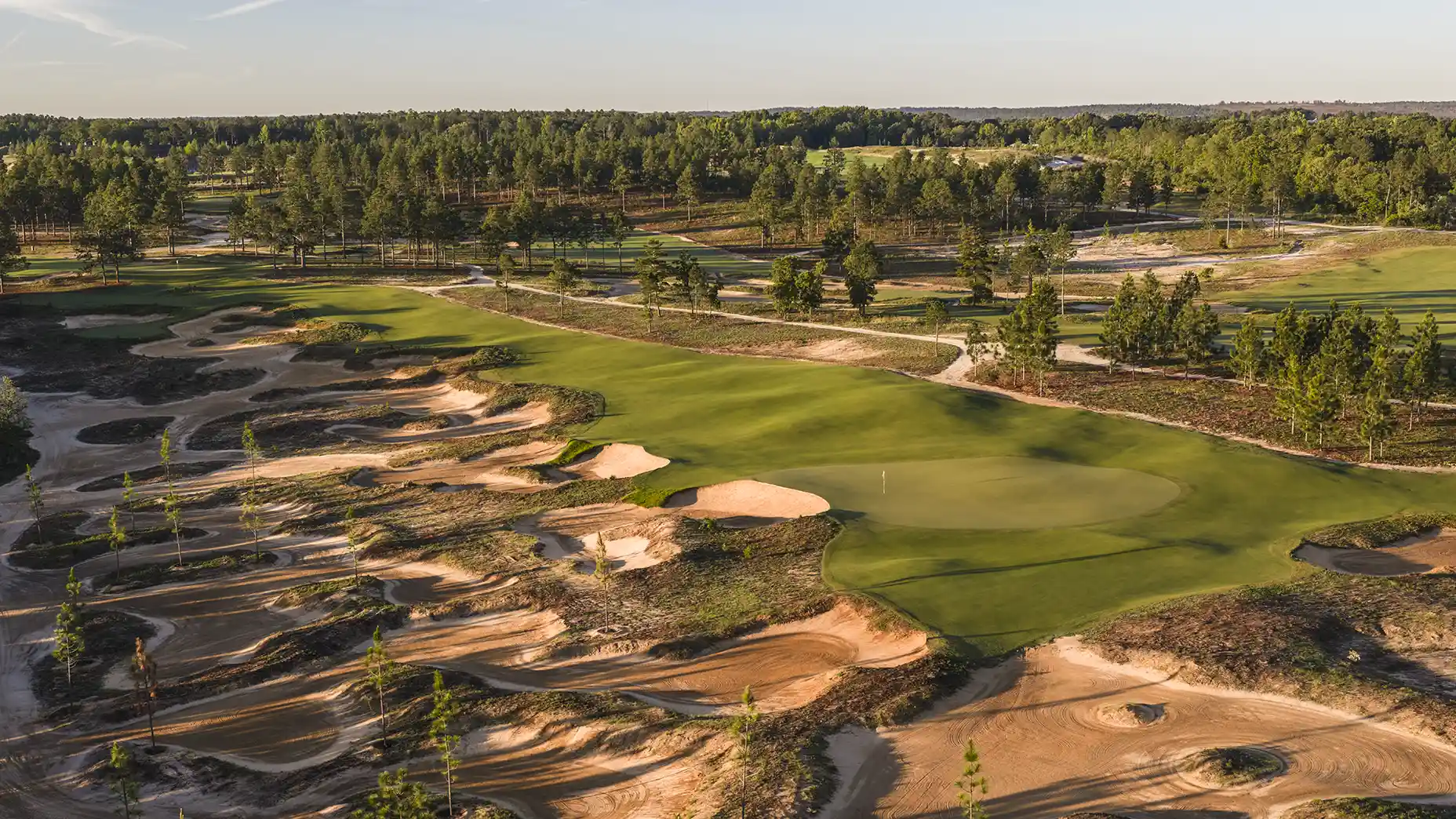
In Georgia, Melbourne-based Ogilvy, Cocking & Mead saw a buckled landscape of longleaf pines and dunes and thought of home. The result is the Sandbelt-inspired West Course at Fall Line (No. 68), one of two 18-holers OCM created for the club, where balls run fast, bunkers flash and greens spill to their sandy edges. On the high plains of the Texas Panhandle, Childress Hall lands two courses on the list, each informed by its terrain. On the Upper Course (No. 44), Tom Doak took minimalism to the max across a dunescape wrinkled by wind and ancient river deposits, while Gil Hanse and Jim Wagner, working closer to the water on the Lower Course (No. 55), weaved three loops that all return to the same point.
Outside Nashville, Rob Collins and Tad King took a light touch on the tousled acreage of the Bounty Club (No. 83), routing play around natural barrancas and dramatic ravines. (The club is owned by 8AM Golf, GOLF’s parent company.) Rounding out the newcomers are two from Bill Coore and Ben Crenshaw, who did what they do best in starkly different locales: the chop hills outside Denver at Rodeo Dunes (No. 88) and the pine-and-granite-studded suburbs of Boston for the Pines Course at The International (No. 84).
Yale, at No. 52, and Baltusrol (Upper), at No. 85, also reappear on the list this year after they had previously dropped off it.
Newcomers to GOLF’s Top 100 Courses in the U.S. (2026/2027)
No. 44 — Childress Hall (Upper)
Set in the Texas Panhandle along the Prairie Dog Town Fork of the Red River, Childress Hall tumbles through a wrinkled landscape of yucca, prickly pear and mesquite. Doak left this crumpled canvas largely alone, intervening mostly to build bunkers and greens while injecting doses of creative mischief. Take the par-4 10th, with its split fairway: the upper tier is harder to find off the tee but keeps you level with the green and gives you the better angle in, while the lower fork winds around a dune and leaves an uphill approach to a perched green that runs away from you. The club sprawls across 2,400 acres, and Doak’s broad-shouldered design fits the scale, its expansive front nine giving way to a dramatic back side that skirts bluffs along the edge of the river valley. Early this year, the Upper was joined by the Lower Course, a Gil Hanse/Jim Wagner design that has also been anointed to the U.S. Top 100, making Childress the first property since Streamsong in 2013 to debut two courses on the ranking.
No. 52 — Yale (Re-entry)
Just in time for its centennial, the finest university course in the country reopened this spring after a $30 million restoration by Gil Hanse and Jim Wagner. The project sharpened the iconic template holes that define Macdonald and Raynor’s work, from the Alps and the Short to the Redan and the famously fearsome Biarritz 9th, a par-3 of more than 200 yards to a massive green with a swale running crosswise through its middle. Conditioning was a problem before the restoration, and well-documented reports of uneven turf have persisted since the reopening. Consider that a blemish on an otherwise sublime work of architecture, one whose great bones are now sturdier than ever.
No. 55 — Childress Hall (Lower)
Members at Childress Hall like to say that Tom Doak barely moved a thimbleful of earth to build the Upper Course, while Gil Hanse moved heaven and earth to complete the Lower. You’d never know it from the layout, which, true to its name, flows naturally along a lower portion of the property, closer to the ruddy banks of the Red River. A more intimate design than its sibling, the Lower defends itself with deft bunkering and large, richly contoured greens, many flanked by steep and ticklish runoffs. Texas golf is wind-blown golf, so be prepared to hit some knockdowns and bump-and-runs. The Lower welcomes them. But there are forced carries, too, none more memorable than at the 15th, a short par-3 that plays up over a gully and offers some of the property’s most astounding views.
No. 68 — Fall Line (West)
The sandy reaches of west-central Georgia are a long way from Australia, but the land here reminded Geoff Ogilvy of home. For the West Course at this intensely private club, he and fellow Melbourne natives Mike Cocking and Ashley Mead drew inspiration from the fabled Sandbelt where they learned the game, creating a firm, fast, bouncy layout with sandy wastes fringing the fairways and flashed bunkers cut hard along beguiling greens. In keeping with this Down Under aesthetic, finding the short grass is only the first step in problem-solving, as even slightly out-of-position tee shots can complicate approaches to targets that spill off into bunkers and tightly mown collection areas. The result is a sweet complement to the East Course, which is patterned on the heathland layouts of England. Together with a par-3 course, the two 18-hole tracks make the Fall Line an all-OCM property.
No. 83 — Bounty Club
Like a country rock band returning from a tour, King/Collins came back to Tennessee, the state where they had their breakout hit with cult favorite Sweetens Cove. Unlike Sweetens, which is public and sits in a remote floodplain, the Bounty Club is private (it’s owned by GOLF’s parent company, 8AM Golf) and spills through rolling farmland just outside Nashville, on acreage spliced with creeks and tree-studded ravines. On land so naturally golf-ready, little in the way of formal bunkering was needed. The architects instead conjured extra intrigue with a bold, compelling routing that follows the lilt of the terrain, mixing in blind shots, dramatic elevation shifts and alluring green complexes, with views of the Nashville skyline along the way.
No. 84 — The International (The Pines)
For years, the Pines at the International, an hour outside Boston, was known mostly as a novelty: at more than 8,300 yards from the tips, it was the longest course in the country but also widely seen as short on character. Coore and Crenshaw changed all that, with a redo so thorough it counts as a new build. Trading scale for strategy, they trimmed more than 1,300 yards from a routing that now moves more nimbly through a classic New England landscape of creeks, ponds, conifers and granite outcrops. The par-3s alone show the range, from the stout 14th, a 200-plus-yard shot to a devilish green, to the short 16th, which protects itself with a 16-foot-deep bunker in front. Drivable par 4s and fine risk-reward par 5s add to the already high entertainment value of a layout that reminds us: the quality of a course is not contingent on its size.
No. 85 — Baltusrol (Upper) (Re-entry)
Baltusrol’s members harbor a not-so-well-kept secret: for a quick nine or a casual Saturday fourball, most prefer the Upper Course, not the more famous, championship-hardened Lower. Now a recent Gil Hanse and Jim Wagner restoration (completed in 2025) has given Balty regulars even more reason to frequent the Upper. Working from a trove of archival photos and maps, Hanse and Wagner pushed A.W. Tillinghast’s greens back to their original dimensions and cleared trees to reopen sight lines across the rolling mountainside property, which delivers more variety in hole settings than its bruising sibling. Among the design delights is the par-4 14th (pictured above), where the club added a backup green ahead of the 1936 U.S. Open because the original was prone to flooding. Abandoned in the late 1950s, Hanse and Wagner unearthed the second green during the restoration, and it now sits beside the original, a nod to Tilly, who was a fan of dual greens. Which surface is better? Jury’s still out.
No. 88 — Rodeo Dunes
As you leave the Denver airport, you pass a giant statue of a rearing mustang. But that’s not where you see the wildest ground. To find that, continue some 40 minutes to the chop hills in the high plains north of the city. Here, on land long owned by a prominent rodeo family, Coore and Crenshaw unloosed a spirited layout that moves in all directions on the tousled terrain. The humps and bumps alone are plenty compelling, but so are the quirks of a routing that features back-to-back par 3s, blind shots over dunes and blowout bunkers, and an approach to a hidden green on a hill where a cow skull serves as a directional marker. Rodeo Dunes is one of three big projects in the works from Sand Valley co-developer Michael Keiser Jr. (he is also busy in Florida and Texas), who, in keeping with family tradition, has a multicourse destination in mind. A second 18, by longtime Coore/Crenshaw associate Jim Craig, is already well underway and slated for preview play late next year.
Disclaimer : This story is auto aggregated by a computer programme and has not been created or edited by DOWNTHENEWS. Publisher: golf.com