
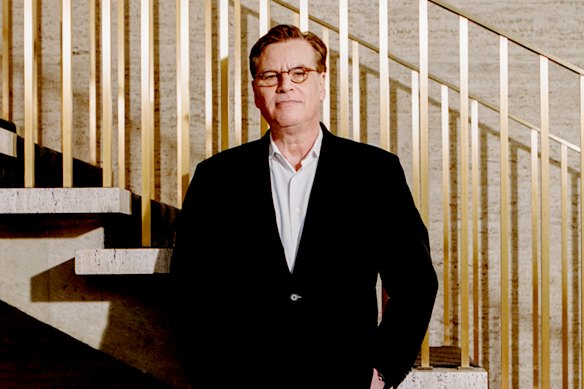
Oscar-winning writer Aaron Sorkin discusses his return to the social-media giant with his latest movie.
The walk-and-talks. The soaring monologues. Aaron Sorkin has, for the last quarter-century, dramatised the institutions at the centre of American society. From his first play, A Few Good Men, in 1989, which he then adapted into the blockbuster movie (and is now bringing back to Broadway), to The West Wing, The American President, The Newsroom and beyond, Sorkin has created work that in many ways has shaped our understanding of how politics, the media and the military work in the US. Or should work.
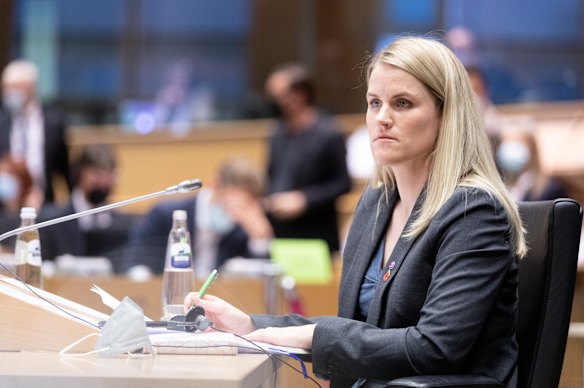
Sorkin’s script for the 2010 film The Social Network not only won Sorkin an Oscar for best-adapted screenplay, but became the defining story of how Mark Zuckerberg created Facebook, even if it wasn’t all exactly true. Now Sorkin has returned to Facebook with The Social Reckoning, which opens in Australia on October 8. It focuses on the real-life Facebook product manager and whistle-blower Frances Haugen, who leaked thousands of internal documents to The Wall Street Journal reporter Jeff Horwitz, showing that the company knew its platforms were having a number of negative effects and resisted doing anything to address them.
Sorkin’s movies and television shows are often more idealistic than realistic, and The Social Reckoning is no exception. This impulse to romanticise is something Sorkin is often dinged for, and on the two occasions we spoke – once before Meta settled a landmark lawsuit about harms its social media platforms cause teenagers, and once after – he defended and explained his trademark uplift to me in ways that surprised us both.
Andrew Breitbart, the founder of the right-wing website Breitbart News, would often say that politics is downstream from culture – essentially that Hollywood has more sway over our politics than Washington does. How do you view your role in that equation? It’s not a political agenda. Before a movie can be anything else – before it can be thought-provoking or relevant – it has to be good. It has to work as something that you watch while you’re eating popcorn. That’s what I’m thinking about while I’m writing. Beyond that, I write idealistically and romantically. I find that these areas – government, the news, journalists – are where the stories are that really suit the way I like to write.
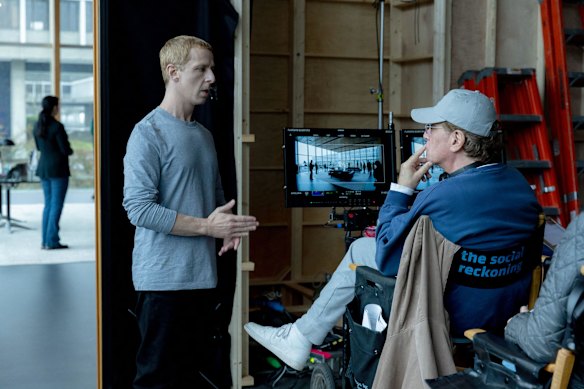
I want to talk about how that view fits into your new movie, The Social Reckoning. In 2022, you told The Guardian: “I very much doubt that I or anyone else is going to write a sequel to The Social Network.” What changed your mind? First, I’m not really sure you can call this a sequel. This is another movie about Facebook, written by the same writer who wrote The Social Network. And one of the characters from The Social Network is in this as well, but played by a different actor. It’s as if the character of Henry Hill [from Goodfellas] showed up in Casino. To answer your question, there were two reasons in 2022 I said that. There had been a few people in my world asking me for a while to write something else about Facebook after Cambridge Analytica. I just didn’t want to be the writer of Jaws 2. I was afraid of that. But mostly I just couldn’t find the story. I couldn’t find the movie part of what they were talking about, until I started learning about Frances Haugen and Jeff Horwitz and what they uncovered.
I went back and watched The Social Network again. I was really shocked by how sceptical you were of social media back then. This came out in 2010, the height of tech optimism, when we were still happily connecting with our high school friends and former sweethearts. What did you see that the rest of us didn’t? What I remember is thinking that here’s an interesting story: that this very successful social network is being built by an extraordinarily antisocial guy. That this person who was uncomfortable in the social structure of college, the way many of us are, invented his own social structure that he couldn’t be shut out of. And he’d be the mayor of that social structure.
You’ve been asked before about your responsibility to be fair to people when you’re writing stories that involve real-life characters, and you’ve said you’re making a painting and not a photograph. But looking back, some of the details you changed are pretty big. That idea of this antisocial person creating this social network – Zuckerberg was dating his now-wife, Priscilla Chan, at the time. So it wasn’t exactly true, but it’s become the origin story that everyone understands about Facebook now. Whether Mark was dating Priscilla Chan at the time or not, I honestly don’t know. In all of the research, her name never came up, but I think broadly speaking, your question is: “What am I willing to fictionalise when I’m telling the story of a real person who’s still living?”
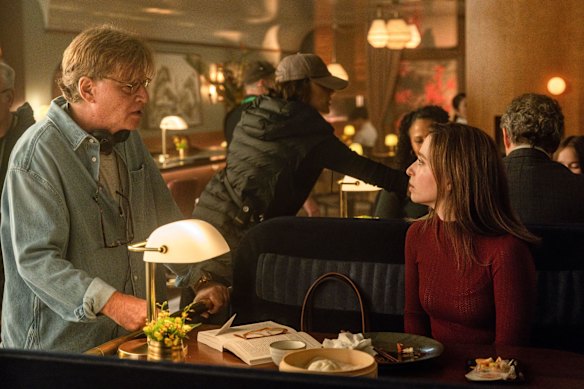
Right, because it is the way so many people understand things. I would never defame someone. By the way, I could never defame someone. It’s a really interesting area for me because I have lately done a lot of nonfiction, and in some cases about people who are still alive: The Trial of the Chicago 7, Molly’s Game, Steve Jobs. One critic once said – and they didn’t mean it as an insult, and I didn’t take it that way – that when I write nonfiction, I am really just using the characters for parts. And they had a point. There’s an idea that I’ll get about a character’s motivation, like Mark’s. I’ll do my research. I’ll learn everything I can about the reality. But in the process of thinking about it, and then the process of writing it, it becomes the same as a fictional character for me. It becomes my character that I’m creating. The studio’s legal department will make sure that I’m staying inside the lines. But it’s this imaginary thing, and it has my voice, and eventually it’s going to be played by an actor and it’s going to have that face. But I will tell you that in terms of Mark, in both cases, The Social Network and The Social Reckoning, or any antihero – which is what Mark is, not a villain – I, as the writer, can’t judge that character. I write that character as if they’re making their case to God on why they should get into heaven.
You don’t think Mark Zuckerberg is a villain? Are we talking about real Mark or my Mark?
Well, tell me what the distinction is. I don’t want to pass judgment on real Mark. I’m not here for that. The Mark in The Social Reckoning is an antihero, not a villain. And I just want to add that the character and the person not only have me trying to defend them, but Jeremy Strong, who blows the doors off the place playing this part, was constantly defending Mark to me. Not just on the set. He’d write to me late at night. And as soon as his last shot was over, on his last day of shooting, as soon as I called, “Cut!” Jeremy Strong marched up to me – and this was the first time I heard him use his own voice on the set, not Mark’s voice – and in his own voice said, “If I’d been playing Jeff [Horwitz], I’d have been defending Jeff.”
What is Mark Zuckerberg’s case to God now? That he’s bringing people closer together. That’s been his mission from the beginning, and I imagine that the advances that he’s making with AI and with the dumb glasses, he imagines those are steps forward for all of us.
Just to stay with Jeremy Strong’s portrayal, Jesse Eisenberg turned down the role. Part of the reason he said he didn’t want to do it is because he felt like he had been so identified with that role and he was tired of people coming up to him and saying … It’s the only reason he said he didn’t want to do it. He does not want to be conflated with this character any more. He really doesn’t like Mark Zuckerberg. He would talk about being in airports at the baggage claim and young kids coming up to him, wanting him to sign a business card that said “I’m CEO, bitch,” and things like that. He doesn’t like that he kind of looks like the guy. Just wouldn’t do it. And he meant it, too, because he was offered every incentive that usually works with actors. Jeremy was the next call, and as it turned out, it was like replacing [legendary baseballers] Joe DiMaggio with Mickey Mantle.
In a recent interview, Strong said he reached out via email to Zuckerberg, and Zuckerberg wrote back. Yeah, I read that.
Did you know? No, I had no idea.
That’s interesting. Why do you think he didn’t tell you? I don’t know. I’m not shocked that he didn’t. Jeremy does a lot of his own work. He does a tremendous amount of work before he shows up on your set. He did not speak in his own voice on the set or walk the way Jeremy walks. I told all the other actors in his scenes: “Guys, he’s not going to be hanging out with you at craft service. He’s not going to be yucking it up with you between takes. He’s probably not going to speak to you at all. He is going to treat you the way he imagines Mark treats the people around him.” And that’s what happened. You cannot argue with the results.
Was it hard to get the movie made? Because we’ve seen other films about technology companies having trouble in Hollywood these days. I’m thinking of Artificial, the film about Sam Altman, which got dropped by Amazon MGM Studios, and Laurene Powell Jobs, the widow of Steve Jobs, tried to kill your biopic of Steve. Has Meta ever warned or threatened you over The Social Reckoning? It’s my understanding that Sony did get letters from Meta, and I do not think those letters said: “We’re wishing you all the luck in the world. Send us some tickets for opening night.” Under ordinary circumstances, with a piece of nonfiction, the studio’s legal department would do a thorough vet. With this movie, they hired an outside law firm just to handle the legal vet to make sure every single thing that is presented as a fact is a fact.
Was that nerve-racking? Oh, it’s agonising, and the things that I wasn’t able to say or do are agonising. The irony wasn’t lost on anybody that we were doing a thorough fact check of a movie about a company unwilling to do the same thing.
In 2019, you had this very public back-and-forth with Zuckerberg. You wrote an open letter to him in The New York Times Opinion pages where you said that Facebook was “assaulting truth” by allowing lies to be pumped into the ecosystem. And then, in what seemed like a response, Zuckerberg posted a quote from your speech from The American President, which talks about the value of free speech. Is this new film a continuation of that argument that you two seem to be engaged in over time? As a matter of fact, it is. I wrote that in 2019 as a response to Facebook announcing that they were no longer fact-checking political ads, which is an argument that happens in this film. I saw the response that you’re talking about where he quotes [President] Shepherd’s speech from The American President about free speech and about how American citizenship is hard. I found it a little aggravating because there’s no chance that Mark, who’s a very smart guy, and the people around him, who are very smart people, don’t know the difference between an unpopular opinion and a lie. The First Amendment doesn’t protect lies. If it did, nobody would ever win a libel suit.
So, in some ways this is your response? I found a story to tell. [Smiles] I found a good story to tell where you can eat popcorn and Milk Duds.
This is a classic underdog story, and there is something really hopeful about a regular person taking on a behemoth like Facebook. But I was just reading an interview that Frances Haugen gave and she said that we “may be worse off today than when I leaked the documents”. And Jeff Horwitz, the watchdog reporter who is also lionised in the film, was effectively downsized out of his job at The Wall Street Journal. He’s now working at Reuters. And Congress doesn’t seem to be anywhere close to regulating online safety. You’re saying it hasn’t been fixed? [Laughs] I thought it was fixed!
Aren’t things bleaker than perhaps you’re portraying in the film? Yes. But let me just expand a little bit on what you just said. Frances Haugen is someone who is an incredibly employable person, a young woman who could have gotten a job anywhere, but she wanted to come work at Facebook because Facebook had, at the time, something called a Civic Integrity Team, the one team at Facebook that does not care about growth – its only thing is safety. It was the Civic Integrity Team that came to Mark and said, “We have found ways to reduce misinformation”. The Civic Integrity Team was dissolved, and that’s part of what sent Frances on her way to being a whistleblower. As she says in the movie, she did this because she wanted to help Facebook and not hurt it. She really believed in its mission, believed in what it could be, and believed that people like her could help it get there. This movie – and I want to say this without giving away the end or really anything in the third act – but it ends on an optimistic note. Because of who wrote it. [Laughs]
I’m glad to hear you acknowledge that. It ends on an optimistic note, but not a rose-coloured one. It’s upfront about what’s still wrong. It’s just that David threw a rock at Goliath and connected.
Why do you keep on being attracted to those particular types of characters? You are asking me a very interesting question, and I don’t know the answer. I think it has something to do with my father. I always felt like he had one foot in another century, you know? He was just a very sweet, very bright man for whom decency was the measure of a man.
I actually wanted to talk about the way you grew up. Part of your family fled the Russian ghettos to come to the US, right? Yeah, my father’s parents were chased out of Russia by the czar’s police because they were Jewish, and they came here with $3 in their pocket, as teenagers. Then they had my father, who on his 18th birthday signed up for the Army in the middle of World War II. When the war was over, he went to college on the GI Bill [which provides educational benefits to eligible military service members and families] and then law school. In the course of one generation, the Sorkins went from lower middle-class to upper middle-class.
What did your parents understand about patriotism and duty? They understood patriotism wasn’t the kind of bumper-sticker patriotism that we get sold so often. I was very little at the time of the Watergate hearings, but I do remember watching them, and I didn’t feel like my parents thought this was a national shame. I thought they felt like, “Look at these guys railing against the most powerful person in the world”. And on that day in August, when Nixon resigned, it was nothing but pride that the most powerful person in the world was giving up power and there wasn’t a tank in the street. And so, January 6 becomes a lot more heartbreaking.
Without giving too much away, what happened on January 6 [2021, when rioters attacked the US Capitol in Washington] plays a role in your new film. It comes up. But I believe in all of us, even now. I believe in this country, I really do.
You’ve said that you’re romantic about the institutions of American democracy. I want to confess that watching The Social Reckoning was a little bit disorienting because of its reverence for working within the system – Congress, the courts, journalism – to achieve this goal. We’re at this moment where people are angry at our institutions. They feel the system is rigged. Do you not despair sometimes that your reverence is misguided? It may well be, but what’s the alternative? I mean, what would I do if it was misguided? If I said, “Hey, these institutions, they’re terrible, they’re rigged,” what do we do? All we have are elections. Other than taking to the streets, that’s the only time we get to raise our hand.
This is an edited version of an article that first appeared in The New York Times.
Get the best of Good Weekend delivered to your inbox every Saturday morning. Sign up for our newsletter.
Read more from Good Weekend:
Disclaimer : This story is auto aggregated by a computer programme and has not been created or edited by DOWNTHENEWS. Publisher: www.smh.com.au



