
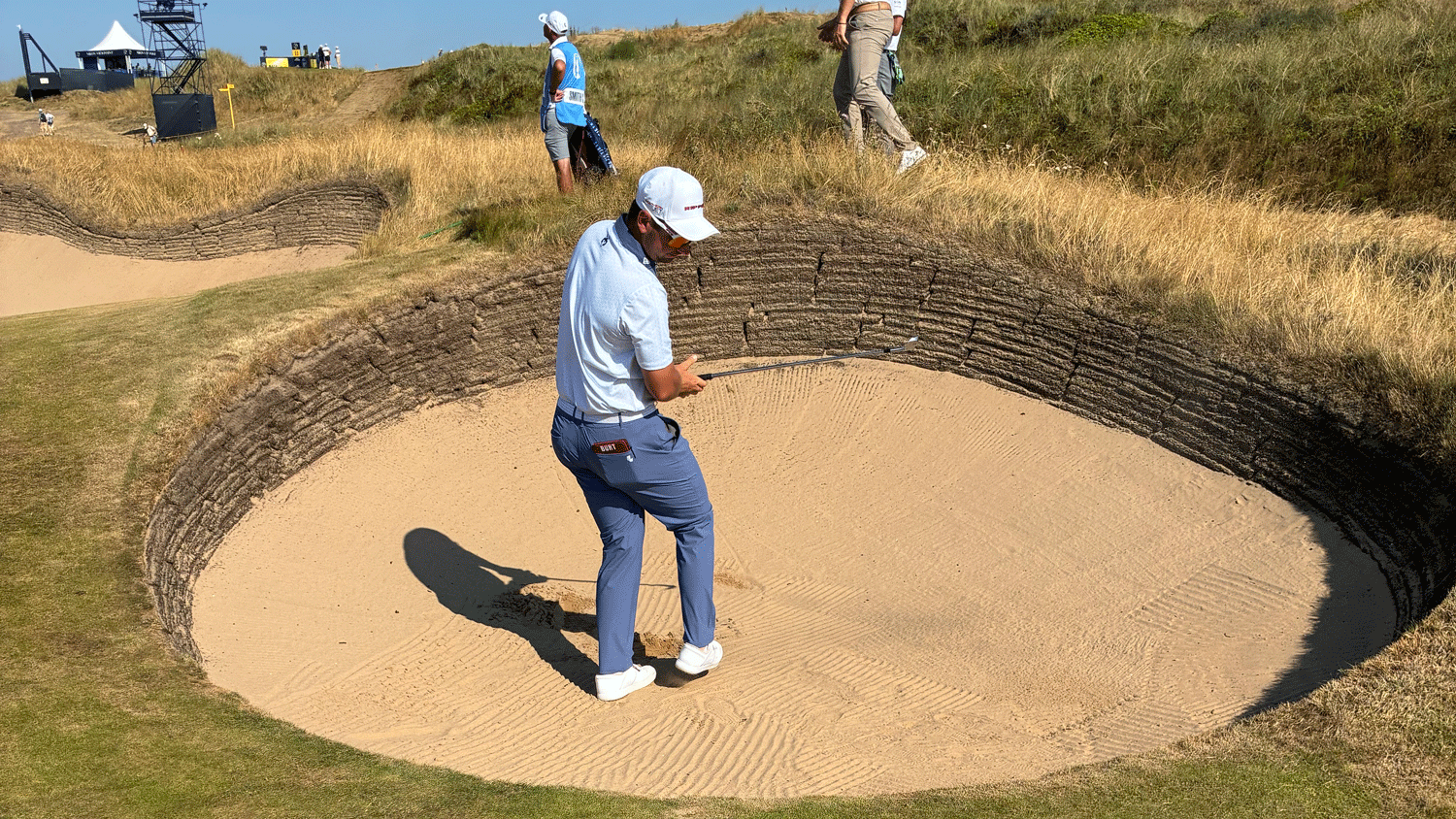
SOUTHPORT, England — Please, don’t get in the bunker. The bunker sand here is the real deal: coarse, heavy, dark — troublesome. This Royal Birkdale course ain’t no country club, and its 104 bunkers will never be confused for American country-club traps. At Hartford, at Colonial, even at Augusta National, a bunker is often a place you want to be. The American bunker, typically filled with manmade sand and smoothed to perfection by gas-powered machines, is spin city. Hence the player-and-caddie phrase, “Get in the bunker.” The players, week in and week out on the PGA Tour, can perform magic tricks. Here they cannot.
“This is linksland sand,” the English golfer Matt Wallace said during a practice round Wednesday afternoon. Wallace had been discussing how the sand at Augusta National and many other American courses is trucked in. The bunker sand here, most decidedly, is not. “Linksland golf is all about sand. The ball settles in these bunkers. You can’t hit it as high. You can’t do much with it, really, at all.”
The Australian golfer Lucas Herbert, upon hearing that Tiger Woods won the 2006 Open down the beach at a baked-out Royal Liverpool course without playing a single bunker shot, said, “Sign me up for that.” His caddie, Nick Pugh, noted that not only is the Open sand different from the sand at other tournaments, it is raked differently, too. “These R&A-sanctioned rakes, with their widely spaced teeth, guarantee that there will be ridges” in the bunkers, he said. Those nasty ridges!
Michael Bamberger
The vertical walls of sod, a feature of bunkers throughout seaside golf in the British Isles, are justifiably famous and challenging. But the furrows left behind by R&A rakes through real-sand traps add to the trauma of it all, too. If your ball settles against one of those ridges, your options shrink fast.
Yes, the sand in the bunkers here is all real. To use a phrase of the farm-to-table movement, it is “locally sourced.” At Augusta National, the sand is trucked in. At almost every new course, sand is trucked in. Course operators order sand in the exact shape and size they want. At Royal Birkdale, the golfers get what nature gives them.
The course here never gets within a half-mile of the Irish Sea. There’s a wide, flat beach, a wide swath of dunes, a coastal road, another wide swath of duneland and then the course. You can see a small mountain of sand, mined by the club, between the course and the dunes that border it. There’s a bulldozer beside it. That sand finds its way to the course as needed.
That mining system may sound, to Americans raised on dune protection in the fight against coastal erosion, like heresy. The opposite view prevails here. The mining of these dunes is actually sanctioned by a national conservation group called Natural England. For starters, trucked sand leaves a carbon footprint — it has an ecological cost. More to the point, local golf people say this particular stretch of duneland has become too stagnant, with invasive trees taking hold of the dunes and stopping their natural movement. These true linksland courses were created out of wind currents that sent sand and grass seed flying. Wallace seemed to understand all that on instinct alone when he said, “This is linksland sand.”
The Old Course in St. Andrews, on the east coast of Scotland, takes you right down to the beach. Turnberry, on the west coast of Scotland, takes you right down to the beach. When people think of British Open golf, that’s what comes to mind: the sea, the beach, the sandy course that comes right out of it. Royal Birkdale is not like that. It’s not hard against the sea at all. But it’s so duney. It’s as sandy as any course in the Open rotation. People often say that Royal Birkdale is the most American of the Open courses. Hmm. Here’s another view: It’s as linksy as a course could be. It’s as sandy as a course could be. This should be a great and true Open.
Michael Bamberger welcomes your comments at Michael.Bamberger@Golf.com.
Disclaimer : This story is auto aggregated by a computer programme and has not been created or edited by DOWNTHENEWS. Publisher: golf.com





