TEHRAN – Several factors have contributed to the decline of U.S. hegemony in West Asia.
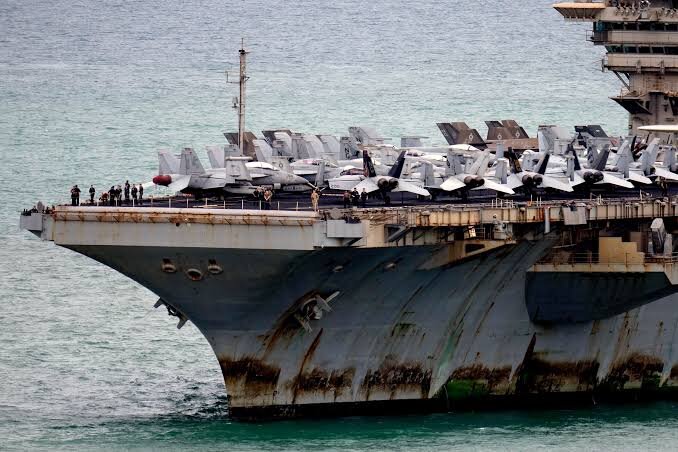
For decades, the United States maintained a clear military advantage in air and naval power. Its advanced fighter jets, such as the F-35, and nuclear-powered aircraft carriers, including the USS Abraham Lincoln, gave it a significant technological edge.
But having the most advanced weapons did not necessarily mean being prepared for a prolonged war, particularly one that required weapons and ammunition to be produced and replenished on a mass scale.
This weakness became particularly clear during the illegal war against Iran. The U.S. deployed a massive fleet designed and built during the twentieth century for operations across the open oceans. It was now being drawn into a war in the Persian Gulf, where narrow waterways and shallow coastal waters presented a very different set of challenges.
The U.S. military faces persistent hurdles in maintaining equipment and delivering new weapons on schedule. Its supply chains also depend on foreign sources for certain critical materials. China plays an important role in the supply of gallium and germanium, which are used in military electronics and other advanced technologies. This dependence creates potential vulnerabilities, especially if export restrictions disrupt access to these materials.
These weaknesses expose a fundamental contradiction in American military power: the ability to field sophisticated weapons does not necessarily translate into the ability to sustain a prolonged war.
Iran’s war of attrition
These dependencies make a prolonged conflict increasingly difficult to sustain. U.S. forces risk exhausting their stockpiles faster than they can replenish them, a structural vulnerability that can be exploited through a multidimensional war of attrition.
By deploying large numbers of inexpensive drones and ballistic missiles across land, sea, and air, Iran has confronted U.S. forces with a stark economic imbalance. Tens and billions of dollars’ worth of carrier strike groups and ground-based air-defense systems have been forced to expend scarce interceptor missiles, costing $2 million each against dense waves of Iranian drones no more than $20,000 apiece.
Moreover, because these high-tech interceptors cannot be replaced quickly, every missile fired represents a permanent drain on American combat readiness, opening a direct strategic opportunity for its competitors.
Instruments of financial dominance
The U.S. military presence in West Asia was also only sustainable to the extent that the financial system funding it was sustainable. American regional dominance has long rested largely on monetary control, specifically the petrodollar and central authority over the global banking system through the SWIFT network.
This monetary monopoly gave Washington an influential diplomatic tool, including the ability to freeze foreign central bank reserves, impose unilateral sanctions, and isolate entire countries from international trade.
But the repeated use of these tools has sent a warning far beyond the countries directly targeted. By weaponizing its financial dominance, Washington has demonstrated to the wider international community that dependence on U.S.-controlled financial infrastructure can itself become a sovereign liability.
As Iran sought alternative payment and settlement mechanisms to circumvent sanctions, energy exporters that were not directly targeted, including Saudi Arabia and the United Arab Emirates, also began diversifying their options.
By exploring non-dollar arrangements for settling oil and gas transactions, expanding the use of local currencies in trade with major buyers such as China, and participating in multilateral digital-currency initiatives, these countries have begun laying the groundwork for a less dollar-dependent energy trade. Such efforts could gradually reduce the reach of Western financial jurisdiction over strategically important markets.
At the same time, the fiscal foundations of American financial dominance have weakened from within. Decades of overseas military adventures, including spending outside ordinary budgetary channels, have contributed to mounting federal deficits and a rapidly expanding national debt. The annual U.S. budget deficit is just shy of $2 trillion, while the national debt has surpassed $40 trillion.
The collapse of moral authority
Perhaps nothing has damaged U.S. hegemony more profoundly than the erosion of its moral authority.
For decades, Washington, backed by Western media organizations and think tanks, has invoked moral arguments to justify coups, military invasions, and forcible regime change. From the 1953 coup in Iran to the invasions and occupations of Afghanistan in 2001 and Iraq in 2003, and the regime-change campaign in Libya in 2011, the U.S. has repeatedly presented its geopolitical ambitions as moral imperatives. The intervention in Syria in 2024 forms part of this same pattern.
For years, Washington managed to defend its international standing against accusations of hypocrisy. That credibility, however, has been badly damaged by the genocidal war in Gaza.
Washington has shielded the Zionist regime from international accountability.
This has undermined the credibility of the so-called rules-based international order, making it increasingly difficult to distinguish universal principles from policies designed to serve the interests of the U.S. and its allies.
By the time Washington waged an illegal war against Iran, its moral authority had already suffered substantial damage. The legitimacy that once helped underpin U.S. global leadership had lost much of its persuasive force. What remained was a political narrative that increasingly struggled to convince a public audience and Washington’s closest allies.
End of an era?
This does not mean that the U.S. will collapse tomorrow. It remains a global superpower, with formidable military, economic, and technological capabilities.
The more consequential change is that the international order dominated by the West for roughly five centuries, an order that shifted the center of global power away from Asia and toward the West, is now eroding much faster.
Disclaimer : This story is auto aggregated by a computer programme and has not been created or edited by DOWNTHENEWS. Publisher: tehrantimes.com