Stepping into the lift to descend deep underground, you can hear the familiar hubbub of Sydney’s city centre gradually fade, and the gateway to another world begins to emerge.
Measuring 20 metres tall, 28 metres wide and 180 metres long, Australia’s largest underground rail cavern will be home to the flagship station on the $29 billion Metro West rail line between Sydney CBD and Westmead.
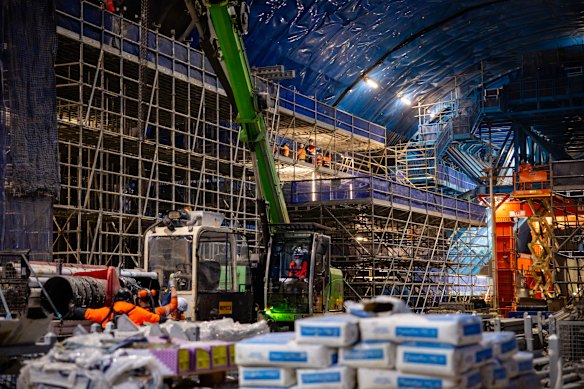
The future Hunter Street station will be larger than both Victoria Cross Station in North Sydney and the Martin Place metro station when it opens to passengers in 2032.
Tunnelling on the mega-project is complete, and attention will now turn to the actual build and fit-out of the stations. It is partly thanks to “Jessie” – a 1100-tonne boring machine – and her efforts digging 2.3 kilometres from The Bays station to Hunter Street, a small but complex section under the harbour on the entire 24-kilometre line.
Jessie began her journey in mid-2024 and worked around the clock, five days a week, to excavate 230,000 tonnes of material. She made her final breakthrough at Hunter Street in early March, where delicate retrieval efforts in Sydney’s cramped CBD will take place over the next few weeks.
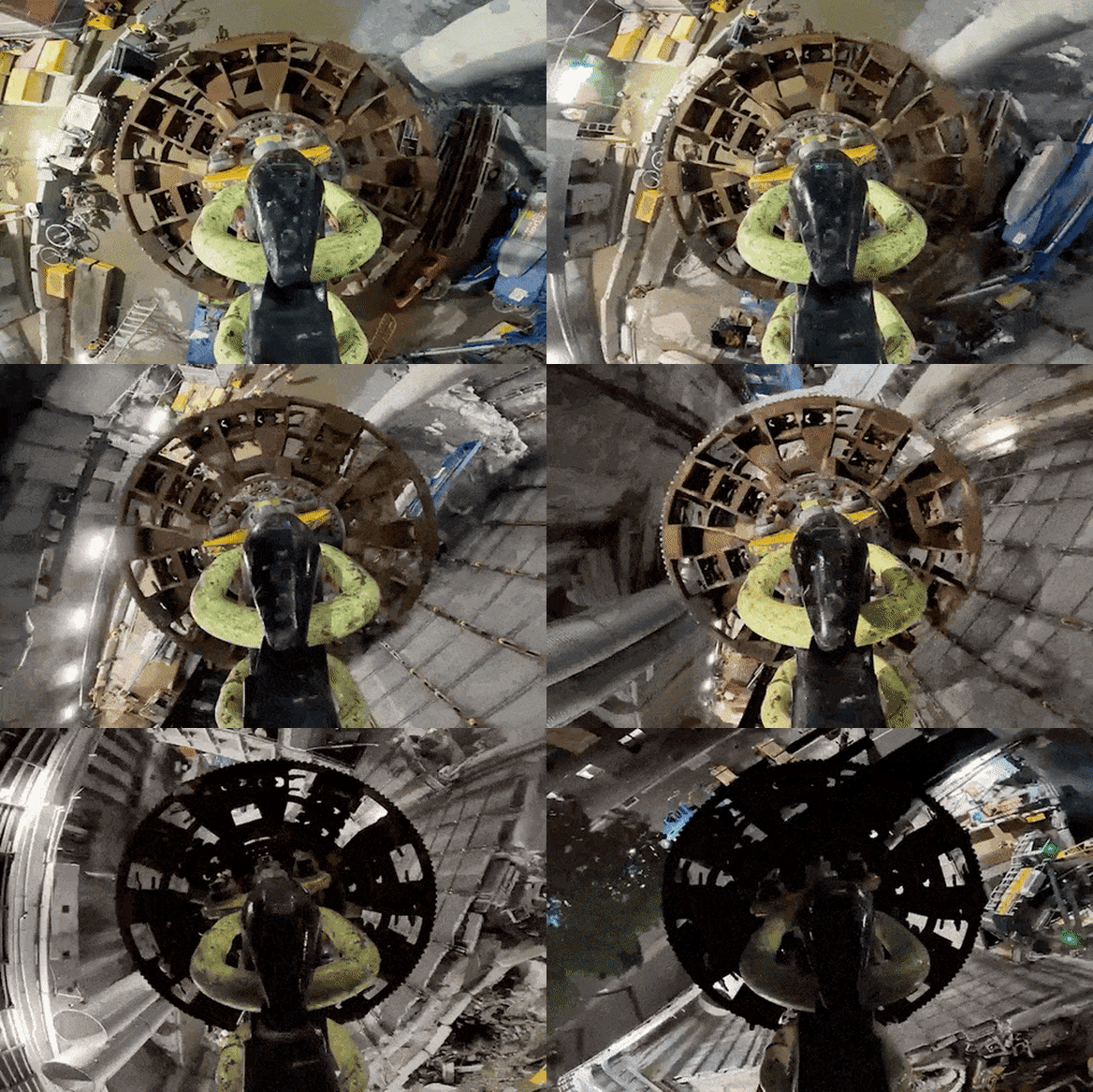
She will be disassembled into 16 pieces, lifted by crane through a shaft to the surface, and trucked out of the central city in the dead of night to Newcastle, where they will be shipped back to China. From there, the pieces will either be melted down and recycled or returned to the original manufacturer.
Having worked on major sections of the Metro City and Southwest lines, JCG project manager Peter Shepherd is no stranger to Sydney’s rail transformation. But he remains fascinated by Hunter Street, and said it has been the largest, most captivating station to deliver by far.
“Just the sheer scale of this is so impressive. The logistics of tunnelling in the city, the volume of work to be done, and it’s also very complex in terms of engineering,” he said.
The next step involves fitting out the station with concrete, laying down tracks and installing vital equipment.
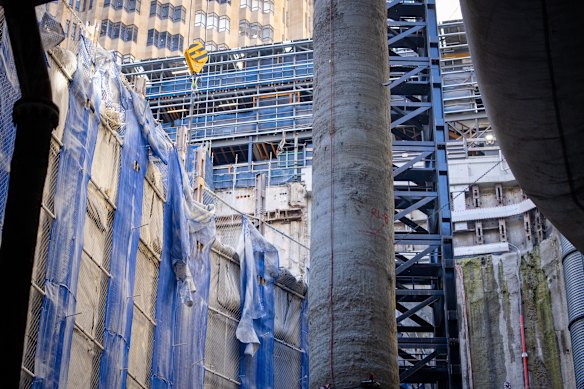
In some sections, concrete over half a metre thick has been poured over reinforced steel to strengthen the cavern’s walls, with blue lining underneath acting as a waterproof membrane.
NSW Transport Minister John Graham said Hunter Street would serve as a “key junction” in the city, complementing Martin Place, allowing commuters to easily switch between metro and heavy rail services.
“We’re here on the street level of the city, but below us there’s an underground city unfolding,” he said.
Once it is built, a web of tunnels between the CBD’s western and eastern sides will also create an underground pedestrian link from Wynyard, through Hunter Street, to Martin Place station.
“This will really be so much quicker underground than it is on street level, you’ll be able to move around in a way that people just wouldn’t expect or couldn’t imagine,” Graham said.
Jessie’s retirement marks the end of tunnelling on metro rail projects in Sydney for the foreseeable future, unless the Minns government changes course and decides to extend or build another metro line.
Asked whether Jessie’s retrieval marked the last tunnelling on any metro projects while Labor was in power, Graham said the government was “looking in the north-west and the south-west of the city”, with more to announce after finalising business cases.
Sydney Metro chief executive Peter Regan said every metro line was designed with possible extensions in mind to minimise potential disruptions to services in the future.
“At Hunter Street there are tunnels that continue right out into the Domain, underneath the State Library where future extensions can be plugged in. They’re all designed so that in the future, the government can decide to tunnel in,” he said.
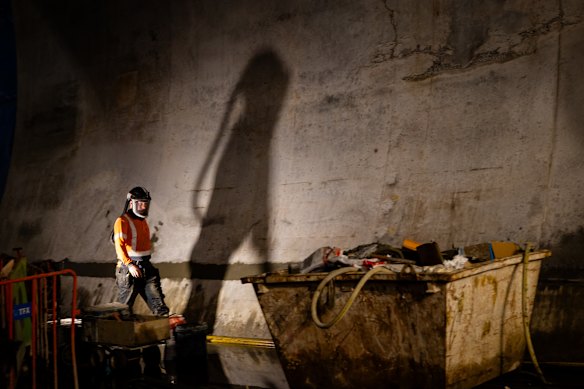
For now, work on the underground city is still unfolding. Beneath the CBD, the air carries distinct smells of damp earth and dust, and construction sounds drone on, barely contained in the cavern’s walls, and crews clad in spacesuit-like respirators, earplugs, and hi-vis vests walk through small puddles of water pooling on the floor.
Hunter Street will be the busiest, and most expensive station on the Metro West line. Internal Sydney Metro figures show the station is forecast to have more than 16,200 passengers passing through it in the 8am to 9am peak, well over twice that of Parramatta, projected to be the next-busiest on the line.
It is also costing the government $1.5 billion, making it the most expensive to be built on Sydney’s expanding metro rail network.
Disclaimer : This story is auto aggregated by a computer programme and has not been created or edited by DOWNTHENEWS. Publisher: www.smh.com.au