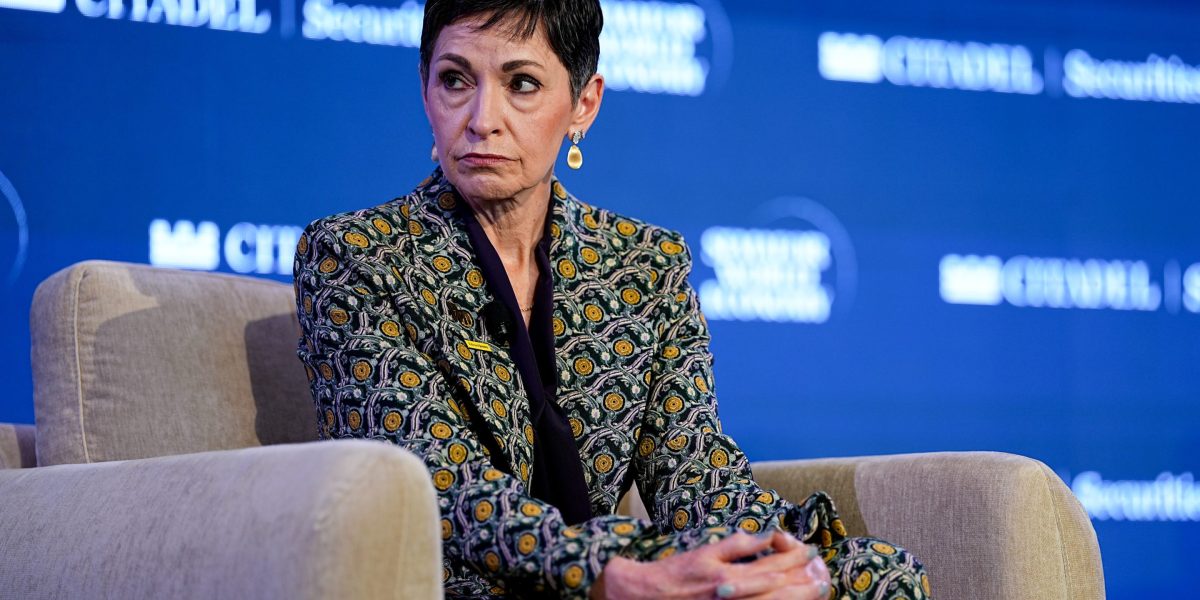
One of the biggest forces reshaping the financial services industry may not be AI, innovation or markets. It may actually be related to who is responsible for keeping families financially organized: eldest daughters.
“The elder daughter phenomenon has to do with caregiving, and often has to do with becoming the executor on an estate,” Penny Pennington, the managing partner of financial services giant Edward Jones, told Fortune. “Making decisions that extend across this family for more members of the family.”
Pennington, herself an eldest daughter, said the responsibility is becoming more significant as trillions of dollars move between generations, a shift known as the “Great Wealth Transfer.” She pointed to the roughly $100 trillion in wealth expected to change hands as older Americans pass assets to younger generations, saying the transfer is not just an investment but also a family event.
According to a report from Cerulli Associates, roughly $124 trillion will be transferred to heirs and charities between 2024 and 2048. About $105 trillion of that is expected to go to heirs, and $18 trillion to charity. Cerulli also estimates that women will receive substantial amounts of the transferred wealth, including roughly $40 trillion in spousal transfers and $47 trillion in transfers to younger women.
“Eventually, most of the wealth owned by older generations in the U.S. will be either donated or passed down to Gen X or Millennial heirs,” Chayce Horton, senior analyst at Cerulli Associates said in the report. “With $85 trillion to be passed down to these generations collectively, providers that can establish relationships with, and adequately address the needs of, these younger investors will be well positioned for success.”
Pennington said women already do much of the logistical work of family finances before they become the ones making investment decisions.
A 2024 Edward Jones survey conducted with Morning Consult found that two-thirds of American women describe themselves as their family’s “chief financial officer,” according to Pennington. She said there remains a disconnect between women handling everyday financial responsibilities and men making many of the household’s investment decisions.
“The job involves an entire family, sometimes multigeneration,” Pennington said. “The job is logistical, but it’s also emotional.”
She suggested that “chief financial officer” might undersell what many women do, and that calling them “chief fulfillment officers” would be closer to their responsibilities.
“I do hope that in heterosexual couples the men step up a bit and take some of the burden off the women for shouldering all of this in the family,” Pennington added.
Daughters really run the world
A 2014 study published in the American Sociological Review found that daughters provide more care than sons to elderly parents. The study also found that daughters’ caregiving more responsive than sons’ to their own and their parents’ attributes.
“Sons reduce their relative caregiving efforts when they have a sister, while daughters increase theirs when they have a brother,” said Angelina Grigoryeva, a doctoral candidate in sociology at Princeton University who conducted the study. “This suggests that sons pass on parent caregiving responsibilities to their sisters
Women in general bear greater economic cost due to caregiving. A U.S. Department of Labor analysis found that unpaid family caregiving can carry significant lifetime employment costs for women. The department estimated that mothers born between 1981 and 1985 who provide unpaid care to children and adults face an average of $295,000 in employment-related costs over their lifetimes.
And according to the 2026 AARP Public Policy Institute report, 59 million Americans caring for adults in 2024 provided about 49.5 billion hours of care—worth about $1.01 trillion if valued at an average hourly rate of $20.41.
Disclaimer : This story is auto aggregated by a computer programme and has not been created or edited by DOWNTHENEWS. Publisher: fortune.com