
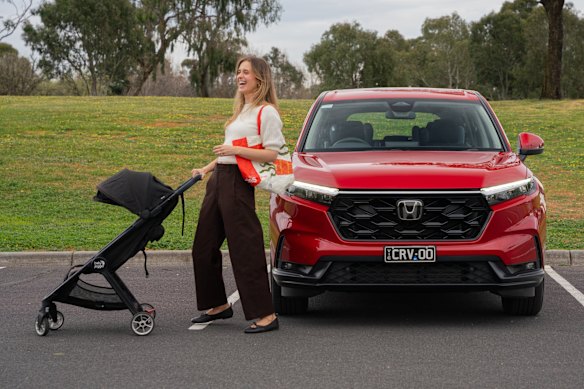

Jessica Tily didn’t necessarily want to buy a Kia Carnival, but she had no choice.
“We had two kids, and then we went in for my dating scan for kid number three and found out it was actually kid number three and four,” she says. “All of a sudden, we had four under four, so we needed something that would fit all the car seats.”
The mother of four from the Central Coast of NSW now calls the people mover her “happy space” and says some of the best features are things she didn’t even have on her wish list.
“Every car should have sliding doors,” she says. “You can park anywhere and still get out.”
The archetypal Aussie family car has undergone a massive transformation over the past two decades.
Twenty years ago, the country’s new-car sales were dominated by wagons, sedans and hatchbacks like the Holden Commodore, Toyota Camry and Mazda 3.
Sports utility vehicles – or SUVs, as they’re now known – were very much a new proposition in Australia in 2006. In fact, until 2003, they were still classified as a sub-category of light commercial vehicle sales, until it was decided these suburb-dwelling four-wheel-drives showed enough promise to warrant their own category.
Back in 2006, there were only two SUV models that managed to crack the top 20: the Toyota RAV4 and Subaru Forester.
So far this year, 15 of the 20 best-selling vehicles are SUVs targeted at family buyers (the remainder are dual-cab utes). Most of these vehicles measure close to five metres long, two metres wide and 1.6 metres tall.
It’s unquestionable evidence that our cars have never been bigger at a time when our families have never been smaller, with Australia’s fertility rate plummeting to record lows.
So when almost every car can technically be a family car, how can overwhelmed parents possibly navigate the endless options?
For starters, don’t assume that bigger is better.
“One of the biggest mistakes families make is assuming that a bigger vehicle automatically means more space for child restraints,” says Rebecca Maher, president of the Australian Child-Restraint Expert Fitters Association.
“In reality, some smaller vehicles offer surprisingly generous rear-seat space, while some larger SUVs can be quite restrictive.”
Car brands will try to sell you on so-called essentials like multi-zone audio, giant cupholders or built-in sun shades; but the real must-haves are those that will ensure your family is adequately protected and accommodated.
Here are the family-car questions dealerships don’t want you to ask.
Do the curtain airbags extend all the way to the third row?
As the name suggests, curtain airbags deploy from the top of the doors and windows and act as curtains to protect occupants’ heads in the event of a side impact or rollover.
Side impacts account for about 22 per cent of crashes in which people are killed or seriously injured, according to the Australasian New Car Assessment Program, Australia’s peak car safety body.
Curtain airbags aren’t mandated on new cars, but they are compulsory to receive a five-star safety rating from ANCAP.
While they are commonly found on most new cars in the first and second rows, they don’t always extend to the third row, which is often where parents will seat their young children.
Seven-seat models such as the Honda CR-V, Skoda Kodiaq and Ford Everest have curtain airbag coverage all the way to the third row, but it’s not a given (particularly on older cars or smaller SUVs), so make sure you double-check.
What level of UV protection do the windows offer?
Think just because you’re in your car you can’t get sunburnt? Think again.
While car windscreens are typically made from laminated glass, which blocks 98 per cent of UVA rays, side windows usually offer less protection.
For example, a 2026 Drive investigation found the windows on the popular Mazda CX-3 small SUV offer UV protection of 65 per cent, which is well above several key rivals.
Meanwhile, the new-generation Mazda CX-5 boasts a minimum of 89 per cent UV protection on its side windows.
It’s worth asking your dealer if they can provide information on how much protection the vehicle offers from the sun’s rays.
If the answer is “not much”, it is well worth investing in a UV-blocking tint or clear window film, or at least some sun shades so your little ones are protected.
Is this variant P-plate legal?
Family cars often become first cars once your kids enter their driving years.
That’s why it’s crucial to check whether your car’s power-to-weight ratio is above the permitted threshold for P-plate drivers in your state or territory.
Victoria, NSW, South Australia and Queensland all have rules that prohibit P-platers from driving cars with power-to-weight ratios greater than 130 kilowatts per tonne.
While the specific rules vary by location, they all have implications for some of the country’s most popular cars – particularly electric vehicles.
For example, the Tesla Model Y – the country’s best-selling electric car – is technically banned for P-platers with its power-to-weight ratio of 132.7 kW/t.
Meanwhile, models such as the BYD Seal electric sedan are only P-plate legal in certain specification grades and not others, which can be a minefield for buyers.
If you’re planning to pass this car on to your kids (or grandkids), better make sure they’re allowed to drive it first.
Can I test all the child seat tether points?
Just because a car seat can accommodate a child restraint on paper doesn’t mean it should in real life.
“One of the biggest misconceptions about seven-seat vehicles is that all seven seating positions can necessarily accommodate child restraints,” says Maher.
“In Australia, child restraints that require a top tether must be connected to an approved anchorage point. Some seven- and eight-seat vehicles don’t provide suitable top-tether anchorages in every seating position, particularly in the third row.”
For example, a recent Drive exclusive found several major child seat manufacturers had updated their guidance on installing their seats in the middle row of the Tesla Model Y L because the seat design was incompatible with top-tether straps, despite featuring a top-tether anchorage point.
How accessible is the third row?
For Tanya Tang, a Melbourne-based mother of nine-year-old twins, buying a seven-seat family car required more logistics than she had expected.
“For you to be able to properly use the third row in a seven-seater, you have to have your kids in the second row, one at the window and one in the middle, so you can access the third row,” she says. “That might not work for everyone.”
Even if you can figure out the seating configuration, getting into the third row is often no easy physical feat.
And once you’re back there, the third row in some cars isn’t a particularly pleasant place to be on longer drives.
“It’s pretty squishy,” Tang says of the third row in her Peugeot 5008. “If you bring the second row forward, then it’s bearable.”
If you plan on regularly using the third row, opt for a people mover like the Kia Carnival, or at least full-fat seven- or eight-seaters like the Hyundai Palisade or the Mercedes-Benz GLS.
Where are the rear air vents?
Australia’s summers are properly hot, and a cracked window in the back seat often won’t cut it.
The humble air-conditioning has evolved into the technically advanced “dual-zone climate control” now present in many modern cars.
But regardless of how advanced your car’s air-conditioning is, it doesn’t mean anything if the air can’t make it to the right areas – and quickly.
On plenty of cars, all that second-row occupants get are two small vents located on the back of the centre console that do an excellent job of cooling their feet and not much else.
Look for cars like the Hyundai Ioniq 5, which has air vents mounted high on the B-pillar between the doors, or the Isuzu MU-X, which has roof-mounted air vents all the way to the third row.
What is the ANCAP child occupant protection rating?
If you only ask one question on this list, make it this one.
When ANCAP tests vehicles, it uses crash-test dummies designed to replicate a six-year-old and 10-year-old child. It also scores a car on how well it can accommodate booster seats and capsules, and whether it offers technology to protect child occupants.
Models such as the BYD Sealion 7, Subaru Forester and Nissan X-Trail are all top performers in this regard, receiving a child occupant protection rating of 90 per cent or higher.
Make the most of your health, relationships, fitness and nutrition with our Live Well newsletter. Get it in your inbox every Monday.
 Susannah Guthrie has worked in print, online and television for over a decade, covering everything from world news to fashion, travel, health and now cars. Having held senior roles at The New Daily, ELLE, Harper’s BAZAAR, People Magazine and Cosmopolitan, she enjoys reaching as many people as possible. These days, Susannah relishes testing cars with the help of her husband and two children, bringing automotive news to a broad audience and helping consumers make sense of the car-buying process.
From our partners
Disclaimer : This story is auto aggregated by a computer programme and has not been created or edited by DOWNTHENEWS. Publisher: www.smh.com.au



