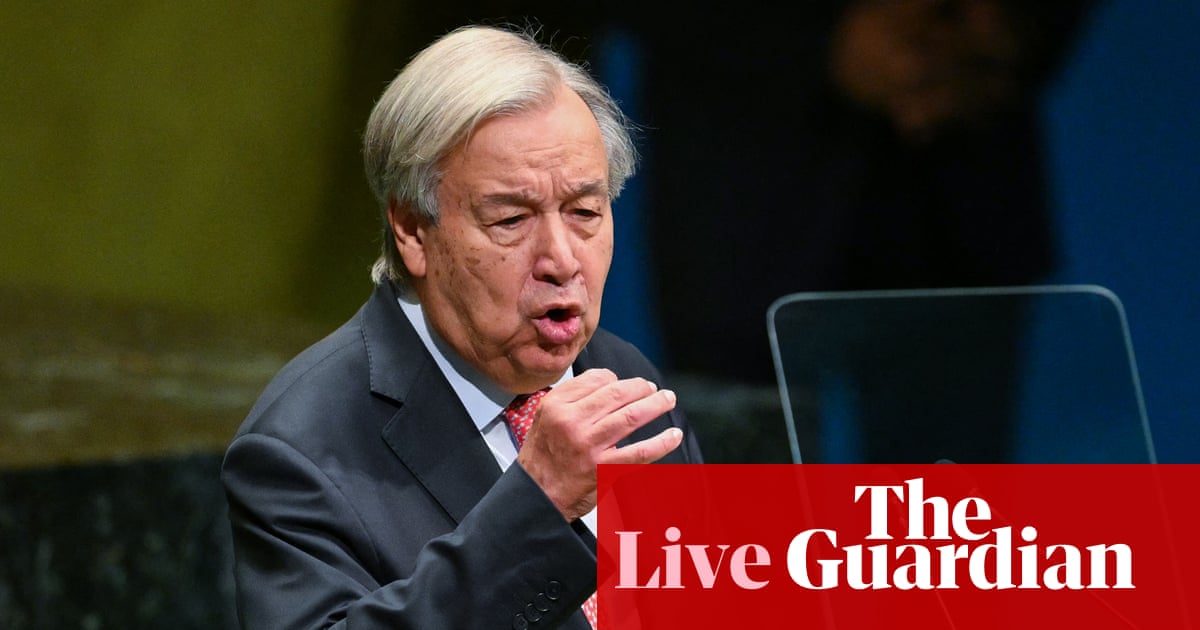
In his address to the world leaders gathered at the UN general assembly in New York, the UN secretary-general, António Guterres, said the world must work together in “interdependence” to solve problems.
“The fault lines in our world are widening,” Guterres, who leaves office at the end of the year, said, citing geopolitical conflicts, the climate crisis and the rapid development of artificial intelligence.
But instead of letting the future continue to veer toward fragmentation, transactionalism and mistrust, he called for “a world built on interdependence – and sustained by a dense web of economic, political, social and technological connections.”
You can watch the address here:
Trump said Iran is the world’s “number one sponsor of terror” and referred to the country as “the bully of the Middle East”.
He said:
There is no better example of a danger that was allowed to gather strength at the world’s peril than the number one sponsor of terror, the Islamic Republic of Iran.
For 51 years, the fanatical Iranian regime has ruled by bloodshed and mass murder, spreading death and carnage and chaos across the entire Middle East and beyond.
They were the bully of the Middle East, but they are the bully no more. From the first day I entered the political arena, I’ve been unwavering. I will never allow Iran to have a nuclear weapon.
Donald Trump has taken the stage to address the world leaders gathered at the United Nations in New York, who together comprise the international order he has deeply rattled in his second term in office.
He framed the Iran war he launched earlier this year the same way he has to his domestic audience — as a necessary conflict to addressing a long-ignored threat.
“I do not believe in letting problems fester,” Trump said. “They only become harder to solve. So while others have talked, I have acted while others have spoken of peace, I have made peace. While others have ignored threats, I have confronted them. While others have talked of courage, America has shown it.”
You can follow his full speech here:
The world is held hostage by the paralysis of the United Nations’ top body, the Security Council, Brazil’s president Luiz Inacio Lula da Silva has said at the UN today.
“We are all held hostage by the inaction of the Security Council for failing to fulfill its role,” he said, becoming the first world leader to address the UN General Assembly annual gathering.
António Guterres completes his term at the end of 2026, with no clear frontrunner in the race to replace him. He vows to “keep championing the conviction that peace is possible” once his term finishes.
The UN secretary general said the work of the UN matters more than ever as global conflicts rage around the world, including wars launched by two permanent members of the security council: Russia and the US.
The UN has been severely weakened during Trump’s second term in office as it faces a funding crisis, diplomatic attacks, including by the US, and has effectively been pushed out by Trump’s Board of Peace in relation to Gaza.
Speaking about the potential dangers of unregulated AI systems, António Guterres said “killer robots must have no place in our future”.
“Let us resolve that life and death decisions must never be surrendered to machines,” the UN chief told the gathered world leaders.
Guterres acknowledges that AI – which he calls a “gamechanger” – could bring a range of opportunities, including in the fields of medicine and science.
However, he said that the danger is “technology without accountability”, “capability without oversight” and “decision making without transparency”.
He said governments with the greatest AI capabilities i.e. China and the US have the greatest responsibility to humanity. He said these countries should, despite geopolitical tensions, establish effective communication channels and work on common safeguards to prevent the technology spilling out of control.
In his address to the world leaders gathered at the UN general assembly in New York, the UN secretary-general, António Guterres, said the world must work together in “interdependence” to solve problems.
“The fault lines in our world are widening,” Guterres, who leaves office at the end of the year, said, citing geopolitical conflicts, the climate crisis and the rapid development of artificial intelligence.
But instead of letting the future continue to veer toward fragmentation, transactionalism and mistrust, he called for “a world built on interdependence – and sustained by a dense web of economic, political, social and technological connections.”
You can watch the address here:
Russian president Vladimir Putin held a phone call with Saudi crown prince Mohammed bin Salman today, Reuters reported.
They discussed the security situation in the Gulf and the need to keep vital waterways open, according to the Kremlin.
It said the two leaders held a detailed exchange of views on the situation in the Middle East and emphasised that a political and diplomatic settlement remains the only viable path forward.
They also “underscored the need for a swift cessation of hostilities” in Yemen amid the deteriorating military and political situation there.
“The importance of ensuring the safe and unimpeded passage of vessels through the region’s international waterways, including the Bab el-Mandeb and Strait of Hormuz, was emphasised,” the Kremlin said.
Iran’s national airline said it had not received any ban on serving neighbouring countries, a day before US sanctions are due to be tightened against the Iranian aviation sector.
“Iran Air has not received any notification or official instruction from the civil aviation authorities of Turkey, the Republic of Azerbaijan, or Iraq regarding a halt or suspension of the airline’s flights to Istanbul, Baku and Najaf,” the company said in a statement carried by state news agency IRNA.
Earlier this month the US blacklisted the Iranian aviation sector and threatened sanctions against any organisation working with Iran’s airlines, AFP reported.
Gaza’s health ministry said in its latest update that at least 1,399 people have been killed by Israeli attacks since a supposed ‘ceasefire’ was signed between Israel and Hamas last October.
Hamas accuses Israel of violating the ceasefire and undermining efforts to implement a broader plan by the US to end the war on Gaza, which includes the Israeli withdrawal from the strip and the disarmament of Hamas. Israel says Hamas has been violating the deal.
Gaza’s health ministry said on Tuesday that 73,919 people, mostly women and children, have been killed in Israeli attacks across Gaza since October 2023, when Isreal launched its assault on the territory following the Hamas-led attack on southern Israel on 7 October 2023, in which about 1,200 people, mostly Israeli civilians, were killed.
A number of legal and rights experts have concluded that Israel has committed genocide – considered the most serious international crime – against the Palestinian population of Gaza. Israel denies the charge, despite the widespread evidence that supports the conclusion.
The US secretary of State, Marco Rubio, has confirmed that the US is open to speaking with Iranians at the UN General Assembly, but said no meeting is currently scheduled (see this post for more details).
“We’re open to that. I don’t think anything is scheduled at this point, but we’re certainly open to something like that, especially if it has the prospects of leading to something positive and ultimately achieving the goal of what this is all about,” Rubio told NBC News.
“And that is the fact that Iran can never have a nuclear weapon. They just simply can’t,” he added.
The renewed US-Iran efforts to resolve the dispute about control of the strait of Hormuz comes amid reports of Saudi Arabia attacking areas under Houthi control in Yemen.
Among the latest reports is of an attack by Saudi Arabia on a prison in northwestern Yemen that killed nine detainees, according to a Houthi official, who spoke to the Saba news agency, which is affiliated with the Iran-backed militia.
“Nine prisoners captured during recent events were killed last night when the Saudi enemy targeted a prison” in Al-Hazm, in Al-Jawf governorate, Houthi official Abdelkader al-Murtada said.
The Houthis, who have controlled Yemen’s capital since 2014, seized the country’s Red Sea coast this month in an advance that routed forces of the Saudi-backed government.
Saudi Arabia, an important US ally, has launched hundreds of strikes in recent days on the fighters’ positions in the highlands, according to the Houthis.
Here is some more analysis from our diplomatic editor, Patrick Wintour:
A fortnight ago Iran said it had reached agreement with Oman for a new agreed temporary route for commercial shipping through the strait of Hormuz that would then be lodged with the International Maritime Organisation. The bulk of the route goes through Iranian waterways in the north of the strait.
But the meeting planned for the Gulf States to endorse the route was cancelled by Saudi Arabia after what it regarded as Iranian-induced attacks on Saudi Arabia by Houthi forces in Yemen. Saudi Arabia also wanted to be a signatory and authoriser of the route, but Iran insisted the route had to be endorsed only by the two countries in which the strait’s waterways passed: Iran and Oman.
Iran had also said the waterway would not be opened even after the route was agreed until seven other conditions were met largely related to lifting the sanctions, asset freezes and broader US aggression towards Iran. Only after that could the issue of Iran’s nuclear program be considered.
The US has been countering this week by trying to impose an aerial blockade on Iran, threatening third countries not to allow Iranian civilian planes to fly in and out of Iran from their airports. The US treasury secretary, Scott Bessent, said all Iranian planes will stop flying worldwide from Wednesday.
Disclaimer : This story is auto aggregated by a computer programme and has not been created or edited by DOWNTHENEWS. Publisher: theguardian.com