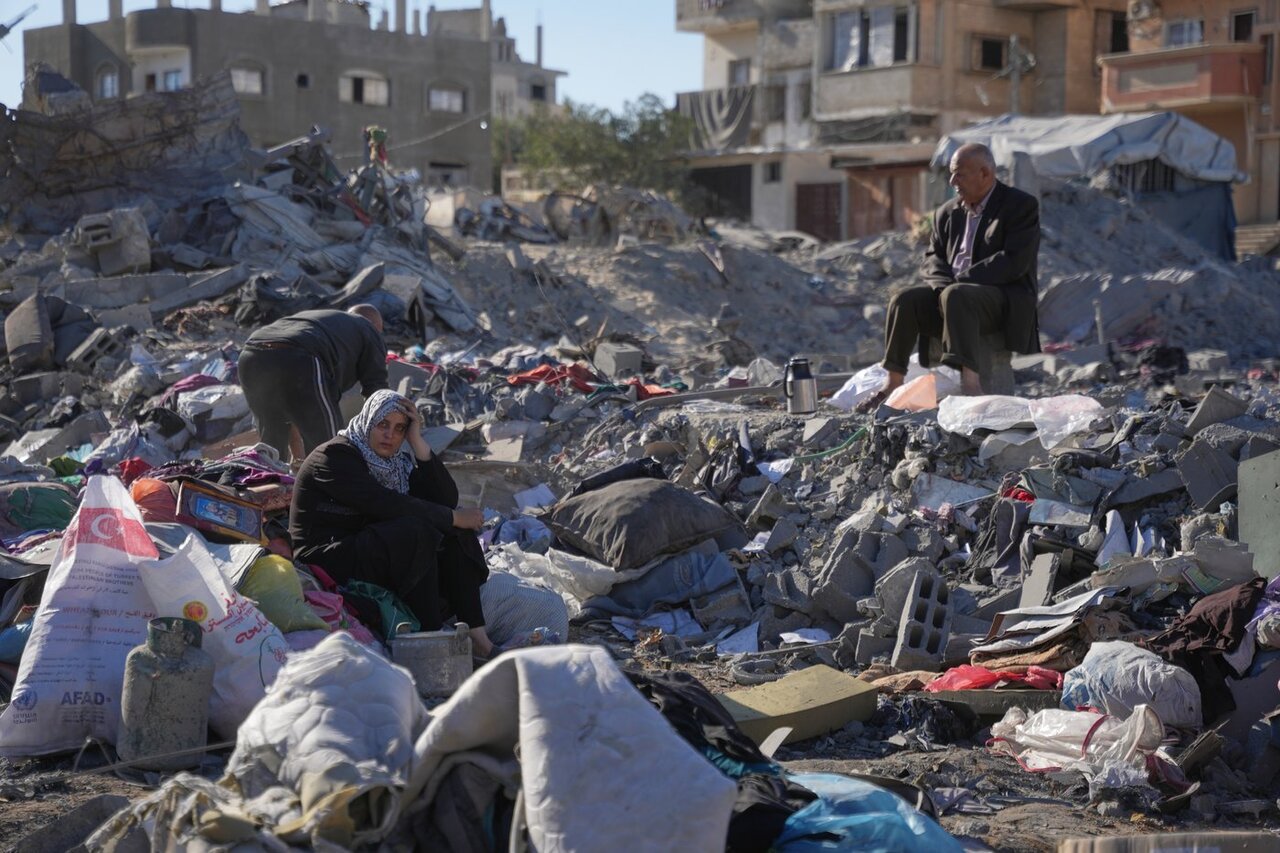
TEHRAN – A year after a ceasefire promised to end the genocidal war, Gaza is enduring a peace that exists in name only.
The ceasefire has not stopped Israeli Occupation Forces (IOF) from committing more war crimes in the Strip. Reports on Monday said the regime’s military waged fresh attacks killing more Palestinians.
On Sunday alone, IOF strikes killed eight Palestinians, five of them police officers in what Gaza’s Interior Ministry said was a “horrific massacre” in the al-Mawasi area west of Khan Younis. Local residents said the attack landed near a makeshift school, causing widespread panic among children.
In a separate strike in Gaza City’s al-Rimal neighborhood, three Palestinians, including a child, were killed when an IOF drone targeted a gathering of civilians on al-Thawra Street. Six others were wounded, some critically.
Those eight deaths bring the toll since the ceasefire took effect on October 11, 2025, to at least 1,580 Palestinians killed and at least 5,711 wounded, according to Gaza’s Health Ministry.
The cumulative toll since October 2023 now stands at 74,594 killed and 175,834 wounded. The IOF has killed 75 police officers since the truce began, men tasked with maintaining what little civil order remains in a territory where 90 percent of civilian infrastructure has been destroyed.
The IOF bombs are not unusual. They are the daily reality of a ceasefire that exists on paper but not on the ground.
“Green light to accelerate famine”
Even as the IOF bombs fall, the humanitarian system that keeps Gaza alive is being dismantled from within. The World Food Program (WFP) stated that funding shortages have forced it to cut food assistance by roughly one-third, reducing its monthly beneficiaries from 1.6 million to 1.1 million people.
That leaves half a million vulnerable Palestinians, the poorest and the most marginalized, without critical food aid as winter approaches.
The cuts go beyond numbers. Families who previously received two food parcels now receive one, and a smaller bag of wheat flour.
Hot meals provided by community kitchens have been slashed from 250,000 to 150,000 per day, and families in hard-to-reach areas now receive a hot meal only every other day.
WFP acting executive director Carl Skau said the cuts were driven by depleted funding, not by a decline in need, and that some people in Gaza are now eating only once a day.
Palestinian officials have described the decision as a “green light to accelerate famine” and a “systematic engineering of hunger.” Gaza’s Ministry of Social Development says incoming supplies meet only 30 percent of minimum humanitarian needs. With 1.4 million people, 67 percent of the population, still facing acute food insecurity, the funding cuts risk reversing what fragile gains had been made.
Around 200,000 people remain in emergency conditions where immediate food assistance is needed to prevent deaths from hunger. Malnutrition also remains severe: around 3,000 children aged 6–59 months are admitted for treatment each month, including more than 360 with severe acute malnutrition in September alone.
Winter is coming with nowhere to shelter
The third blow is seasonal, and it is already arriving. The United Nations warns that 950,000 displaced Palestinians are living in sites at medium-to-high risk of flooding, including more than 400,000 at high risk. Available supplies can only partially cover the winter shelter needs of 18 percent of the 294,250 families requiring assistance.
UNRWA’s acting chief, Christian Saunders, put it bluntly: “Because the infrastructure has been destroyed, that water will accumulate around where people are living and people will be sleeping in water and it gets cold. We cannot allow these conditions to remain.”
More than 90 percent of Gaza’s population is living in tents, under plastic tarpaulins, or in half-destroyed houses. Two-thirds of the population is living in tents and makeshift shelters made of materials that deteriorate after only a few months.
The winter crisis is compounded by IOF restrictions on shelter materials. The occupying regime allows just 15 trucks carrying items they designate as “dual-use” including tents and tarpaulins, to enter Gaza from Jordan each week, and these can only be offloaded at the IOF-controlled Karem Abu Salem, the only crossing for aid, one day per week.
A minimum of 500 truckloads of shelter items are waiting to enter; at the current pace, it would take more than seven months to bring them in. “Palestinians in Gaza cannot be expected to survive another winter in worn and torn tents that were never designed to withstand these conditions,” said NRC Secretary General Jan Egeland.
“This is not an unavoidable natural disaster, it is a manmade humanitarian crisis because life-saving shelter aid is blocked by the occupying power.”
The funding emergency makes everything worse. UNRWA is facing a $100 million cash-flow deficit for 2026 and has warned that without immediate funding, it will have to cut staff and reduce core services.
The agency provides services to about 1.7 million people through more than 10,000 employees and 80 shelters, and provides about 70,000 medical consultations weekly. “If you cut the money, then we have to cut the number of people working for UNRWA,” Saunders said, “and that means a reduction in the quality and the breadth of our services.”
For Gaza’s displaced, the deadliest season may not be war but winter arriving with empty food lines and flooded tents.
The political vacuum
Behind the immediate crises lies a stalled political process. The Trump administration’s “peace plan” has stalled as expected, and the core dispute over the IOF withdrawal remains unresolved.
The ceasefire that was supposed to end the genocidal war has instead produced a prolonged limbo in which strikes continue, aid shrinks, and the population is left to survive on less and less.
The aid cuts are not happening in a vacuum. They are happening because of pressure imposed by the Israeli regime against organizations like UNRWA and the ongoing IOF blockade.
Saunders warned that the situation is “becoming normalized.” For the 500,000 people who just lost their food assistance or the 950,000 facing floodwaters, normalized is not an abstract word. It is the knowledge that no one is coming to stop the preventative catastrophe that winter will cause.
Disclaimer : This story is auto aggregated by a computer programme and has not been created or edited by DOWNTHENEWS. Publisher: tehrantimes.com