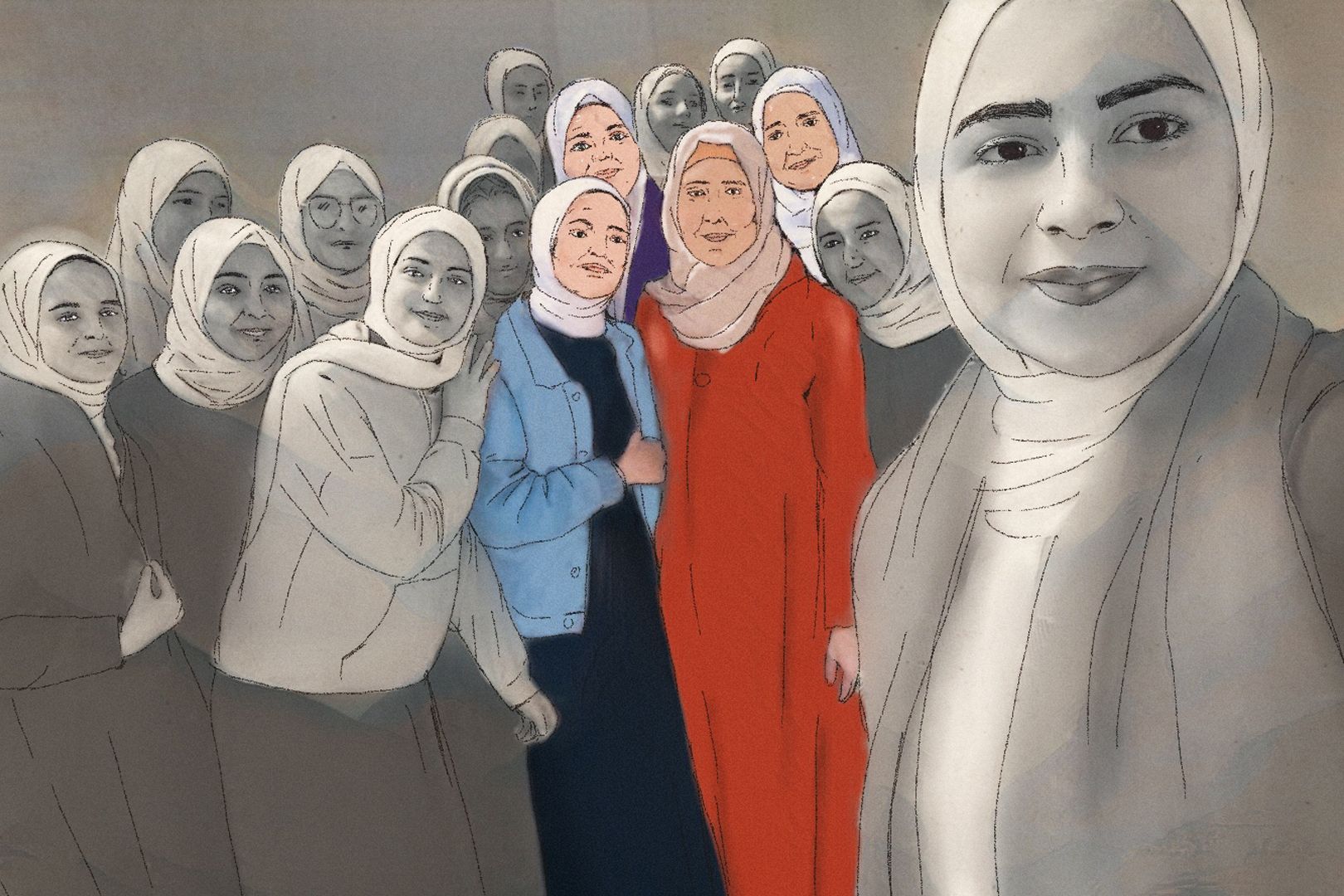
Aya Adnan stands with the three in the new photograph, tall, with a dimple in her chin and her hijab falling behind her shoulders.
Three years earlier, she had been looking forward to university. She wanted to become a doctor, preferably a neurosurgeon.
Aya enjoyed studying. She arrived early for extra physics lessons and worked through difficult material until she understood it. She had also noticed how few female surgeons there were in Gaza and disliked hearing that surgery was too demanding a profession for women.
Her interest in neurology had become personal in the 11th grade, when she suffered a severe headache and dizziness that lasted 24 hours.
“It felt like my head was heavier than my body,” she recalls, “as if it might fall off.”
After undergoing scans and seeing a neurologist, she was told pressure from the vertebrae in her neck was affecting her spinal cord. The experience only made her more determined to study neurology.
When her final school results came, she had scored 96 percent.
But studying medicine was expensive, and the family – her father was an UNRWA social worker – could not comfortably afford the fees.
Aya turned to her older brother Yasser.
Seventeen years her senior, Yasser was a lawyer with his own practice, a wife and three children: Adnan, nine, Ahmad, seven, and three-year-old Ilaf. He helped support their parents and hoped one day to teach law at university.
“I used to always tell him, ‘You’re a second father to me,’ because he was so kind to me, just like my father,” Aya says.
Aya remembers a summer’s day in August 2023. Yasser, still dressed in his smart work clothes, came to take her from Nuseirat to the Islamic University of Gaza.
“Together, we went from department to department, trying to find a course that was affordable and that I would enjoy,” she says.
Professors suggested engineering. But when they came out, Aya told Yasser she couldn’t imagine herself studying computers or becoming an engineer.
“I could picture myself wearing a white coat, that’s all,” she told him.
They tried health sciences next.
“Maybe I could study something in the medical field,” Aya suggested. “I really liked medical laboratory sciences.”
Yasser knew that his sister was giving up the version of university she had imagined. But he refused to let her see the decision as the end of something.
“Perhaps it’s for the best,” he told her. “Maybe one day you’ll become a doctor in the field you choose to specialise in. You don’t have to be a medical doctor; you could become a university professor with a PhD.”
Then, he offered her a thought that has stayed with her. “He told me, ‘Sometimes what is withheld from us can be better for us than what is given to us,’ and I believe him.”
Afterwards, he took her to Al-Taboun restaurant for lunch, while they kept talking about university and the choices available.
Aya enrolled in medical laboratory sciences, and Yasser bought her books and supplies. University had barely completed its first week when the war began.
A strike on a neighbouring two-storey house badly damaged the family home in Nuseirat, where they had lived for more than 35 years. They moved into an aunt’s house.
The new university timetable that had occupied Aya only weeks earlier disappeared. Instead of laboratories and lectures, her days revolved around finding water, helping prepare food, and learning how to cook without the things the family had once taken for granted.
She didn’t know how to build a fire; she hadn’t needed to.
Yasser would continue to return to the family’s damaged home, partly to check on what they had left behind and partly because he feared their possessions would be stolen. Sometimes, he stayed there.
On one of those visits, he asked Aya to come with him. There were dishes to wash, floors to sweep, rooms to tidy. She said she couldn’t. She was helping their mother prepare food.
On December 12, as the family gathered for afternoon prayers at her aunt’s house, they heard a missile strike. Several minutes later, one of Aya’s friends called. She wanted to know where the family was. Then she asked about Yasser, who had returned to their damaged home alone. The strike had hit the house, killing him. He was 32.
Aya would return again and again to Yasser asking her to come with him, and her reply that she couldn’t. It was an ordinary exchange between siblings, insignificant enough that Aya might never have remembered it, except it was also their last conversation.
When she returned to the house about a week later, she found what remained of the plastic shopping bags that held the university supplies Yasser had bought for her only months earlier. Shaking off dust and ash, she opened them one by one.
“I was surprised I found them at all; they reminded me of Yasser,” she says.
Some books had survived, but others were almost entirely burned; only three pages remained from one set of lecture notes. Ballpoint pens, markers, and coloured pencils lay among the notes. Aya gathered, and still has, what remained.
After 18 months, when universities started offering remote learning, Aya logged on whenever electricity and an internet connection allowed. Medical laboratory sciences was supposed to be hands-on: equipment, experiments, laboratories. Aya was trying to learn it without any of those things.
“My major is very practical, and most of its courses are practical,” she says. “It was difficult for me to study them online when I wasn’t even at the university, and there were no laboratories or equipment in front of me.”
She kept going, and so did another girl in the photograph who once imagined herself in a white coat.
Disclaimer : This story is auto aggregated by a computer programme and has not been created or edited by DOWNTHENEWS. Publisher: aljazeera.com