
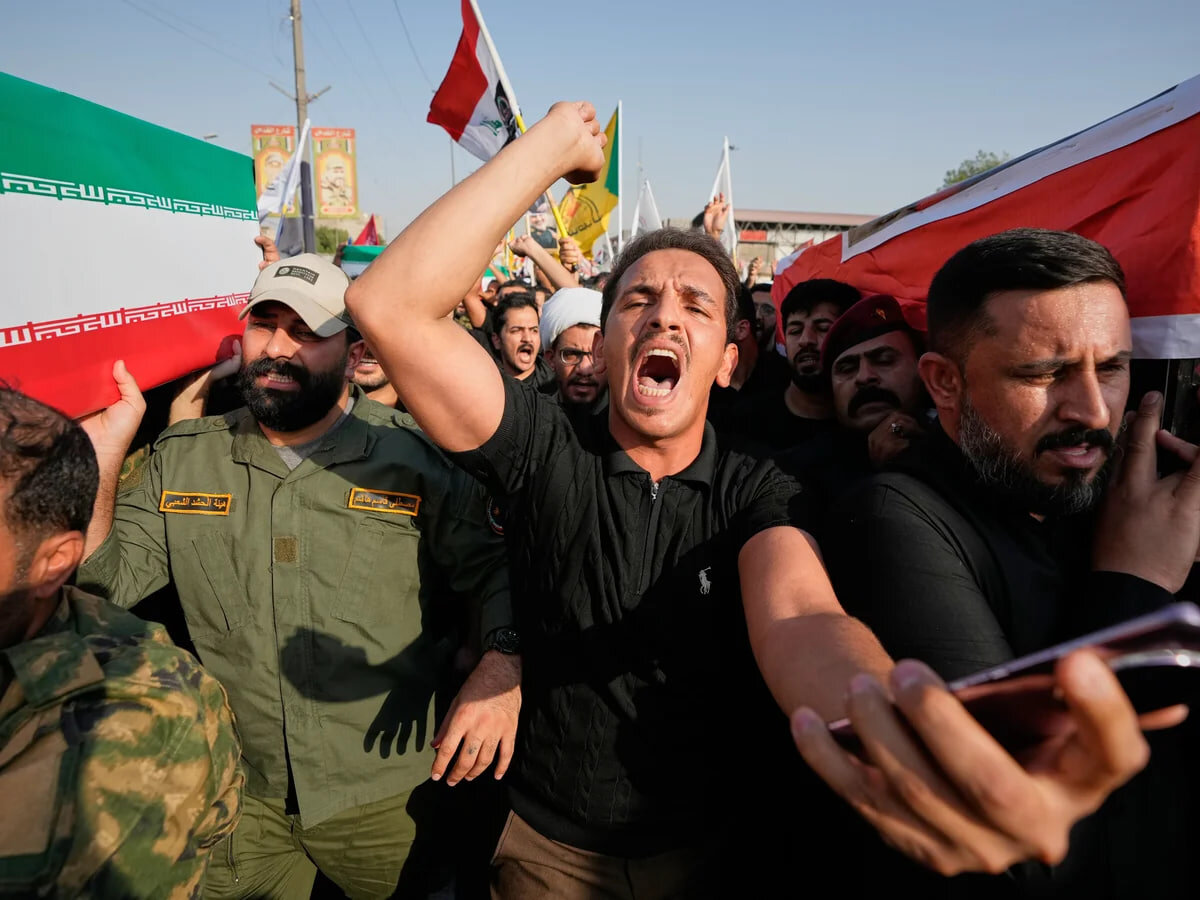
TEHRAN -The joint US-Saudi aerial aggression against Iraqi territory, launched in the early hours of Wednesday, marks not a display of strength but a profound strategic miscalculation. It underscores the unraveling of American military credibility and the steady ascent of Iranian power across the region.
By targeting the Popular Mobilization Forces across seven Iraqi provinces, Washington and Riyadh have not only violated Iraq’s sovereignty but have also accelerated their own strategic defeat.
The strikes, which killed at least 20 PMF fighters and wounded 32 others, were framed by the US Central Command and Saudi defense ministry in response to allegations of more than 30 drone attacks from Iraqi territory against Saudi oil facilities.
The Saudi security apparatus, in practice, serves Israeli interests, functioning as a frontline defensive shield while using its military power exclusively against neighboring Arab nations, including Yemen.
The timing of the aggression is telling. The joint strikes came hours after the Islamic Revolution Guard Corps launched a ballistic missile attack against a US base and CENTCOM command center in Jordan in direct retaliation for American military actions.
Washington and Riyadh, acting in coordination, sought to project strength. Instead, they revealed their desperation. The US, after months of war, finds itself trapped in a reactive posture, forced to respond to Iranian initiatives rather than dictating the tempo of conflict. Iran, by contrast, has turned the table entirely.
The United States was once the sole arbiter of war and peace in the region. Now, as Trump himself admits, Washington considers itself on the defensive, reacting to Iranian strikes rather than initiating them. The US is no longer dictating the tempo nor deciding when to hit.
The United States has decisively lost the war with Iran, and what remains is a fighting retreat, not speculation, but a sober assessment based on undeniable evidence. Former US counterterrorism chief Joe Kent, a Green Beret and CIA paramilitary officer who served 11 combat tours, resigned in March 2026 in protest against the war, calling on Washington to withdraw its forces and abandon its bases in the Middle East. Military analysts have described the conflict as a devastating defeat, noting that Washington has failed to achieve a single one of its strategic objectives: regime change in Iran, the elimination of Iran’s uranium enrichment capabilities, an end to Tehran’s support for regional allies, or the termination of Iran’s long-range missile program.
The evidence is overwhelming. All US bases in the region are damaged or destroyed. Radar installations are offline, leaving American forces blind. The Pentagon’s claims of near-perfect interception rates for Iranian missiles are contradicted by independent experts who place actual interception rates in the single digits. The US military machine, despite its staggering budget, cannot win a sustained conflict against a determined, geographically-gifted, and technologically capable adversary like Iran. China, Russia, and the world are watching with great interest what Iran is capable of and what the United States is incapable of.
Saudi Arabia’s actions must be understood within the broader context of what can only be described as a Yazidi state; a political and military establishment that systematically uses violence against Muslim populations while shielding the Zionist entity from harm. The example is the interception of Iranian missiles and drones targeted at Israel when Tehran responded to the joint US-Israeli war of aggression against itself in late February and June 2025.
This is not merely a strategic choice; it is an ideological alignment that has defined Saudi policy for decades. Riyadh has consistently acted as an enforcer of Western and Israeli interests in the region. Its support for radical extremist groups like ISIS in Iraq and Syria, alongside military strikes targeting locations inside Iraq, reveals a pattern of behavior that prioritizes the destruction of resistance forces over any genuine commitment to Arab unity or Palestinian rights.
The confrontation is now set to expand significantly. Yemeni forces have imposed a naval blockade on Saudi shipping, successfully hitting Saudi tankers and launching ballistic missiles and drones targeting Aramco refineries at the port of Jizan and refining facilities in Yanbu. Drone strikes have partly damaged the East-West Pipeline, responsible for transporting approximately 5 million barrels of oil per day. In response, the Saudis have bombarded radar positions and military bunkers in Hodeidah and Kamaran Island.
According to leaks obtained by regional media, Saudi Arabia is expected to announce an international coalition next week to forcibly reopen the Bab el-Mandeb Strait. Key Red Sea coastal states Egypt, Sudan, Djibouti, and Somalia have already agreed to participate. The Saudis have also invited France, Germany, Italy, the United Kingdom, and the Netherlands, all of which already have warships in the region and are awaiting Washington’s green light. The total list of potential coalition members could reach around 50 nations.
Yet this coalition, however broad, will not alter the fundamental reality: Iran controls the Strait of Hormuz, and no US naval vessel has successfully transited the strait under fire. The economic catastrophe of the closure has triggered shortages in oil, gas, helium, and fertilizer, leading to problems in the supply chain across the globe.
The strategic thinking in Tehran has shifted decisively toward the conclusion that US dysfunction will continue to manifest in the form of economic pressure and kinetic action for a long time to come. Iranian decision-making is increasingly shaped by an intense pessimism about what diplomacy with the US can achieve. Most senior figures, whether pragmatists or conservatives, simply do not believe a deal is possible. This pessimism has grown worse since the MOU was signed.
The Trump administration was unable to execute even the most basic confidence-building measures; no assets were released, and the oil waiver was never operationalized. At a political level, the Iranians have seen the overblown reaction to the MOU from a full range of politicians in Washington, with Democrats attacking provisions that would be fundamental to any viable agreement. At an individual level, there is a growing sense that Trump is too erratic to stick by his own deals. Even Saudi Arabia, the country with perhaps the greatest influence in the White House after Israel, could not shield its own nuclear deal from Trump’s excessive demands.
The war is over, and the United States has lost. The only rational path is peace: a US withdrawal from the Middle East, an end to the disastrous policy of propping up Israel at the expense of Arab nations, and a focus on rebuilding at home rather than bombing abroad. But peace is unlikely to break out any time soon, because truly reckless forces remain in charge of the American empire. The era of global domination is over. The tombstone of American naval supremacy now lies at the bottom of the Strait of Hormuz. Iran has won, not by conquest, but by endurance. And the world is watching.
The final lesson of this conflict is not written only on battlefields, but in the changing calculations of nations. From Iran to Iraq, from Lebanon to Yemen, the idea of resistance has become a force that cannot be erased by airstrikes, sanctions, or military pressure. The region’s future will not be shaped by those who rely only on weapons, but by those who can endure, adapt, and sustain political will.
The struggle continues, and the voices of resistance continue to echo across borders. Whether through diplomacy, politics, or the battlefield, a new regional order is being contested, one in which the old rules of dominance are being challenged.
From Tehran to Baghdad, from Beirut to Sana’a, the message remains clear: resistance is alive and the future of the Middle East will be decided not by fear, but by the determination of those who refuse to surrender.
Long live the spirit of resistance.
Disclaimer : This story is auto aggregated by a computer programme and has not been created or edited by DOWNTHENEWS. Publisher: tehrantimes.com






