James Rothwell
Updated ,first published
Berlin: It was the moment that heralded a dangerous new escalation in Saudi Arabia’s war on the Houthi rebels of Yemen.
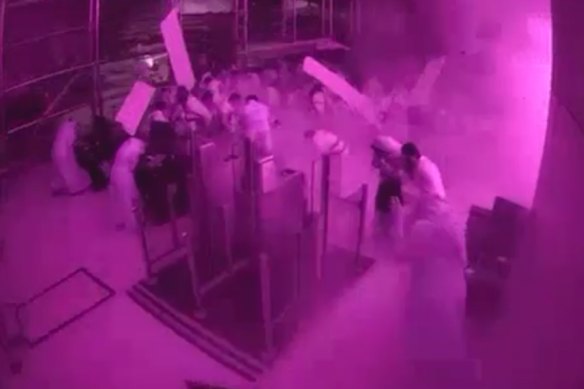
As civilians made their way through a passenger terminal at King Khalid International Airport in Riyadh, a long-range, highly accurate missile struck the building. In the aftermath, the terminal was filled with dust, and dazed passengers could be seen stumbling around in the rubble.
They were the lucky ones: the Houthi attack on Saturday (Riyadh time) killed 13 people and was the most deadly of its kind since March 2015.
US President Donald Trump has said he’ll consider joining strikes on Houthi-controlled territory in Yemen in retaliation for what the Saudi-led coalition described as a “full-fledged war crime”.
Trump’s advisers, however, will be carefully weighing whether to rush into a conflict with the Houthis, whom their foes have sorely underestimated time and again.
Once dismissed as “terrorists in flip-flops”, the Houthis have been diligently building up their arsenal since they joined the Israel-Hamas war in 2023 with rocket attacks on commercial ships.
Gone are the dodgy North Korean missiles of old; the Houthis now wield their own Palestine-2 hypersonic missile, which is highly accurate and can travel 16 times the speed of sound.
It was not immediately clear on Sunday whether the Palestine-2 was used on King Khalid airport, but experts say it was clearly a sophisticated missile – and worryingly so.
Saudi Arabia, which has been waging war on the Houthis since March 2015, has not disclosed why its air defences failed to intercept the airport attack. But military experts suspect the fault may lie not so much in the power of Riyadh’s air defences but in the sophistication of the missiles being fired at them.
“We don’t know what percentage of missiles Saudi Arabia is intercepting, but clearly some are hitting their targets. That raises questions about the warhead the Houthis used,” said Danny Citrinowicz, an expert at Israel’s Institute for National Security Studies and a former Israeli military intelligence commander.
“We have had reports of the Iranians sharing expertise with the Houthis based on their experiences [of recent wars with the US and Israel],” he said. “Maybe they have changed something in the missile to make it harder to intercept.”
A key issue that Trump will be weighing is what will happen to his own bases should he launch attacks on the Houthis.
Reuters news agency reported in August that the US had depleted “virtually all” of its long-range missiles as a result of the Iran war, citing three sources. Air defence concerns are especially important as a major attack on the Houthis could prompt the group to hit American forces in Jordan or the United Arab Emirates.
In other words, the question might not be, “Will Trump wage another Middle East war”, but simply, “Can he?”
Then there is the rule of unintended consequences, as reflected in Trump’s fateful decision earlier this year to launch a war on Iran, the Houthis’ most powerful regional ally.
When Trump struck the Islamic Republic in February, he apparently had no idea that the Iranians would react by sealing off the strategic Strait of Hormuz shipping route. The chaos unleashed by that oversight is still felt today, with soaring energy prices suppressing Trump’s approval ratings in the lead-up to next month’s midterm elections.
Even so, Bridget Toomey, an expert on the Houthis at the Foundation for Defence of Democracies, a US security think tank, warned that in some sense Trump is already at war with the Yemeni militia group.
“Yemen is not a separate conflict; the Houthis are part of Iran’s regional strategy and Washington cannot ignore that,” she said, referring to Iran’s network of proxy forces, which also includes Hamas in the Gaza Strip and Hezbollah in Lebanon.
Citrinowicz says the Trump administration is likely to move very cautiously.
“For Trump, it is difficult for him to decide whether or not to get in, because if you get in, you may not know how to get out,” he said.
“I sense that Trump is very reluctant to start a war with the Houthis. I suspect a couple of people in Washington will be thinking it’s better to interact with the Houthis rather than start an all-out war … if they did enter [the fray] it would be a very symbolic thing,” he said.
The Telegraph, London
Get a note directly from our foreign correspondents on what’s making headlines around the world. Sign up for our weekly What in the World newsletter.
From our partners
Disclaimer : This story is auto aggregated by a computer programme and has not been created or edited by DOWNTHENEWS. Publisher: www.smh.com.au