
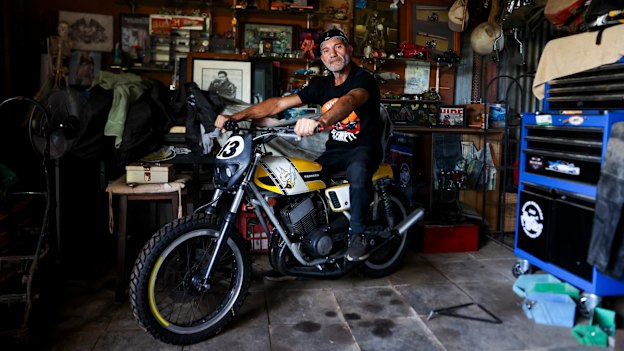
Manwell Cini’s excruciating wait in a Sydney emergency department underscores what happens when new hospitals and hospital beds lag population growth.
For 14 long hours, Manwell Cini and his wife Dianne Hand sat on the rigid plastic chairs in Campbelltown Hospital’s emergency department, waiting.
Cini was there after a motorbike accident dislocated his shoulder, broke his thumb and lacerated his liver. Despite also suffering from bowel cancer, and despite his pain, he had an extended wait for emergency care.
“I was just so distressed, and in so much pain. And I watched the nurses, they were just so busy, there was nothing anyone could do,” he said.
“I think the stress of having to deal with the health system will kill me before the cancer does. It just puts you off going again, no matter the reason.”
New data shows Cini is not alone, with one in 10 patients waiting up to 27 hours in the ED to be admitted at Campbelltown Hospital. And that figure gets worse across the region, with one in 10 having to wait up to 36 hours at Westmead Hospital, 34 hours at Blacktown and 27 at Nepean.
Waiting has become part of their daily routines, a tax on their lives for daring to live in an area that has grown too quickly for infrastructure to keep up.
That is despite successive governments’ flailing attempts at urban planning, each time seeing their population forecast quickly outstripped by reality.
It means Cini’s wait time wasn’t an anomaly, but reflected the impacts of the state’s failure to adequately prepare for the population explosion in these key areas.
‘There are thousands of new homes here. They’re going to have babies and car accidents and kids who break bones.’Dianne Hand
“I’ve lived in Bringelly for 27 years. And, in that time, they haven’t built a single new hospital,” Hand said.
“Just like with schools and roads, all this new housing has meant all our services are overrun and overcrowded. There are thousands of new homes here. They’re going to have babies and car accidents and kids who break bones.
“But where is the hospital for these people?”
The $632 million Campbelltown Hospital redevelopment, completed in 2022, was intended to service 130,000 new residents in the area over the next decade. But approximately 100,000 people have already moved into the area less than five years later, easily exceeding projections.
In fact, most of the south-west has surged past population projections and the many phases of government visions for the region. In 2018, the government’s Western Parkland City plan (which included much of the south-west) projected the region to grow to 1.1 million people by 2036.
As of March 2026, the population of the South Western Sydney Primary Health Network was 1.215 million. And that only covers some of the original area in the plan.
Construction has not proven the immediate solution it may feel like it is, despite an intense government appetite for it. The Minns government has touted big spending, including $2 billion for the new Bankstown Hospital, $790 million for the new Rouse Hill hospital and $120 million for extra beds and treatment spaces at Blacktown and Mount Druitt Hospitals.
But Professor Penelope Abbott, the chair of General Practice at the School of Medicine at Western Sydney University, said construction and redevelopments were essentially an “endless road”.
“I think it would represent more of the same,” she said.
“You can’t just keep on making hospitals bigger and bigger and adding more and more beds. You really need to meet the people’s needs when they’re in the community, so that they’re not ending up there in the first place.”
Abbott said there were signs the healthcare system could “collapse in the future” without investment that worked as both Band-Aid solutions and long-term goals.
“People need to be looked after. So even if it’s a Band-Aid solution, it’s absolutely necessary.”
It’s a double-edged sword the Minns government has attempted to address by moving to increase staffing levels as well as supporting the rollout of the federal government’s urgent care clinics.
Health Minister Ryan Park was determined to maintain a positive outlook on the issue, pointing to improvements in patients treated on time and the rollout of Safe Staffing Levels across EDs in western Sydney.
“Labor is investing in more staff, more beds, more hospitals, more quickly. There’s more to do, but we are making progress.”
The concession that there is more to do is telling – this is not a race the government is winning, despite its efforts.
This population growth has stretched and cracked the health system, borne out by the long waits in EDs. The latest data, from the Bureau of Health Information (BHI), showed major hospitals in western Sydney were mostly far below the state average on metrics such as median overall stay at a hospital, the time to go from being admitted to getting into a ward and rate of how many patients are seen on time.
The data also showed the give-up rate, where patients leave the emergency department without being seen, as well as ambulance transfer times, all higher across western Sydney hospitals.
Compounding the issues faced in EDs around the region are the increase rates of potentially preventable hospitalisations, indicating access to timely care in the community is a parallel challenge.
The LGAs with the worst rates of preventable hospitalisations were Blacktown, Cumberland, Campbelltown and Wollondilly. And according to the NSW Branch Chair of the Australasian College for Emergency Medicine, Dr Rachael Gill, all this data points to a system under compounding pressure.
She points to other factors adding to the strain, including low levels of health literacy and the need for translation services further narrowing the bottleneck, revealing a “systemic failure” to “actually meet patient needs.”
And to her, a large part of the picture is “holistic care”, which she explains as being about ensuring people have access to care that covers the full spectrum of health issues, and ensures there are follow-up steps taken once a patient is out of hospital.
“If we have greater investment in GPs providing long term, continuous and engaged care. It reduces the number of patients who have deterioration in their chronic diseases, and it keeps them well and comfortable and being cared for in the community,” she said.
Without this broader approach to care, patients will be cared for in “a less comfortable or private space. They’re being treated in chairs or hospital beds that aren’t inpatient beds, for extended periods”.
“And that can be confusing, it can be less appropriate for frail or elderly patients. It can lead to deconditioning, delirium and can increase the risk of complications. It is essentially not the most dignified patient journey.”
To Cini and Hand, all of this just leaves them wanting to stay away from the system and try and work it out for themselves. There was a dignity in that, they explained.
“It just makes you feel worthless,” Hand said. “It’s so demoralising, particularly when you are there for a serious reason and it feels like your concerns aren’t addressed.
“It makes us feel like no one cares.”
Tomorrow in Stranded Sydney: Where the footpaths are the only playgrounds.
Disclaimer : This story is auto aggregated by a computer programme and has not been created or edited by DOWNTHENEWS. Publisher: www.smh.com.au


