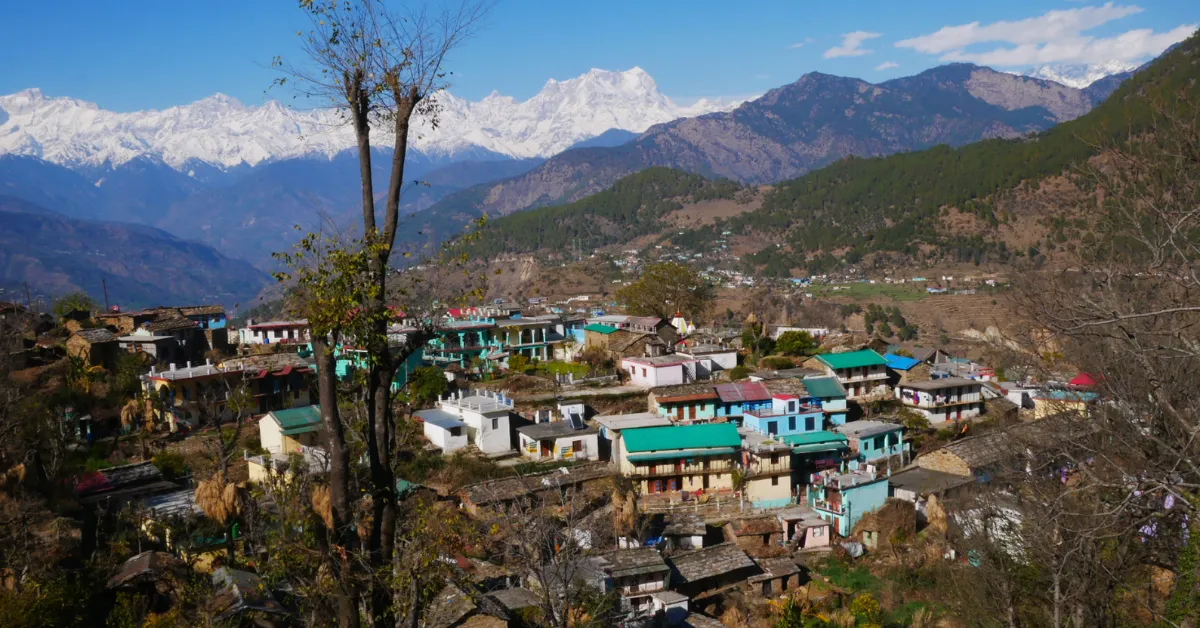
Situated at 1,664 metres in the Agastyamuni block of Rudraprayag district, this small village of Maniguh in Uttarakhand commands sweeping views of peaks including Chaukhamba, Satopanth, and Thalay Sagar.
But what sets Maniguh apart from the many beautiful hill villages of Devbhoomi is not its altitude or its panorama. It is the fact that, on any given day, you are as likely to find a child absorbed in a book by a mountain path as you are to find one on a screen.
Maniguh holds the distinction of being Uttarakhand’s first ‘library village’, a designation earned through years of steady, community-driven work by the Hamara Gaon Ghar Foundation. This non-profit conceived and built this ecosystem of reading from the ground up.
Inside Maniguh’s 20,000-book treasure
The centrepiece of the Library Village initiative is the Maniguh Central Library, known locally as Pustak Tirth, which houses a collection of over 20,000 books.
The range is striking for a rural hill community: the shelves carry titles in Hindi, English, Urdu, Sanskrit, Kashmiri, and Punjabi, spanning subjects from science to literature, history, competitive examination preparation, and children’s fiction.
Rare books from the Naval Kishore Press, dating between 1800 and 1905, are also preserved here, giving the collection an archival dimension that extends well beyond a community reading room.
Access is entirely free of cost. The library remains open on all working days throughout the year, serving school students, competitive exam aspirants, women returning to education, and curious visitors in equal measure.
Reading spaces that follow you up the mountain
What makes the Library Village model distinctive is that it does not confine reading to a single building. The Hamara Gaon Ghar Foundation has established a network of eight smaller reading spaces, called ‘pustak mandirs’ (book temples), at locations across the surrounding region, including Pratapnagar, Khamoli, Bandi, and Khalyu.
These open-air reading spots bring books directly to where people already gather — along trails, near temples, in village commons — embedding the habit of reading into the texture of daily life rather than making it a destination activity.
The foundation has also envisioned an extension of this concept along the trekking route to Kartik Swami Temple, a less-travelled alternative to the popular Kanakchauri path.
The idea is to develop this route into what they call a ‘Gyan Marg’ or Knowledge Path, with pustak mandirs placed at intervals so that pilgrims and trekkers encounter both nature and literature along the way. It is a quietly radical idea: that the journey to a sacred place can also be a journey through ideas.
From books to livelihoods: the wider model
The Library Village initiative has always understood that sustainable community development cannot rest on reading alone. Just as this Tamil Nadu village demonstrated how grassroots education can anchor an entire community, Maniguh has woven together literacy, livelihood, and cultural programming into a single coherent model.
Pine needle craft workshops are among the most imaginative of these efforts. Pine needles, long regarded as a fire hazard and an environmental nuisance in the hills of Uttarakhand, are transformed in these workshops into handcrafted products, including intricately designed rakhis that have found buyers in other states and even abroad.
/filters:format(webp)/english-betterindia/media/media_files/2026/06/04/4-2026-06-04-16-37-28.png)
A significant phase of this initiative was led by Manju R Shah, widely known as the ‘Pirul Woman of Uttarakhand’, whose expertise gave both technical grounding and broader visibility to the programme.
The workshops primarily engage women from the village, turning an ecological problem into a source of supplementary income.
Alongside this, the foundation runs honey bee training workshops that introduce villagers to apiculture as a sustainable livelihood, connecting environmental stewardship with economic resilience.
These efforts mirror what community-based livelihood models across rural India have repeatedly demonstrated: that when knowledge and skill-building are offered together, the impact runs deeper than either can achieve alone.
Turning the village into a centre of ideas
Each year, Maniguh hosts the ‘Gaon-Ghar Mahotsav’, a two-day cultural festival that has, over three editions, become a genuine intellectual gathering. Professors, authors, poets, theatre artists, dancers, singers, and scholars travel to this Himalayan village for what amounts to a festival of ideas rooted in community participation.
The festival creates a space where rural audiences engage directly with scholars and artists, while local voices and traditions are equally celebrated.
/filters:format(webp)/english-betterindia/media/media_files/2026/06/04/1-2026-06-04-16-37-46.png)
The Book Marathon, another of the foundation’s regular programmes, extends reading into a village-wide collective exercise, encouraging people of all ages to participate and treating literacy not as a solitary pursuit but as a shared social practice.
Together, these initiatives reflect a vision of the village as a centre of intellectual and cultural life, a counter-narrative to the idea that education and culture belong only in cities.
Reversing migration, one page at a time
At its core, the Library Village model is also an answer to one of Uttarakhand’s most pressing challenges. The state has seen significant out-migration over decades, as young people leave for cities in search of economic opportunity.
The foundation’s approach, which combines a reading culture with craft livelihoods, homestays, educational tourism, and institutional partnerships, is explicitly designed to create reasons for people to stay.
The Uttarakhand Open University has recognised this potential, adopting Maniguh as one of eight villages under its community engagement programme. A workshop held in March 2026, in partnership with the university, focused on reconnecting women whose education had been interrupted, offering them pathways into higher learning.
The active participation despite adverse weather conditions that day said something important about what this village has come to mean to its residents.
As initiatives across rural India have shown, reversing migration is rarely about a single intervention. It requires building a place where life has texture and possibility. Maniguh, with its books, its book temples, its rakhis made of pine needles, its annual festival, and its quiet Himalayan views, is doing exactly that — one page at a time.
Images courtesy of Library village Maniguh
Sources:
‘A ‘library village’ is being built in Uttarakhand, with these facilities available at the book temple‘: by AajTak, Published on 2 January 2023.
‘Republic Day 2023: Uttarakhand’s first theme village library ready for inauguration‘: by ETV Bharat, Published on 22 January 2023.
‘First book marathon held in Uttarakhand‘: by The Sunday Post, Published on 22 May 2023.
‘There is a unique library village in Devbhoomi Uttarakhand‘: by Dr. Shrigopal Narson for Chanakya Mantra, Published on 13 September 2024.
‘Pine leaves are doing wonders in the mountains, women are preparing special Rakhi’: by ETV Bharat, Published on 27 August 2023.
Disclaimer : This story is auto aggregated by a computer programme and has not been created or edited by DOWNTHENEWS. Publisher: thebetterindia.com