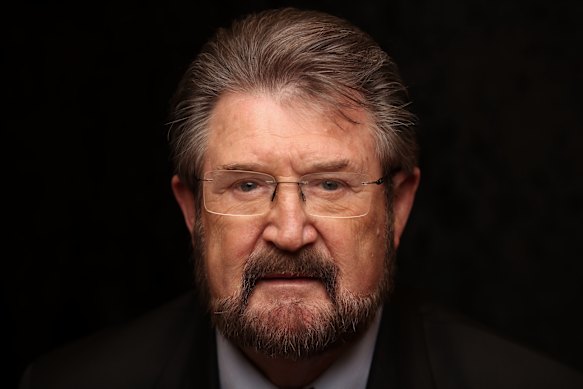
Gerry Carman
DERRYN NIGEL HINCH
1944 — 2026
Not surprisingly for someone who revelled in the title “The Human Headline”, Derryn Hinch was a serious bon vivant, stirrer, interlocutor and incisive interrogator, yet also given to tell-all public confessions.
His was a life that could easily have been book-ended by two plays on his name: Derryn Hunch and Derryn Lunch. Fellow journalists cringed at the way he would land himself in legal trouble by acting on hunches; others equally admired the way in which, for many of his rampaging years, lunch would stretch to dinner and beyond.
There was also admiration, even if some was grudging, for the opinionated, crusading journalist from wide sections of society – except the judiciary – when he challenged what he saw were poor laws that did not protect children from sex offenders.
Hinch was convicted three times of breaching court suppression orders: In 1987 he was jailed for 12 days for naming a paedophile priest on his radio program; in 2011 he served five months’ home detention for defying another gag by naming two serial sex offenders three years earlier; and in October 2013, he was found guilty of contempt of court for revealing the criminal history of Jill Meagher’s killer, Adrian Bayley, refused to pay the fine and was jailed for 50 days in early 2014.
Hinch’s crusade against paedophiles eventually led him into politics and in 2015 he formed the Justice Party on a platform of justice in sentencing, bail reform and parole; a public register for sex offenders; equality for all; animal rights and voluntary euthanasia.
In July 2016, he was elected a senator from Victoria in the double-dissolution election that resulted in a narrow win for Malcolm Turnbull’s government.
Hinch died at his Melbourne home on Friday after a long battle with a series of infections arising from a bad fall in September last year. He was 82.
In March 2011, the High Court unanimously rejected his arguments for breaching suppression orders in 2008 by naming a serial rapist and a paedophile in defiance of court orders.
Facing a jail term of up to five years or a fine of up to $60,000, he had appealed to have home detention when he underwent a liver transplant operation early on July 6, 2011.
Later that month, a magistrate ordered Hinch to serve five months’ home detention. He was banned from conducting his afternoon radio show or giving interviews.
Years earlier, another conviction entailed a $25,000 fine and 250 hours of community service for naming a “chauvinistic” Victorian judge who ruled that a man could not be charged for raping his estranged wife.
“I named him because I figured at least his wife should know who he was,” Hinch said.
And so it was with revealing bomb threats and extortion attempts that authorities wanted to keep under wraps.
Even at his workplace he caused waves. In the late 1980s he accused 3AW’s celebrity cleric, Alex Kenworthy, of using his Nightline program to meet and sexually abuse vulnerable women. Kenworthy sued Hinch but dropped the action before it reached court. Kenworthy died in 1994.
Nor did he spare himself. In one confession that angered listeners, Hinch in 2005 admitted that he had had sex with a 15-year-old girl when he was in his early 30s — but said he had “thought she was about 25”. Several years later, Hinch wrote that after 30 years, the woman had contacted him and said he was wrong about her age – that she was in fact 17 during their liaison.
Also, fellow workers at 3AW were angered and dismayed when Hinch sought to “balance” their effusive praise for Victorian cricket coach and 3AW sports commentator David Hookes as a “family man” following his abrupt death in January 2004 by revealing that Hookes was estranged from his wife and was in another relationship.
Then, in May 2005, he outed the former king of television, Graham Kennedy, as a homosexual and claimed he had died of AIDS, angering Kennedy’s friends and many of his listeners. Hinch later backed down on the AIDS claim.
Hinch had an elephantine capacity for the high life, soaking up copious amounts of alcohol and, conversationally, everything from the mundane to the sensational, to be used in his lively newspaper columns, books or often provocative radio and television broadcasts.
He progressed from newspapers and radio to television, when he hosted Channel Seven’s Beauty and the Beast in 1982-83. In 1987, he began hosting a current affairs show on the same network with the ultimate ego-boosting title, Hinch, which later carried over to the Ten Network, and was followed by Midday on Nine.
It was hardly surprising when the miffed premiers of the far-flung states of Queensland and Western Australia branded him “The Mouth from the South” and “The Beast from the East” respectively.
Blessed with the hide of a rhinoceros, he wore the names as badges of honour.
In 2012 he rejoined Seven as a national affairs commentator before moving to Sky in 2015 to host Hinch Live.
Hinch seldom took a backward step. Argumentative and confrontational, he also had a well-honed sense of fairness, varnished with theatre. Early working years in New York had honed his theatrical flourishes. His was a life lived to the full, epitomised in the signature tune for his on-air programs, Frank Sinatra’s That’s Life.
Hinch had instant success as an author in the mid-1970s when the first of his many books, The Scrabble Book, became a bestseller in the United States. But the words that encapsulated his life best to that stage came in 2004 on the back cover of The Fall and Rise of Derryn Hinch: “Meet the human headline — Sacked 14 times. Married three times. Spent 12 days in jail. Earned millions. Lost them all.”
Hinch, being himself, later added a fourth wife to his list and, after hitting rock bottom and being sacked a few more times, rebounded.
Obviously not worried about repetition, he commemorated 50 years as a journalist with his book, Human Headlines, and followed with several others, including two on his federal political career.
Born in the sleepy New Zealand town of New Plymouth to Betty and Dick, Hinch helped his father on his early morning milk delivery round from a young age. He was educated at the local school and in 1960 got a job as cadet reporter on the Taranaki Herald. Two years later he moved to the Christchurch Star as a reporter and assistant sports editor but soon moved on to the Waikato Times. His stay was short-circuited over the unauthorised use of an office car; he claimed he “beat being fired by 30 seconds” by resigning first.
Hinch moved to Sydney in 1963 and got a job on The Sun as a police roundsman, before moving back to New Zealand in 1965. He covered the Commonwealth Games in Jamaica in 1966 as a news agency correspondent before joining the Fairfax bureau in New York later that year. In 1972, aged 28, he was appointed bureau chief for North and South America.
He reported on such momentous events as the assassinations of Martin Luther King jnr and Bobby Kennedy, the moon landings, the Watergate scandal and president Richard Nixon’s resignation. In sport, he covered the biggest golf (US Open, PGA and Masters) and tennis (US Open) tournaments. The time he spent in Newport covering the America’s Cup led to the novel Death in Newport.
In 1976, he returned to Sydney as deputy editor of The Sun — and six weeks later, aged 32, he was appointed editor.
His turbulent employment history is summed up by his relationship with top-rating Fairfax radio station 3AW in Melbourne (sold by Nine, the owner of this masthead, earlier this year to the billionaire pubs and pokies Laundy family), which he first joined in 1979: hired, quit, then rehired and fired, he was back for the third time in early 2003. However, he was fired again in late 2012 while reigning supreme in the afternoon Drive timeslot, as he had done years earlier in the morning slot.
In 2014 he began guest appearances on the Sky channel, which led to Hinch Live the following year.
He had a penchant for mixing bravado with self-deprecation, perhaps typified by the last words in The Fall and Rise, using a quote from his grandmother to sum up his various battles: “You can’t kill weeds.”
If he thought he was indestructible — he had turned over a new leaf, conceded he was an alcoholic and reduced his drinking and taken up exercise — Hinch had a rude awakening in 2006 when his long-hammered liver became diseased and he suffered septicaemia, kidney malfunction and a failing immune system. He shed 30 kilograms.
By then he had achieved such status as to have appeared as himself in movie The Wog Boy , Dancing With The Stars on Seven, as a radio crusader with a grimy secret on City Homicide, as the narrator in the Melbourne season of The Rocky Horror Show and as himself in the Underbelly series on Nine.
Never a shrinking violet, he claimed to have almost single-handedly changed Australia’s broadcasting law that stopped political comment on radio and television 48 hours before an election. This involved the stratagem of reading newspaper reports on 3AW during successive elections; each time the station suspended him without pay. But in 1983, prime minister Bob Hawke finally scrubbed the archaic law.
Hinch also boasted of not only dislodging Bert Newton from the No.1 slot on radio in Melbourne but driving him from the airwaves altogether. He squared off by rating Newton the king of television.
Hinch’s ups and downs in life included a Bill Clintonesque confession to having spent all night at a brothel but adding that it was “not all that sexual, to be honest”.
He also revealed that (elsewhere) one lover bit him on the nose; another imbedded her stiletto in his head. In his own words, he said: “I have to concede that I was a multi-bottled, multi-opinionated frustrating prick to live with.”
In the 2019 federal election, Hinch lost his Justice Party seat in the Senate, with the seat going to the Greens. He said announcing the decision to dissolve the party in 2023, after losing the last of its MPs in the Victorian Parliament, was one of the saddest moments of his life.
“It’s bittersweet. It hurts, but I’m pleased we did it and we gave it a good shot. They certainly knew we were there,” he said.
In an interview with Neil Mitchell in September 2025, Hinch, then 81, using a walker and contemplating life in a nursing home, spoke about the pain of ageing and said he would consider accessing voluntary assisted dying if he was facing a terminal illness.
“I’m very lucky that my brain still seems to be going,” he said.
Since his liver transplant in 2011, he told Mitchell he had cardiac arrhythmia and had undergone surgery and treatment for melanoma, which was “under control”.
Hinch married five times – including reportedly twice to Australian actress Jacki Weaver for 14 years. He announced the collapse of his most recent marriage, to Chanel (nee Hayton) early in 2013. They had married in 2006.
He is survived by his brother Desmond and sisters Sandra and Barbara (deceased).
Hinch chose brevity for his tombstone: “He Tried.”
From our partners
Disclaimer : This story is auto aggregated by a computer programme and has not been created or edited by DOWNTHENEWS. Publisher: www.smh.com.au