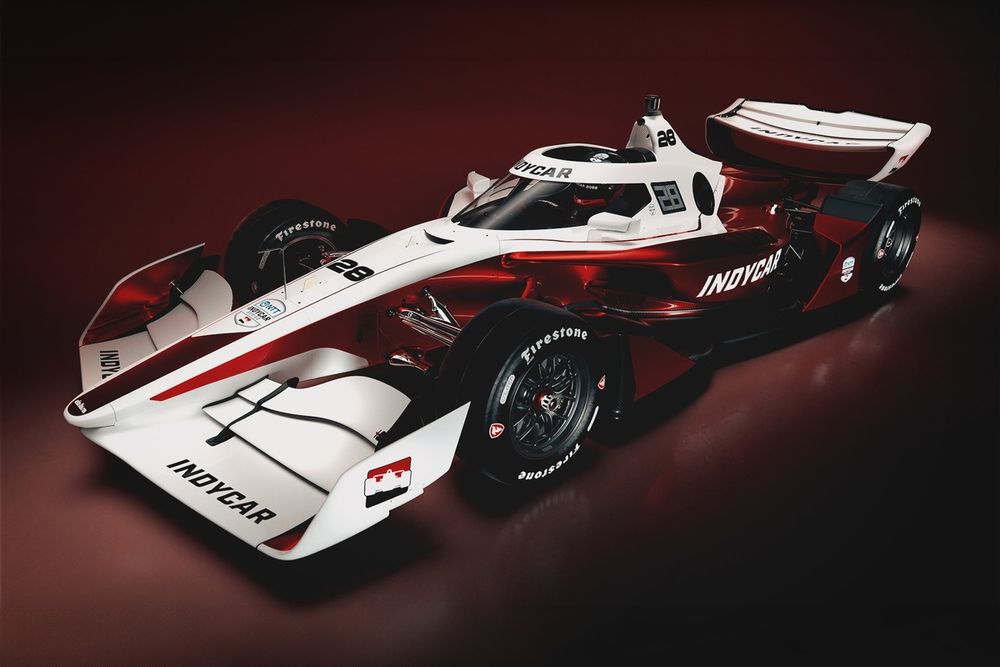
The IndyCar Series took a monumental step into its future with the first official look at the Dallara IR-28 – the brand-new chassis and aerodynamic package set to usher in a new era of open-wheel racing in 2028. Replacing the long-serving DW12 platform, the IR-28 features an aggressive visual overhaul, a purpose-built safety structure, significant weight reduction, and refined aerodynamics designed to improve close-quarters racing. Reaction across the paddock was overwhelmingly enthusiastic as drivers and team leadership got their first look at the future of the series.
Visual First Impressions: Aggressive, Futuristic, and Raw
Indycar 2028 race car
Photo by: IndyCar
The immediate consensus among drivers was clear: the car looks dramatically faster and more aggressive even before touching the track.
“The car looks aggressive and raw, and I love the integration of the aeroscreen with the rest of the chassis and aerodynamics,” said Marcus Ericsson, driver of the #28 Andretti Global Honda.
“Dallara has made some really good steps. They have improved so many areas both inside and out. I jumped in and quickly got the urge to take it for a spin. I wish we could go sooner than 2028.”
Reigning and four-time IndyCar Series champion Alex Palou was equally impressed with how the design balances modernization with IndyCar’s traditional identity.
“Seeing the car for the first time made me even more excited about where IndyCar is going,” said Palou, driver of the #10 Chip Ganassi Racing Honda.
“The design is super cool and feels like a proper next step for the series while still looking like an IndyCar Series car. I think the fans are going to love it, and as a driver I cannot wait to get behind the wheel. The most important thing is that we keep the close, fun racing that makes IndyCar special, and from what I’ve seen, we’re heading in a really good direction.”
For former Indianapolis 500 champion and Arrow McLaren Team Principal Tony Kanaan, seeing the chassis provoked an immediate urge to return to the cockpit.
“What a sight,” Kanaan said. “I sat in the car and, in the past three years, I haven’t had the itch to drive again as much as I did sitting in it. The car looks beautiful, futuristic and very impressive. Aerodynamically, it looks a lot quicker – and if it looks quicker, it’s going to be quicker. The safety considerations are a key aspect and well thought out, as well. Thank you, IndyCar and Dallara. I can’t wait and I’m excited about the future.”
Scott McLaughlin, driver of the #3 Team Penske Chevrolet, praised the attention to detail throughout the package.
“It’s awesome. It just looks racy,” McLaughlin said. “It has a really good design. It’s refined, very well thought through and filled with details both inside the cockpit and out. Plus, it’s kept the core IndyCar feel while expanding our technology and taking this to another level. I’m really excited.”
Integrated Engineering and Cockpit Ergonomics

Indycar 2028 race car
Photo by: IndyCar
A primary objective of the IR-28 design was fully integrating safety elements – most notably the Aeroscreen – directly into the tub rather than retrofitting them onto an existing chassis.
Andretti Global’s Will Power, a two-time IndyCar Series champion and 2018 Indy 500 winner, emphasized how cohesive the engineering feels inside and out.
“I was just as excited to see what was inside the car as I was to see what it looks like on the outside,” Power said. “IndyCar and Dallara have done an incredible job combining updated aerodynamic ideas with all of the safety elements from the current car. It has a seamless look and one that’s also modern and aggressive at the same time.”
In addition to visual integration, Dallara placed a strong emphasis on cockpit sizing to better accommodate drivers of different physical builds.
“There is a ‘wow’ factor,” said reigning Indy 500 winner Felix Rosenqvist, driver of the #60 Meyer Shank Racing Honda. “The first thing that struck me is that it has more room in the cockpit and will fit differently-sized drivers, which is really good. Secondly, it still has the IndyCar DNA, which was a worry for me that it wouldn’t look like an IndyCar car. This definitely does. It also has an aggressive look with an integrated aeroscreen and a car that addresses a lot of little tweaks that drivers have asked for. Dallara has delivered on almost everything. I’m super excited for the future.”
Graham Rahal, driver of the #15 Rahal Letterman Lanigan Racing Honda, who served as the tall driver benchmark during cockpit development, expressed optimism about what the chassis could mean for the broader series.
“I’m very excited for the new car – I like the design a lot,” Rahal said. “It’s very striking and aggressive in many ways but isn’t too far of a departure from the old car, which is exactly the way it should look. I was the tall driver used for the seat fit and initial sizing of the cockpit, so I’ve seen the new chassis and I have to say it’s beautifully built especially with the way everything is integrated with the aeroscreen and everything else. One of our goals should be to attract another manufacturer into the sport and I hope this new footprint allows for that.”
Aerodynamics, Dirty Air, and On-Track Performance

Indycar 2028 race car
Photo by: IndyCar
Driver feedback focused heavily on how the car’s reduced weight, refined underbody, and updated aerodynamics will improve wheel-to-wheel racing by reducing dirty air in traffic.
Jack Harvey, who serves regularly as a pit reporter for FOX Sports’ IndyCar coverage but made a one-off appearance earlier this year at the Indy 500 with Dreyer & Reinbold Racing, offered one of the most memorable descriptions of the unliveried car.
“Seeing it without any livery, it feels like Batman has a new toy,” Harvey said. “It feels aggressive in the areas where you want it to be. I think it’s the natural, perfect evolution into a new era. Aerodynamically, everything I hear from Dallara is that they are trying to minimize the effect of dirty air so that we can race even closer. Even if it’s a half-a-wing of clean air, it will make a huge difference. Between Dallara and IndyCar, I think what they have created is really great, and I’m as optimistic as I’ve ever been that this car will race really well.”
Juncos Hollinger Racing’s Rinus VeeKay highlighted specific aerodynamic additions that promise closer competition on ovals.
“It still looks like an IndyCar Series car but so much more modern, integrated and racy,” VeeKay noted. “Over the last few months, we’ve heard bits and pieces about the wings or sidepods, but to see it all put together – it’s better than the expectations. Even details like the barge boards behind the front wheels, I think it’ll help the racing a lot, especially on ovals. And the car is lighter. I cannot wait to hop in and give it a go.”
Conor Daly, who competed in the Indy 500 earlier this year alongside Harvey with Dreyer & Reinbold Racing, echoed the sentiment that the new platform answers key paddock requests.
“I just think there is something exciting about this car,” Daly said. “I love the aggressive way the car sits, the aeroscreen, which is now integrated into the car, and the rear wing, which looks sick. And this still looks like an IndyCar Series car. I like that. And I like that the safety evolutions over the last few years have been incorporated. So, from the weight reduction, expected aero grip and more power from the engine manufacturers, this is the car that’s going to provide exactly what we’ve been asking for it to do.”
Ed Carpenter Racing’s Alexander Rossi pointed out that while testing remains, the initial foundation is solid.
“The car is awesome,” Rossi said. “We all wanted a new, modern-day car that is lighter and looks futuristic and fast but still has all of the incredible safety advancements that IndyCar is known for. This does all of those things. There are still a lot of things to work through in terms of on-track testing and how it reacts to the different types of environments it will be exposed to, but from a visual standpoint, it’s incredible.”
Kyffin Simpson, driver of the #8 Chip Ganassi Racing Honda, concluded by noting the combined excitement surrounding the chassis and powertrain.
“I’m really excited – it has exceeded expectations,” Simpson said. “I’m also super excited about the performance expectations, which sound very promising and will add to the great racing that we already have. I cannot wait to see it out on the track and hear the 2.4-liter engine, as well. This will take IndyCar to the next level.”
We want your opinion!
What would you like to see on Motorsport.com?
– The Motorsport.com Team
Disclaimer : This story is auto aggregated by a computer programme and has not been created or edited by DOWNTHENEWS. Publisher: motorsport.com