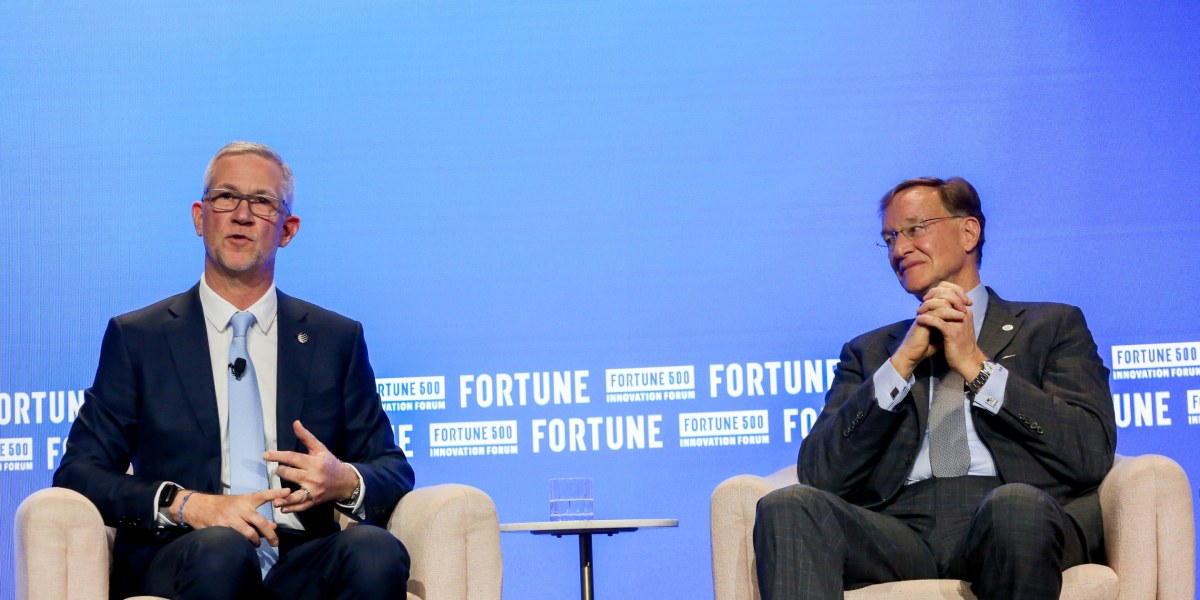
For two decades, the internet has mostly run one way: down. Netflix, YouTube and everything else stream from a data center to a couch, and the networks were built to match. AT&T’s chief operating officer says AI is starting to change that.
“The actual direction of the bandwidth of the internet is undergoing a fundamental shift,” Jeff McElfresh said Monday at the Fortune 500 Innovation Forum in Detroit. With agentic AI, he said, “we’re seeing agents tap the network in a 24 by seven, a very different approach. It’s not so episodic anymore.”
U.S. household upload traffic grew 19.2% year-over-year in the second quarter, more than three times as fast as downloads, which grew 6.1%, according to OpenVault, which tracks broadband usage for internet providers. The average subscriber now uploads 58.2 GB a month. Households still download about 11x as much as they upload, but that ratio was 16.6x in 2019. For the companies spending hundreds of billions on AI and the networks that carry it, that matters: a lot of last-mile infrastructure was built on the assumption that people mostly watch, not send.
‘There’s the Netflix traffic’
McElfresh has been at AT&T for 31 years. He said watching traffic from the network’s control center used to be easy to read, like “Oh wow, there’s the Netflix traffic. Oh, there’s the YouTube traffic.” Human habits created clear patterns, like traffic leaving cities for the suburbs at the start of the pandemic, when many work-from-home networks struggled and video calls glitched.
AI, he said, is “a very different approach.” Agents run around the clock rather than when someone sits down to watch. And a lot of the new demand runs upstream. He pointed to an autonomous vehicle connected to AT&T’s wireless network that “is actually transmitting more data up into the cloud to train a model than it is consuming.”
Mobile operators are seeing a similar shift. In 2025, 43 of 55 service providers tracked by Ericsson saw uplink traffic grow faster than downlink, according to its June Mobility Report. Ericsson’s scenarios have uplink traffic tripling or quintupling by 2031 if AI apps, smart glasses and agents take off. In the near term it points to smartphone apps, user-generated video and cloud storage, and it says mobile traffic “is still expected to remain downlink-dominated.” The company’s warning to operators is blunt: “Current networks are not dimensioned for sustained uplink demand.”
Nokia’s 2026 network traffic report forecasts that AI will drive 44% of global network traffic by 2035, and that for “physical AI” (robots, cars, drones) more than 90% of traffic will start in the uplink. “AI is challenging the asymmetric design of traditional access networks,” Nokia wrote.
Why AT&T likes this story
AT&T has a business reason to tell it. Fiber carries traffic equally fast in both directions. Cable broadband, AT&T’s main home-internet rival, has historically offered much slower uploads than downloads. McElfresh called fiber “the gold standard,” saying it’s “future proof” and has “all of the symmetrical capabilities to be very responsive to the AI future.” AT&T plans to reach 60 million fiber locations by 2030, about 1.5 times its footprint, and signed a more than $3 billion supply deal with Corning in September.
OpenVault’s numbers give AT&T something to point to. Fiber subscribers uploaded an average of 94.1 GB a month in the second quarter, against 58.2 GB on cable’s DOCSIS networks. Not all of that is AI. OpenVault CEO Mark Trudeau told Light Reading in October that he attributes the upstream growth to “gaming and to Zoom and Teams calls, as well as we’re seeing a lot of AI content creation.” Cable companies are also rolling out DOCSIS 4.0, which supports symmetric speeds.
Corning CEO Wendell Weeks, who shared the stage, said customers will feel the shift at home, through “the combination of the bandwidth he delivers, with the type of products that AI is going to enable,” from robots to how people use their devices. Corning makes the glass fiber AT&T installs. Weeks said the next frontier is inside the data center itself, where copper wiring will give way to fiber, converting signals to light “within a centimeter” of the processor.
McElfresh said AT&T technicians are installing fiber in 10,000 neighborhoods on any given day, adding roughly 4 million locations this year. AT&T’s target is 60 million by 2030. Ericsson’s forecast window runs to 2031.
Disclaimer : This story is auto aggregated by a computer programme and has not been created or edited by DOWNTHENEWS. Publisher: fortune.com