
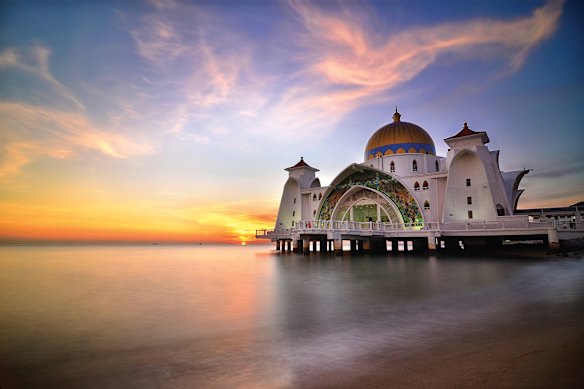

Malacca: The Malacca Straits Mosque, sometimes called the “floating mosque” because it extends over the water, offers fine views of one of the busiest maritime choke points in the world.
Tourists in the storied Malaysian port town that lends the strait its name enjoy the mosque’s back deck at sunset, watching the monolithic container ships that trundle through placid waters, and the changing colours of the sky.
If you were to stand here for a year with binoculars, you would see a quarter of global seaborne trade pass by. More crude oil comes through here each year than even the Strait of Hormuz.
For centuries, the 1100-kilometre passage bound by Indonesia, Singapore and Malaysia – only a couple of kilometres wide at its narrowest – has been the great maritime link between East and West.
In this late-afternoon panorama, we count eight container ships near and far, each heading towards Singapore, old Malacca town’s modern-day successor as South-East Asia’s major trade emporium.
Some of the cargo may be heading to a store or pump near you – more than 40 per cent of Australia’s imports and about two-thirds of its exports pass through the strait.
China relies on it to deliver most of its imported oil and countless other essentials. In 2003, former Chinese president Hu Jintao coined the term “the Malacca dilemma” to describe the nation’s reliance on the route and the ease with which adversaries, namely the United States, could wreak trading havoc should they ever choose to do so. (Some, however, say there are other, albeit longer, potential routes and that China has overstated its dependence on the Malacca Strait as a ruse to project more power through the Indo-Pacific.)
The global energy crisis stemming from the US-Israel war on Iran and the latter’s retaliatory choice to effectively close the Strait of Hormuz has sharpened the focus on the vulnerabilities of other key shipping lanes such as this one. Choke points can be weaponised.
Thailand is re-energised about its controversial plans for a southern “land bridge”, where goods may one day be brought and stored on one side of its territory on the Malay peninsula and transported overland onto waiting ships on the other, cutting out the Malacca Strait altogether.
Indonesia’s finance minister, his eyes flashing with dollar signs, briefly had an even wilder idea. “We sit along a strategic global energy trade route, yet ships passing through the Malacca Strait, we don’t charge them,” Purbaya Yudhi Sadewa mused at a recent industry event.
“I don’t know, is that right or wrong? If it were split three ways between Indonesia, Malaysia and Singapore, it could be quite significant, right?”
Purbaya quickly walked back the comments as a joke, but Singapore and Malaysia took them seriously enough and pushed back. Like them, Indonesia relies on open trade, and the nation’s foreign minister was forced to come out the next day to put everyone at ease.
Of the three custodians of the Malacca Strait, Singapore, which is relatively flush with oil reserves and refining capacity, has taken the highest road during the Hormuz crisis. Asked in parliament if Singapore would negotiate with Iran for the safe passage of its ships, as Malaysia had done, Foreign Minister Vivian Balakrishnan said it would not. To do so, he said, would be “implicitly eroding” the international legal principle that keeps Singapore wealthy – free passage. Needless to say, it has been a tricky period in regional diplomacy.
As for old Malacca town, history may hold a lesson. Its golden years as one of the most powerful and prosperous ports in the world were during the reign of the Malacca Sultanate from the early 15th century to the early 16th century.
Once upon a time, merchants would have sailed past the space now occupied by the mosque to load and unload their cargoes. Spices came from what is now Indonesia, perfumes and carpets from the Middle East, and cloth and opium from India. Visits from famed Chinese admiral Zheng He in the first half of the 15th century opened up trade of Chinese porcelain, tea and silk. The streets teemed with the chatter of 84 languages and dialects.
The port’s strategic position was too enticing for the Portuguese, who took it by force in 1511, then lost it in 1641 to the Dutch, who gave it to the British in 1824 as part of territory swaps in the Anglo-Dutch treaty. These days, it is a tourist hub. Some of the old colonial buildings are remarkably well-preserved.
The reasons for Malacca’s slow decline as one of the world’s great entrepôts are complex and varied, but its fortunes were not helped by Portugal’s mismanagement. Cultural and religious chauvinism turned off the Muslim traders. Some academic papers and a display in Malacca’s Maritime Museum, which is housed in a replica of a Portuguese ship, point to another partial explanation from the Portuguese tenure: heavy taxation.
The merchants, capitalists to a tee, simply started going elsewhere.
Get a note directly from our foreign correspondents on what’s making headlines around the world. Sign up for our weekly What in the World newsletter.

From our partners
Disclaimer : This story is auto aggregated by a computer programme and has not been created or edited by DOWNTHENEWS. Publisher: www.smh.com.au


