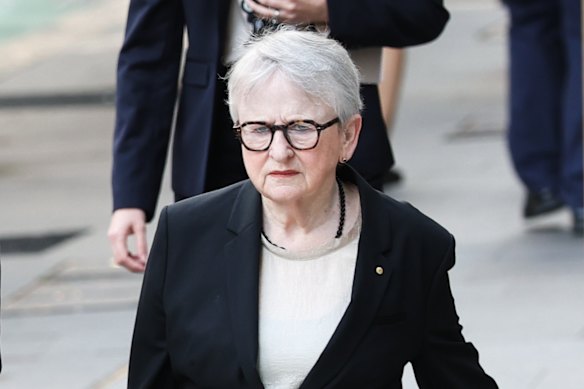

Substantial chunks of royal commissioner Virginia Bell’s interim report on the Bondi Beach massacre – including five of her 14 sensible but modest recommendations for change – remain hidden behind a veil of redactions. And, as Bell warned when she launched the inquiry in February, key questions remain unanswered because of the tight deadline she was given to deliver her preliminary findings.
Yet for all these gaps, the former High Court judge’s interim report offers important clues about the topics she plans to probe when she begins public hearings next week and continues reading the thousands of submissions the inquiry has received.
While her writing style is not prone to flourishes, Bell has put state and federal police, domestic spy agency ASIO and the Albanese government on notice that they can expect to be grilled on one pivotal point in the months ahead. While authorities at various levels acknowledged the rising danger faced by Jewish Australians after the October 7 attacks and war in Gaza, what exactly did they do about it? Was the rhetoric of those entrusted with keeping a vulnerable community safe matched by their actions?
Reflecting a jurist’s belief in the importance of due process, Bell is not yet pointing fingers at anyone for the fact 15 innocent people died at Bondi Beach on a sunny day in December. But it is obvious she is considering what could have been done better.
For NSW Police, Bell finds that three general duties officers and one supervisor attended the Bondi Hanukkah event, with a local area commander attending at various times. The two inspectors rostered on were asked to attend the event but told there was no need to stay until it ended. This came after the Jewish community’s security group warned ahead of the event that “a terrorist attack against the NSW Jewish community is likely and there is a high level of antisemitic vilification”. Even acknowledging the benefit of hindsight and limited police resources, Jewish community leaders believe the security presence on the day was clearly inadequate given the rising threat level.
As for ASIO, Bell notes the spy agency raised the terror threat level from possible to probable in August 2024, meaning there was a 50 per cent chance of a terror attack being planned or undertaken in Australia over the next year. And ASIO boss Mike Burgess singled out the “disturbing escalation” of antisemitic incidents in Australia. So, full credit for being aware of the problem and sounding the alarm. But what flowed as a result? Bell says: “It will be necessary to investigate whether and how ASIO and other Commonwealth and state intelligence and law enforcement agencies understood and acted on those assessments of a probable attack; and to consider the adequacy of what was said to be ASIO’s ‘full use of our capabilities and powers’ in the context of ongoing antisemitic attacks.”
For example, Bell is likely to probe whether ASIO should have reassessed lapsed cases such as Naveed Akram, who came onto their radar in 2019 and has been charged with carrying out the Bondi massacre, given the heightened threat level.
As for the government, Bell is clearly interested in the attention and money given to counter-terrorism as the warning signs began flashing red.
Bell finds that funding for police and intelligence agencies grew between 2020 and 2025, with ASIO’s funding expanding by almost 40 per cent over this period. Yet even with this growth, “the proportion of funding allocated to counter-terrorism significantly declined” across the national intelligence community as espionage and foreign interference threats sucked up more resources.
Given this decline, Bell says: “A question for examination will be whether the resourcing for counter-terrorism in respect of ASIO specifically, and in respect of the [intelligence community] more generally, was adequate in the deteriorating security environment, including Hamas’s attacks on Israel, and reflected in the raising of the National Terrorism Threat Level to ‘PROBABLE’.”
Similarly, why has the counter-terrorism coordinator position been a part-time role juggling other responsibilities within the Department of Home Affairs since 2019?
If police, ASIO and the government believe they did everything possible to respond to the surge of antisemitism that has erupted since 2023, Bell is obviously not convinced. Her initial report reflects an open mind, but one asking the tough questions and intent on discovering the answers.
Cut through the noise of federal politics with news, views and expert analysis. Subscribers can sign up to our weekly Inside Politics newsletter.
 Matthew Knott is the foreign affairs and national security correspondent for The Sydney Morning Herald and The Age.Connect via X, Facebook or email.
From our partners
Disclaimer : This story is auto aggregated by a computer programme and has not been created or edited by DOWNTHENEWS. Publisher: www.smh.com.au