Acropolis Rally Greece kicks off a run of seven consecutive gravel rallies as the World Rally Championship enters its crucial second half of the season.
Regarded as one of the most attritional events of the season, Greece’s rough gravel stages look set to offer up another brutal edition. This year, the rally has moved south from Lamia to the town of Loutraki, which means almost 75% of the route is new for this season. The route may have been revised, but drivers are expecting the challenge of managing punishing rough gravel stages held in intense heat to be as tough, if not tougher, than ever.
Here are the key talking points ahead of the 17-stage rally that will comprise 323.47 competitive kilometres.

Can Hyundai repeat its Acropolis form and reel in Toyota?
This rally is among the few events where Hyundai has managed to regularly edge its rivals Toyota, winning three (2022, 2024, 2025) of the past four editions.
While the Korean brand has been found wanting against Toyota on asphalt this year, on gravel it has already tasted victory when Thierry Neuville won in Portugal in May. Hyundai has put its faith in its i20 N’s ability on gravel as it bids to reel in Toyota, which has won six of the seven events to date.
Hyundai will also have a strong road position advantage with Toyota occupying the top five spots, and with five of the Friday’s six tests only run once, the cleaning effect could prove hugely beneficial.
“The second part of the season is full of gravel so that’s an opportunity for us. We need to make that an opportunity to score points,” said 2022 and 2024 Acropolis Rally winner Neuville.
Team-mate Adrien Fourmaux, chasing a maiden WRC win, believes he can once again be in the victory fight after proving his pace last year. The Frenchman had to settle for third after clipping a rock, which caused suspension damage 12 months ago.
“I think that’s [challenging for the win] a possibility. I’ve got the road position for that also which is helping definitely,” said Fourmaux, who will start sixth on the road.
“So yes, I think we are in this situation, but every year is different. Last year I clipped the rear wheel and I think I had one puncture and at the end of the stage, it was quite okay. This year, if I only have a puncture at the end of the stage, I’m happy.”
Hyundai sporting director Andrew Wheatley added: “Honestly to come to Greece and be confident is a good step. But, this is one of the hardest rallies of the year and one rock on one corner can destroy the rally. For sure, we have more confidence that the performance is level, but we really know that this rally is not easy.”

Rough stages perhaps even rougher for 2026
However nothing can be guaranteed at the Acropolis Rally with Neuville admitting that this edition will likely not be decided until the final stage given high risk of punctures on the rough stages.
“I would say that roughness is on a reasonable level. The risk of punctures for me has definitely increased due to the enormous amount of loose stones and rocks added on the stages to resurface them. I guess that will be definitely more difficult for the tyres than last year,” Neuville added.
“Honestly, you can drive slowly and pick up a puncture so I would say that you should drive your rhythm and my view is don’t try to overthink it. If there’s a puncture, stop, change and go again. Until the Sunday Power Stage, which is probably one of the most difficult for tyres, nothing is done, so it’s really up until the very end.”
It is a view echoed by nine-time world champion Sebastien Ogier, who claimed his only Acropolis win (2011) to date when the rally was previously based in Loutraki.
“I think it’s typical Acropolis stages in general with some beautiful sections and some also much more rough and challenging. I think there is no easy loop, no easy moment during the weekend where you’re going to think this stage I can relax,” said Ogier.
“Generally I think it’s going to be a demanding one, but it’s always been the case in Greece.”
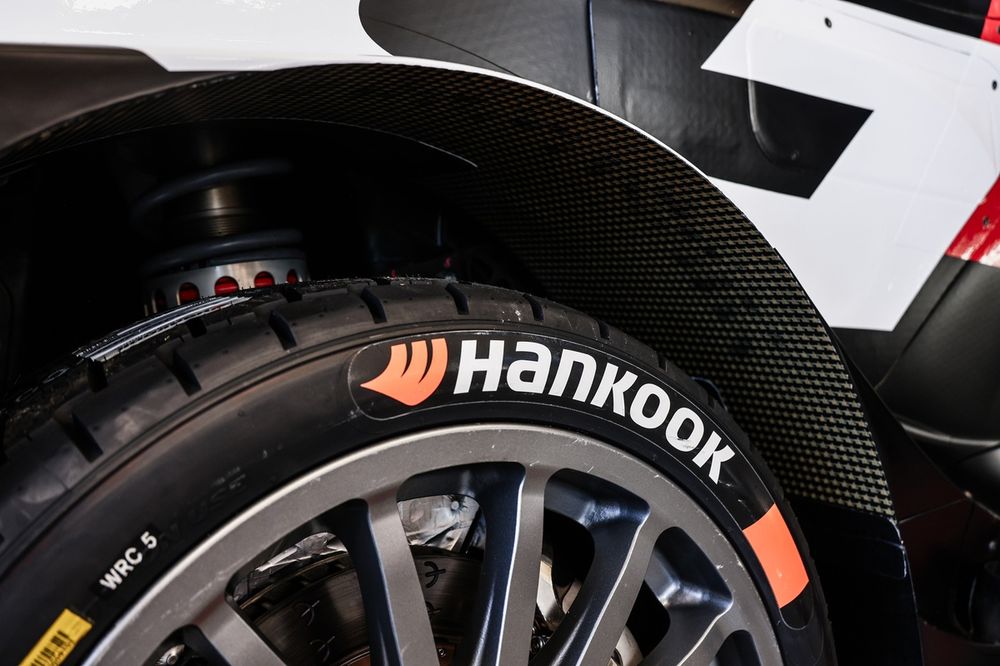
How will Hankook’s revised tyre perform?
Hankook has brought a revised hard compound tyre this weekend to cope with the tough conditions after receiving criticism regarding the durability of its product following Rally Portugal.
Despite facing a short validation period, WRC teams have been running the updated tyre during pre-event tests in Greece,
“It’s really kind of just a small evolution from the tyre that we had before, very small, but that very small change made quite a significant improvement on our side,” said Hankook WRC representative Steven Cho.
WRC drivers have noticed improvements but there remain question marks as to how the tyre will perform when the stages begin.
“We had one day with these new tyres and I mean, it’s too early on to really say. I think the race is always the best test to really find out if it’s going in the right direction or not,” said Ogier, who has been among those critical of the Hankook rubber.
“Part of the problem we had with the previous tyres, I think has been solved. But overall, as a package, we still have to see in the race conditions. The delamination issue, which was very bad, seems to go in the right direction, but again, usually in race condition, you are putting more stress and you find out more than during testing. It’s still positive to say that the manufacturer is trying to bring things. They are trying their best.”
Championship leader Elfyn Evans added: “We have enough tyres to do what we need to do. We have enough to put six on the car at every service, but whether that’s enough still, that’s the question.”

Championship leader braced for tough task
The driver facing arguably the most difficult challenge this weekend will be Evans, who will have to open the roads. This task will be made even more difficult by the fact that Friday’s leg features five first-pass-only stages.
“It is a tough job. A few of those [first pass] stages are exceptionally bad in terms of cleaning as well, like super loose. It looks like [it is worse than last year],” said Evans. “It is what it is, and we have to do what we can and see how it goes.
“But with everything going on this year, actually being out of trouble could also be quite important. Of course, we’re all going to start doing the best we can. Let’s see how things evolve as the event goes on.
“It’s more difficult to judge, I think with everything going on. The amount of loose rock seems worse this year as well, so I think the puncture risk is even higher.”
Drivers embrace new floating parc ferme
This year’s Acropolis Rally will boast a rather unusual feature. After Thursday night’s opening super special stage in Athens, crews will board a ferry from Port of Corinth to Itea in order to begin Friday’s leg.
The ship will become the official floating parc ferme, with crews having the option to remain onboard overnight. It is hoped this method of transporting the cars will save time and ease logistics for teams.
“It’s a cool story. I’m not sure if everyone will handle the boat well, but I like being on the boat, it will float and I will sleep like a baby. I think it will be calm on the sea,” said Toyota’s Oliver Solberg.
“I will maybe give you my feedback after it. Let’s see how it goes. At the end of the day, the idea is to save us a long road section, so why not? I can see some positives. Let’s see how it works and we’ll give you my feedback afterwards,” said Ogier.
We want your opinion!
What would you like to see on Motorsport.com?
– The Motorsport.com Team
Disclaimer : This story is auto aggregated by a computer programme and has not been created or edited by DOWNTHENEWS. Publisher: motorsport.com