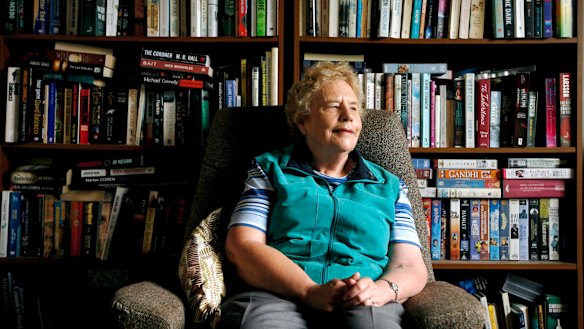

Myree Harris 1944 – 2026
Sister Myree Harris devoted her life to the care and causes of the marginalised: society’s cast-offs, the mentally ill, the homeless, drug-addicted, disabled and destitute.
As a Josephite nun in 1989, she had volunteered at a community house for alcoholic and homeless men in Melbourne and “to my surprise, I loved the place”.
Harris realised that the most basic needs of those marginalised men and the thousands like them were not being met, condemning them to a fringe existence in substandard boarding houses, hostels or on the streets. She recalled later visits to some NSW boarding houses saying “the wretchedness of some of those facilities remained seared in my memory”.
In January 1990, she became house leader at St Francis House in Sydney’s Stanmore where she took on the care of “a collection of vulnerable people, crooks and conmen and tried to impose some order into the existing chaos”.
Deciding that poverty need not be equated with dirt, she started cleaning. Rather than rely on donations of food, she went shopping, telling residents they had to pay their weekly rent. Two strikes and they were out.
After St Francis House was evicted from its premises, Harris found a Marrickville terrace to rent and that became a registered charity: the Gethsemane Community. The vision was to provide a safe, secure and permanent home for up to six men and women who had mental illness or other disabilities.
Word had spread quickly that there was this no-nonsense nun laying down the law and making things happen. Some of the boarding house owners became concerned, calling her “the mad nun” and working out ways to “put her out of business”. She continued undeterred.
Harris became an advocate for the homeless and the mentally ill and the Gethsemane Centre, later located in Petersham, became a byword for care and Christian responsibility.
Harris became an adviser to the Catholic Church nationally, chairing numerous committees and representing the Australian Catholic Bishops Conference at three Vatican conferences on homelessness.
Myree Anne Harris was born in Dubbo in 1944 daughter of a furniture shop proprietor, Vince Harris, and Ellie. In 1954, the family, including brother Peter and sister Carmel, moved to Cowra, where Harris developed a strong religious faith while a student at St Brigid’s then St Raphael’s High School. In 1962, she joined the Sisters of St Joseph.
After Teachers’ College, she taught science, mathematics and religious knowledge at five Catholic secondary schools. In 1976, she graduated from Macquarie University, majoring in biology and psychology and completed a master of arts in 1980 at the Institute of Pastoral Studies at Chicago’s Loyola University. From 1981 to 1989, she worked at the Catholic Education Office and this is where she volunteered once a week at Melbourne’s Corpus Christi Greenvale, a community house for alcoholic, homeless men: where her commitment to helping the less fortunate solidified.
In 1992, she became president of the St Vincent de Paul Society’s State Advisory Committee for the Care of People with Mental Illness.
“We set goals for the committee, two of which became pivotal,” she said. “We wanted to assist residents of licensed boarding houses for people with disabilities and being conscious of the loneliness and social isolation of these people, we wanted to set up a friendship program.”
Harris started the Compeer program, founded in New York, which provided friendship to hundreds of people with mental illness over many decades.
After finding one suburban boarding house in an appalling condition, Harris started lobbying government ministers, including then premier Bob Carr. She wrote to the health minister Andrew Refshauge, who then dispatched the central Sydney Boarding House team to do an assessment. Community services minister Ron Dyer also asked a Department of Ageing and Disability licensing team to do an inspection. Eighteen months later, the boarding house was closed, to the intense chagrin of the boarding house owner. Harris was warned to be careful for her personal safety.
But Harris was more concerned with the plight of the marginalised who had become old and were in aged care. She found “an epidemic of loneliness”.
From 1994, she began packing Christmas gift parcels for residents of licensed boarding houses: Christmas cards, hampers of toiletries, general and festive food and a calendar were packed for clients of the Inner West’s mental health and drug health teams.
It would grow to a point where Gethsemane reached 822 people.
“The first time we took parcels to one large nursing home in the Inner West, a staff member burst into tears … she said they had been so worried about the loneliness of the residents at Christmas that they thought of giving each person a packet of shortbread biscuits,” Harris said.
In 1995, Harris and three others formed a Coalition for Appropriate Supported Accommodation (CASA) for people with disabilities in NSW. After three years of letter advocacy, the state government announced a $66 million ($58 million recurrent) Boarding House Reform program, which eventually relocated 500 of the highest-need residents to 24-hour care in group homes.
“This is a major win in the struggle for social justice for some of our community’s most deprived and marginalised citizens,” Harris said at the time.
In 1998, she became a founding member of a government Boarding House Expert Advisory Group. The same year, she joined the Board of Churches Community Housing. In 1999, the Gethsemane Centre relocated to a house in Petersham.
Harris had seen that one of the greatest problems facing homeless shelters was dealing with residents who had a dual diagnosis of mental illness and substance abuse. She won a Churchill Fellowship and travelled to Canada, USA and England in 2003 studying treatment programs.
In 2007, as a delegate of the Australian Catholic Bishops Conference, she went to Rome to attend the First International Pastoral Meeting on Homeless Persons. In 2008, she became mental health adviser to the National Council of the St Vincent de Paul Society and in 2010 she was the Australian delegate at the Pastoral Care of the Road/Street for Asia and Oceania meeting in Bangkok.
In 2012 she became a member of the Australian Catholic Disability Council and later the chair. When the NSW government passed the Boarding Houses Act 2012, she and CASA were commended in the second reading speech.
“It had taken 17 years of advocacy to provide legislative protection and quality of life for residents of what were now called assisted boarding houses,” Harris said.
In 2015, Harris was again in Rome as the Australian delegate to the Vatican International Symposium on Pastoral Care of the Street. She delivered a paper on the trafficking and abuse of women and children in Oceania and had an audience with Pope Francis, even sharing a joke with the pontiff.
Harris was awarded in 2011 the Medal of the Order of Australia (OAM) for services to people with mental illness and the homeless. She continued to care for the small Gethsemane group who relied on her.
“I probably get more than I give,” she explained. “Being with people who aren’t the most successful human beings in the world is important in a world where there is such an emphasis on beauty, success and being popular. Here, we’re just people together.”
Friends say that she was “Christ-like, washing their feet, devoted to the end and a possible candidate for sainthood”.
Myree Harris died on May 15 after a short illness. She is survived by her siblings Peter and Carmel, brother-in-law, Kevin Hutchinson, niece Kerry Coker and nephew, Dr Darren Hutchinson. Her funeral will be held at St Mary’s Church, North Sydney on May 27 at 10am.
Start the day with a summary of the day’s most important and interesting stories, analysis and insights. Sign up for our Morning Edition newsletter.
From our partners
Disclaimer : This story is auto aggregated by a computer programme and has not been created or edited by DOWNTHENEWS. Publisher: www.smh.com.au