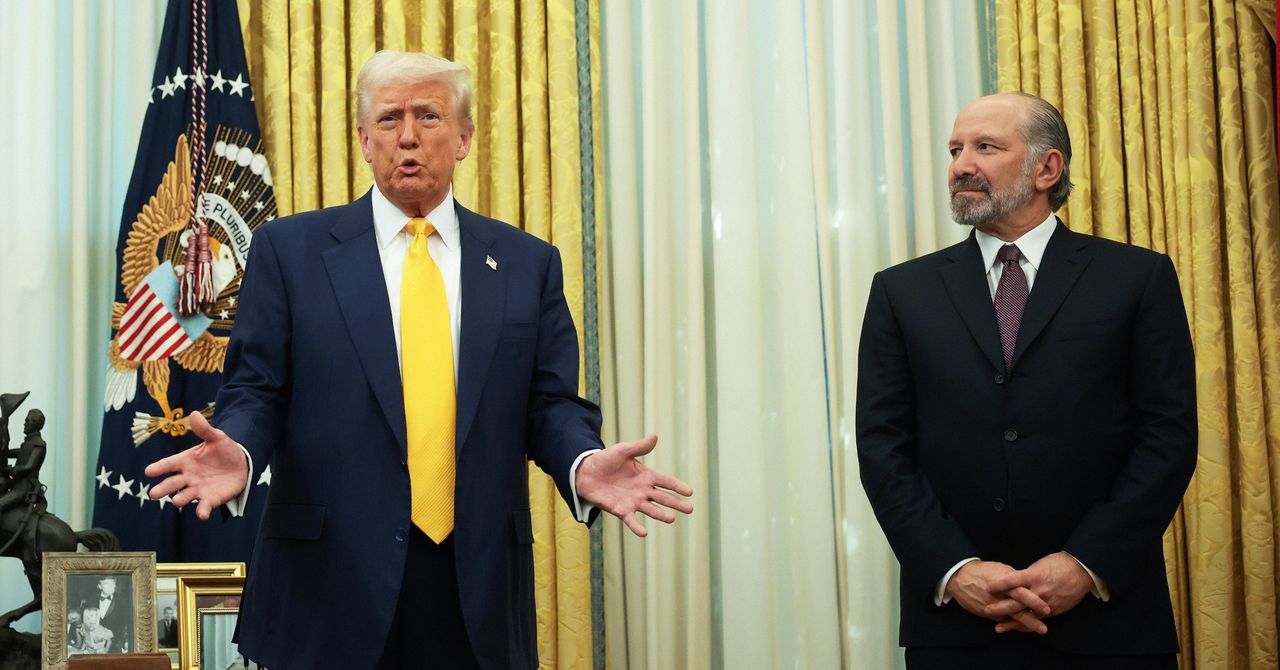
After days of political fallout from former Nvidia CEO Jensen Huang’s affair with a suspected Chinese intelligence asset, President Donald Trump is defending commerce secretary Howard Lutnick.
Last week, Lutnick came under fire from treasury secretary Scott Bessent for not aggressively imposing export restrictions on advanced AI chips to China.
But Trump’s defense of Lutnick, sources tell WIRED, reflects the president’s own view that allowing the sale of some advanced AI chips to China can keep China reliant on US technology and simultaneously boost US tech stocks.
Lutnick “was doing that because if you didn’t delay it, if you didn’t do something, you could have a blowup with China. We’re having a very good relationship with China right now,” Trump said ahead of a multiday trip to Asia and a meeting on Thursday with Chinese leader Xi Jinping.
Trump convened an Oval Office meeting on November 5 to discuss the political fallout from Huang’s affair with Alice Huang, the former Megaspeed executive whom some in the US government believe was recruited to spy for China, according to two sources briefed on the discussion.
Megaspeed received advanced AI chips manufactured by Nvidia through several layers of companies that started with a subsidiary of a blacklisted Chinese server conglomerate called Inspur, The New York Times has reported.
In the meeting, the sources say, Bessent confronted Lutnick, asking why Megaspeed was not added to the entity list faster, given that secretary of state Marco Rubio and US trade representative Jamieson Greer, among others, had already agreed it was the correct move.
Lutnick responded that he would defer to Trump and would add Megaspeed to the entity list if that was what the president wanted, the sources say.
But Trump settled on a third approach: for Lutnick to work on introducing a new interim trade rule to stop Chinese AI labs from using advanced AI chips remotely by leasing their compute power from data centers in Southeast Asia.
In a statement to WIRED, a White House spokesperson said the new rule would “crack down on the smuggling of advanced US SI chips” and “help ensure that America’s most advanced chips go first to US SI innovators, not Chinese shell companies.” (Superintelligence, or SI, is the administration’s term for artificial intelligence.)
A senior White House official added that Trump has been adamant that Chinese firms cannot acquire the most advanced Nvidia chips, known as Blackwells and Rubins. Those are different from the H200-type chips, built on previous-generation Hopper architecture, that Megaspeed was acquiring.
Lutnick’s position appears to have been based on a series of considerations, the sources say. For one, Megaspeed has already had the chips for months, and blacklisting the company would be akin to playing whack-a-mole unless the administration dealt with the underlying issue of Chinese firms getting remote access to US chips.
Meanwhile, Lutnick has moved cautiously on any new export restrictions—essentially waiting to get explicit approval from Trump—after he faced heavy criticism in 2025 for expanding restrictions against firms with Chinese ties, the sources said.
In September 2025, the Commerce Department’s Bureau of Industry and Security started aggressively using the so-called affiliates rule, which automatically extends trade restrictions to any company that is 50 percent owned by a company already on the US entity list or the military end-user list.
But the move prompted immediate retaliation by China, which suspended exports of critical rare earth metals to the US and, the sources said, prompted a wave of internal criticism accusing the Commerce Department of having sparked a trade war.
After the Busan summit at the end of October 2025, where Trump and Chinese president Xi Jinping agreed to a trade truce, the White House instructed Commerce to halt the use of the affiliates rule and clear new export controls in advance, the sources said.
The suspension of the affiliates rule—which came almost as soon as it was implemented—may have had a knock-on effect on companies like Megaspeed, one person familiar with deliberations said.
Inspur, the Chinese server conglomerate connected to Megaspeed, operated a subsidiary called Aivres, which, as a California-based company, could legally buy restricted Nvidia chips without triggering direct export bans and ship them internationally to Southeast Asia.
In total, Aivres transferred billions of dollars’ worth of restricted Nvidia chips, including the powerful H200 chips, to Megaspeed’s subsidiaries.
Instead of shipping the physical chips into China, Megaspeed hosted servers at data centers in Malaysia and Indonesia—then rented out compute power to major Chinese companies. A spokesperson for Aivres said in a statement that the company complies with all US export controls.
Disclaimer : This story is auto aggregated by a computer programme and has not been created or edited by DOWNTHENEWS. Publisher: wired.com