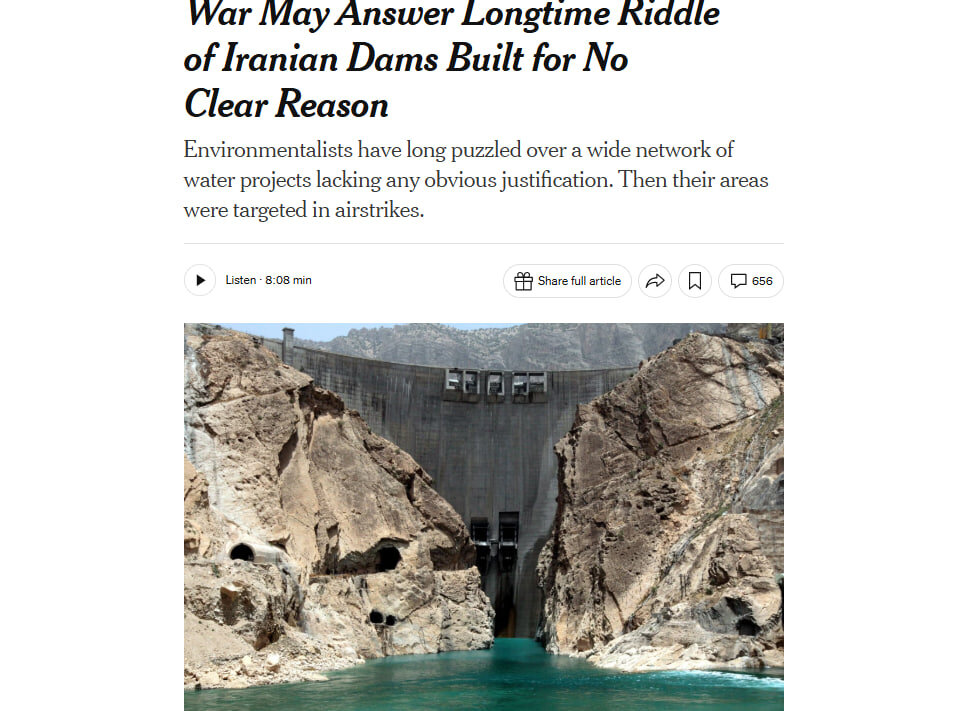
MADRID — A recent article published by The New York Times, which attempts to link Iran’s network of dams and hydraulic infrastructure to its missile program, has provoked considerable outrage in the country, where it is seen as something that could be used to justify future attacks on its water infrastructure if the conflict resumes.
The article cited military analysts and water-resources specialists who speculated that the Islamic Revolution Guard Corps might be using the dams to supply electricity to underground missile facilities.
Sanam Mahoozi, one of the authors and herself Iranian, said on X: “There is no conclusive evidence, but these are questions worth raising.”
The newspaper itself acknowledged that “given the secrecy surrounding Iran’s missile program, any link between it and Iran’s ambitious, decades-long initiative to build water infrastructure remains merely speculative. However, some experts believe the indications point clearly in that direction.”
Kaveh Madani, director of the United Nations University Institute for Water, Environment and Health and a former senior Iranian environmental official, was one of the experts cited in the report and challenged the newspaper’s reasoning. “Speculation is not evidence. Spatial proximity does not imply causation,” he wrote on X, adding: “Not even those who have attacked Iran have made claims of this kind linking dams to missiles! This reductive and sensationalist account is an exercise in irresponsible journalism, with potentially dangerous consequences for civilian water supply infrastructure. The New York Times should know better.”
It bears recalling that deliberately attacking the civilian population or civilian infrastructure, such as schools, hospitals, water supply systems and power plants, is strictly prohibited under international law and constitutes a war crime. But to do so, it is necessary to construct a story in which dams and other civilian infrastructure are part of Iran’s military complex.
The aim of the article is clear: to portray Iran as a gigantic military machine in which everything is tied to the IRGC. In this narrative, Iran is not a normal country but an enormous military base in which the line between civilian and military blurs. That destroying the dams could unleash a chain of humanitarian and environmental catastrophes, including floods, displacement, agricultural losses and disruption of water and energy supplies, is a necessary risk, for which the Islamic Republic itself would, in any case, be responsible for having turned the country into a military base.
The article is a perfect example of the role played by the media, the NYT in particular, in what is known as the manufacturing of consent for war against Iran.
As the association of the Iranian Water Diplomacy noted in a statement, “International media have a responsibility that goes beyond publishing a hypothesis. When dealing with issues with humanitarian and legal consequences of this magnitude, they must clearly distinguish between verified data, circumstantial evidence, expert hypotheses and speculation. They should also consult specialists in hydrology, hydraulic engineering, environmental science, political geography, remote sensing and international law.”
Beyond the technical response, Iranian authorities have also weighed in on the article and its political implications. Foreign Minister Abbas Araghchi called the allegations “garbage” and described it as a pro-Israeli media of promoting narratives reminiscent of those that preceded the US invasion of Iraq in 2003.
For his part, Iranian parliament speaker Mohammed Bagher Qalibaf accused the newspaper of preparing the ground for new attacks on civilian infrastructure and warned that this could trigger an Iranian response. “New rule: any dam, port or power plant located near a US or Israeli base is dual-use. We will apply your logic consistently and impartially,” he posted on X.
This is not the first time the NYT has served to manufacture consent against countries labelled enemies by the US administration of the day.
In the period immediately before the invasion of Iraq, the NYT, like other outlets, among them CNN, repeated the lies about Saddam Hussein’s “weapons of mass destruction”. The parallels run deep: in December 2002, just months before the invasion, CNN went as far as reporting on an intelligence document suggesting that Iraq had a “dirty bomb”.
In September 2002, then NYT journalist Judith Miller co-wrote a report which, citing US officials, claimed that Iraq had stepped up its search for nuclear weapons and that Baghdad was seeking aluminium tubes to enrich uranium.
Then Vice President Dick Cheney cited the newspaper’s coverage of the aluminium tubes to bolster the case of President George W. Bush’s administration against Iraq. Those claims were later discredited.
Publishing an article without conclusive evidence, as one of its own authors admits and as happened in the Iraqi case, yet one that fits the plans of the United States and Israel to attack and destroy Iran’s civilian infrastructure, amounts to manufacturing consent for war crimes.
Disclaimer : This story is auto aggregated by a computer programme and has not been created or edited by DOWNTHENEWS. Publisher: tehrantimes.com