
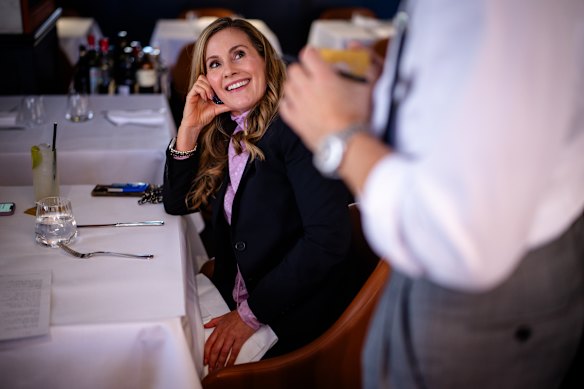

Julie Inman Grant can slay tech dragons, it seems, or at least take the fight to them – that’s why she gets up the nose of e-billionaires like Elon Musk.
It turns out that Inman Grant can also speak Italian, with what sounds to me like an impeccable accent.
I learn this when she orders the pappardelle with braised Wagyu beef cheek from our Italian waiter, as we sit down for lunch at Gowings Bar and Grill in the Sydney CBD.
“I love Italian-inflected English,” she tells the waiter.
It turns out the Italian is a legacy of a stint in Florence, while studying for her Masters in International Communications.
Inman Grant ended up falling in love with a Dutchman and living with him for a while in Holland, before taking a job for a telecommunications consultancy in Brussels.
But we are getting ahead of ourselves.
As I discover over the course of our lunch, the e-Safety Commissioner’s CV is long and contains many interesting turns, but it begins in Seattle, where she was raised by a single mother with a yen for adventure.
“My parents divorced when I was five … I grew up with my mum and my sister and a female dog, very close to the beach, so we would go to the beach after school,” she says.
Like all members of Generation X (Inman Grant is 57), she grew up in the vanished utopia of a phone-free childhood.
Her mother was a free spirit who was not good with money.
“She very much lived hand-to-mouth and she had this fascination with travel,” Inman Grant says.
“Dad would send child support payments, and she would use that for a trip to China.”
But, Inman Grant says, her mother “put herself in precarious situations where people had to bail her out financially”.
“So I think that imbued in me: never be dependent on another person or a partner for your economic self-sufficiency.”
Inman Grant attended Boston University where she studied international relations.
She graduated in 1990 and moved to Washington, DC, the following year, and landed a job with John Miller, a “Rockefeller” Republican Congressman from her home state (Washington state).
A company called Microsoft was head-quartered in his congressional district, and he asked Inman Grant to take on technology along with her social policy portfolio.
“So it’s 1991, and here I am working at the intersection of policy, technology and social justice before there was an internet,” she says.
Later, in 1995 (after her Italian stint, the Dutch boyfriend and the career misfire in Brussels) she was recruited by Microsoft to open their government relations office.
It was the cusp of the internet age, and all the technology companies were jostling to ensure a benevolent regulatory environment.
As a lobbyist for Microsoft, Inman Grant was involved in shaping section 230 of the Communications Decency Act, passed in 1996, which shields social media companies from civil liability for content posted by third parties.
“So it’s kind of a weird circular thing, like, for my sins, for shaping this thing, I’m now trying to fight to make these companies safer and take responsibility and focus on safety by design,” she says.
I ask her if she thinks it was wrong to draft the legislation that way.
“I think it was right for the time,” she says.
“I joined the technology industry … when it was really about empowerment and the internet was going to connect us all. It was very, very optimistic and so this was really about preventing it from being over-regulated and stopped in its tracks.”
Her early career gave Inman Grant ample opportunity to study tech CEOs up close.
Once, when Bill Gates was speaking at the National Press Club in 2013, he turned up so unsuitably dressed that an emergency intervention occurred, and one of the company’s lawyers took off his own suit and gave it to Gates to wear.
On another occasion, a security guard wouldn’t let Gates into the White House because the tech genius had forgotten his wallet, which included his photo ID.
“I’ve met a lot of tech CEOs in my time, and they’re a particular type of individual,” Inman Grant says.
This type of individual generally has disdain “for anyone who is different, who’s not as smart as they are, who has a different kind of intelligence”, she says.
“It’s rough and tumble,” she adds. “We used to get trained on precision questioning – how do you say things as quickly as possible?”
Later, when working at Twitter, she worked with co-founder Jack Dorsey.
“He wasn’t a yeller, he was going on his silent retreats and dating supermodels and he didn’t use a PC,” she says.
“He fasted all day, so you had to bring snacks when you accompanied him to meetings for the day.”
In 2000 Microsoft posted her to Australia where she met her husband, human resources specialist Nick Grant.
Her disillusionment with the company began in 2009, when she moved back to corporate headquarters in Redmond, Washington State, to become the global head of privacy and safety.
“We had just acquired Skype. I started looking at some of its usage patterns in the developing world, and it was a vector for livestream child sexual abuse material,” she tells me.
Her concerns were dismissed, she says.
“I got the eye roll … I kind of got to this point where I thought, ‘You know what? I’m never going to win against the engineers,” she says. “I’m never going to win against the revenue guys’.”
Around the time she grew disillusioned with Microsoft, she fell pregnant with twins. She also had a five-year-old daughter, Zoe.
When her Australian husband was offered a job back home, she quit Microsoft and they decided to move back to Sydney, which they did in 2012.
Then Inman Grant experienced the perilous loss of status – social and financial – that often happens to women who give up their jobs to focus on family.
Filling out a rental application for a family home in Sydney, “I was like, ‘I don’t have a job’,” she tells me.
“I mean, I’ve got my own savings, but I have no power in this relationship. It was kind of a weird realisation.”
In 2014 she was recruited by Twitter (now X), which, at that time, had a great brand.
“It was a great leveller, it was about speaking truth to power, and I was so inspired by that,” she says.
But after a couple of years at Twitter she became dismayed that when it came to safety, “we were putting the burden on the user rather than the platform responsible”.
After a brief stint at Adobe, she applied for the e-Safety Commissioner role and was appointed in 2016, by Malcolm Turnbull’s government.
In 2021, she became responsible for enforcing the world-first Online Safety Act.
A hideous part of working in digital regulation is you have to peer deep into the sewers of the internet, and Inman Grant has had exposure to plenty of “explicit and obscene” sexual content.
“These are not things you can talk to your partner about,” says Inman Grant.
“You learn a certain compartmentalisation.”
Inman Grant says that the result of seeing this material, often involving children and babies, is “when I see people who are on the civil libertarian side, saying, you know, ‘You’re creating surveillance systems’, I really want to say, ‘I would love to invite you into our offices’.”
Which brings us neatly to Elon Musk, the world’s richest man.
He publicly attacked Inman Grant after she issued notices to X (formerly Twitter), the social media platform Musk owns, to take down graphic footage of the church stabbing of Bishop Mar Mari Emmanuel in Walkley in 2024.
He called Inman Grant a “censorship commissar” and an “unelected bureaucrat”.
Within 24 hours of the first taunt, she was the subject of 75,000 posts, the vast majority of them toxic, against her and her children.
She had credible death and rape threats against her (they continue today), she was doxxed, with her family members’ names made public.
She says she can’t walk directly into her work building any more, and the elevators of the office are locked because strangers have tried to walk in off the street.
The police are pursuing criminal charges on her behalf against one individual.
“I get called e-Karen, e-slut, left-wing Barbie, feminazi,” she says.
“A lot of it is about how ugly I am, how fat I am, how old I am, how old I look. It’s all gender-based, sexualised and that’s how online abuse works.”
It seems time to ask her about the implementation of the Albanese government’s social media ban (she prefers to call it “the delay”), which is supposed to prevent under-16s from accessing social media sites like TikTok, Snapchat and Instagram.
I ask Inman Grant if it has been a success.
“It depends what your expectations were,” she says.
I ask what her expectations were, and she says something surprising.
“I don’t know if you know this, but I was not really keen on it when it was first discussed,” she says of the ban (or delay).
“I thought, this is a very blunt force approach, and what I said is … if we’re going to make these platforms safer, we have to take a holistic approach.
“What you’re effectively asking us to do with this is fence the ocean. We might be able to create some friction and some degree of safety but it’s a futile exercise if you think you’re totally stemming the ocean.”
She says the legislation for the ban was developed “very quickly”.
“It was very thin scaffolding. I don’t have potent powers.”
Did you want greater powers? I ask.
“Well if you’re going to take on the biggest technology companies in the world … it’s not like you’re sticking a pink parking ticket on a windshield,” she responds.
“What I would say is a regulator is only as good as the tools and the resources that they’re given.”
It’s time for coffee so we summon our Italian waiter.
I order a skim piccolo, and I learn the Italian word for skim milk (latte scremato), although the very notion of skim milk seems offensive to Italian cuisine.
Inman Grant says the latest data they have on the efficacy of the ban – a 37 per cent reduction in under-16 year olds holding accounts, in the first four months – is “pretty good”.
Her next great concern for online safety is kids using AI chatbot companions. She says AI companies are “more clever” than social media companies.
“I think they’ve watched what the social media companies have done,” she says.
Inman Grant’s phone has been buzzing, as if to remind us of its centrality to this entire conversation. Now mine starts buzzing too.
It is Inman Grant’s EA, trying to tell me to tell Julie that she needed to leave some 15 minutes ago.
She is running late for her next appointment, with the Age Discrimination Commissioner – she is speaking on his podcast about digital fraud on the elderly.
We split the bill – Inman Grant can’t accept any gifts, and her expenses and diary are often the subject of Freedom of Information requests from libertarian lobby groups.
She will stand down from the Commissioner role when her second term ends on January 17.
From our partners
Disclaimer : This story is auto aggregated by a computer programme and has not been created or edited by DOWNTHENEWS. Publisher: www.smh.com.au


