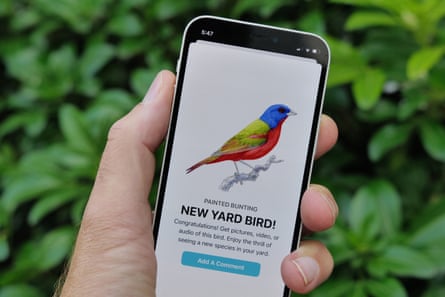
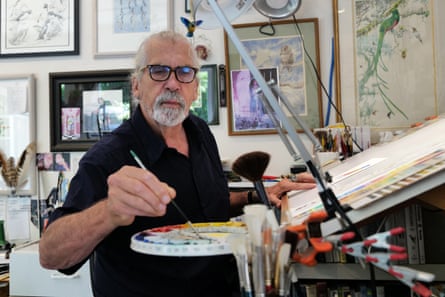
On a brilliantly bright afternoon in his gallery and studio in Bolinas, a small town on the northern California coast, Keith Hansen was putting the finishing touches on a watercolor of an almost improbably flamboyant painted bunting.
With an ultra-fine sable brush, he made a few intricate additions to the cobalt blue plumage on the bunting’s head, and, satisfied with his work, slipped the watercolor into a stout binder that every few days welcomes a new addition.
“That was number 420,” he said. Or to put it another way, just 584 to go.
Hansen, a renowned ornithological illustrator and author, has a monumental task – a hand-painted compendium of every one of the roughly 1,000 bird species ever recorded from the US and Canada, including those found in waters up to 200 miles from shore, Hawaiian birds not included. When finished, it will complete the visual backbone of an app called Flock, whose mission, compared with that of most apps, is quietly subversive.
For rather than seeking to monopolize and monetize its users’ attention, it deftly employs elements of computer gaming and social networking to draw people outward, into the world of birding, with the broader aim of cultivating a community of conservationists.
Flock was conceived and created by two of Hansen’s friends, Adam Donkin and Bob Stevenson. Both have impressive tech industry CVs. Donkin, 52, who lives not far from Hansen in Marin county’s San Geronimo valley, worked for many years as a product and user experience designer. As a lead product designer at Amazon, he led the charge on design for several models of the Kindle e-reader.
Stevenson, a 58-year-old Scotsman, lives in St Helena in the Napa valley. He founded his first company in Edinburgh at 18, and at 24, moved to California to work as an art director for Richard Branson’s Virgin Games, embarking on a decades-long career as an art or design director, or as a producer, for more than 50 video games.
Despite their disparate disciplines, the three friends are united by a shared passion for birds and birding.
Hansen fell in love with the avian world in sixth grade, when, on a walk in the Maryland woods, his brother, Rob, drew his attention to a cedar waxwing. “It’s just an exquisite bird,” Hansen recalled. He began illustrating birds during his senior year of high school, and in 1986 – after a decade and a half observing and studying birds on numerous expeditions – he settled in Bolinas, opening his gallery there in 1991.
Donkin grew up on the San Francisco peninsula and began birding at the age of four under the wing of his father’s friend Rich Stallcup, an esteemed ornithologist and birder, and a founder of the Point Reyes Bird Observatory. “He was like a nature wizard,” said Donkin. “Birds and animals would appear when you were in the field with him. He knew every bird by call and by sight.”
Donkin moved to Marin in 2012. “When I moved to Marin,” he said, “Rich introduced me to the thriving birding community here, including Keith.”
That same year, Stevenson was looking for a designer for his new company. “One of our investors recommended that we chat with this designer, Adam,” said Stevenson. “It was meant to be a quick call, but we ended up talking for over an hour. We became friends on the first call.”
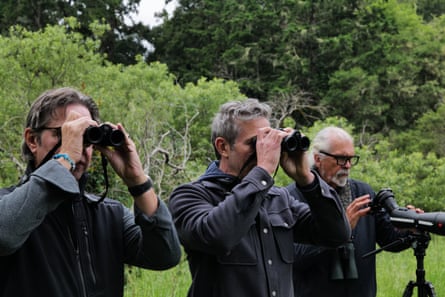
In 2016, Donkin visited Stevenson at his home in the southern Marin town of Tiburon, overlooking Richardson Bay, a major habitat for migrating waterbirds. “One day Adam came round to the house,” Stevenson recalled. “I didn’t know that he was an avid birder. He turned up and said, ‘Hey, dude, you’ve got to bird! Do you have binoculars?’”
Stevenson, who had recently stepped away from his company to focus on his family, fell hard and fast for birding. He bought binoculars, scopes and cameras, began birding from his deck, and, as an outlet for his avian photography, opened his own gallery in Tiburon.
He was also struck by the ways in which birding resembled multi-player gaming, in that it involved learning new skills, a mastery curve, collecting (by way of so-called yard lists and life lists – tabulations of the bird species sighted in one’s yard, or over a lifetime), an awareness of how one is progressing relative to others, and a community which, while competitive, helps its members learn more quickly. He also recognized, at the age of 48, what he had given up by trading the beauty of the natural world for computer screens. “It was such a revelation, because going back to nature at that age, you realize what you’ve been missing.”
Shortly after, he and Donkin began discussing the idea of building an app around birding. For Donkin, his friend’s newfound passion was a catalyst. “I had the experience with Bob of turning someone on to it, and seeing what a huge impact it had on him.”
For Stevenson, the spark was a conversation with Robert Snow, the president of the Fresno Audubon Society, who said the organization was concerned about its ability to bring future generations into birding, as this was critical to perpetuating its mission of protecting birds and their habitats.
To Donkin, the path from birding to conservation is a natural progression. “Birding creates an infinite well of curiosity,” he said. “You start to notice things and think, ‘Well, how can I help?’ You might start with providing water, providing food, providing shelter. By restoring habitat in your area, you can have an impact. It could be your yard, a park in your neighborhood, sometimes ranch land, sometimes public land.”
Initially Stevenson and Donkin thought they might develop an app in partnership with Audubon, or with the Cornell Lab of Ornithology in Ithaca, New York, where they had given a presentation on the parallels between birding and gaming, with an eye towards how aspects of game design could be employed to increase engagement with the Cornell Lab’s Merlin app, which identifies birds based on their songs and calls, or images.
They ultimately decided to strike out on their own and, in 2017, set to work on Flock. Having worked on projects backed by publishers and by investors in Silicon Valley, Stevenson said they decided to fund it themselves “so we would not be bound by anyone’s rules”. They also set out to break the addictive conventions of app design. “The games industry is so comfortable making experiences that are so engaging that you can’t look away,” said Donkin, “and we were very aware of the negative aspects of social media.”
“We didn’t want to make something that got you addicted to the dopamine hit of getting a like, or followers,” Donkin continued. “We wanted to make something that was a companion to the experience of birding. In an attention-based economy, we’re going to use that same system, but we’re going to flip it. We’re not trying to get your attention on the app, we’re trying to get your attention away from your phone so that you can then turn your attention outward.”

The result is an app whose interface is refreshingly spare and minimalistic, with a tab where users can search for birds or for other users; another for recording sightings, made, perhaps with the aid of the Merlin app or an old-fashioned field guide; a leaderboard which ranks users according to the number of unique species they saw in the current month; and a community tab where users can upload photos, message one another, and congratulate other users on their sightings.
As with every detail of the app, even the way in which users cheer one another on was carefully considered. Instead of a “like” button, there is a “high-five” button. “We put ‘high five’ rather than ‘like’,” Stevenson explained, “because kids were using it, and we wanted it to be, ‘Nice job on seeing that bird!’ rather than, ‘I like you.’ We didn’t want kids to collect likes.”
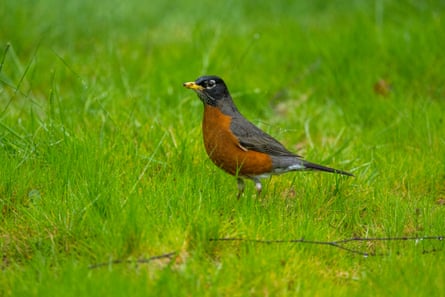
They enlisted their longtime friend Hansen, whose artistic sensitivity brought a unique beauty to the app. While Stevenson coded, Donkin scanned and processed new batches of illustrations as Hansen completed them, following an algorithm that sorted the bird species in order from the most- to the least-commonly seen. Given that it can take Hansen up to four days to complete an illustration, this prioritized the birds Flock users are more likely to encounter: an American robin or a northern cardinal, for instance, rather than a Steller’s sea eagle, a huge Siberian raptor, one of which, acting on some unknown impulse in 2020, flew from northern Asia to Alaska and then Texas, before settling on the coast of Maine.
In early 2025, they released Flock on Apple’s app store. By April of that year, Flock had about 100 users. Today, although Donkin and Stevenson have not yet done anything in the way of marketing, it has on the order of 1,000. Among the recent enhancements they enjoy are uncannily realistic animations that bring Hansen’s illustrations to life. The short animations – which Stevenson created with AI, with Hansen’s guidance – give a sense of the way each particular bird moves. The formerly static white-crowned sparrow now darts its head this way and that in a most sparrow-like fashion, peering inquisitively at its viewer; the great blue heron, meanwhile, tiptoes along a sandy bank, and pausing, stealthily lowers its bill to the water’s surface, preparing to strike.
Among Flock’s growing flock is Amy Tan, the bestselling writer whose most recent work, The Backyard Bird Chronicles, grew from a series of pencil sketches, color portraits and journal notes she collected on her avian neighbors during the pandemic. A friend of Hansen’s for 10 years, and more recently of Stevenson’s, Tan logged her first sightings in the app late last summer. In an email, Tan wrote that Flock was “hands down the most beautiful bird app and the easiest one to track and share sightings of my backyard birds. With each bird I add to my daily list, I feel rewarded when its illustration suddenly comes to life. All my friends are blown away and become instant fans.”
This reporter, meanwhile, who entered his first sighting – a western gull – in Flock last spring, has found himself growing ever more attuned to the sights, sounds and habits of his feathered compatriots in San Francisco, and has recently begun shopping for a hummingbird feeder.
Disclaimer : This story is auto aggregated by a computer programme and has not been created or edited by DOWNTHENEWS. Publisher: theguardian.com