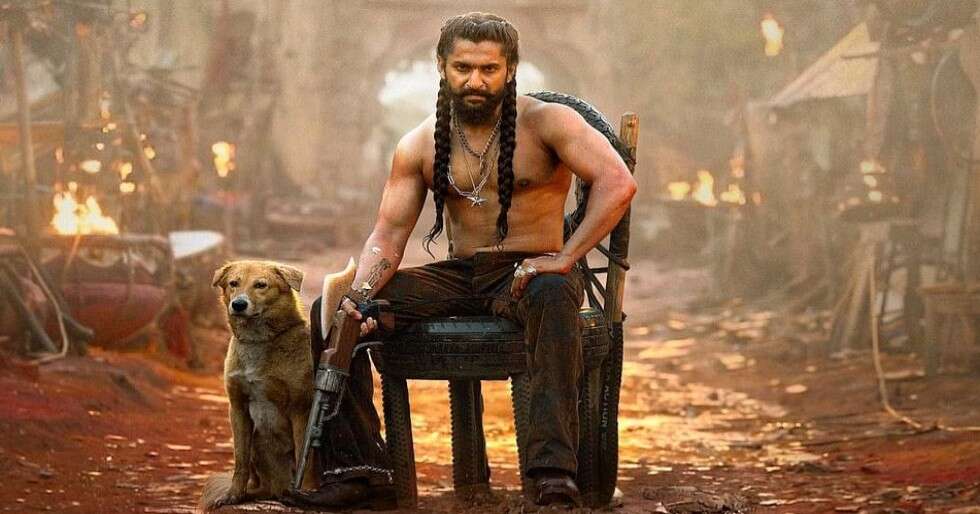
Quick Take: The Paradise is a violent and mass drama that hardly finds emotional weight
Larger-than-life cinema sometimes requires an anchoring of solid logic and story beats. Nani’s new film, The Paradise sets its sights on ambitious scale and thundering drama, but in its march towards grand ambition, the film sometimes loses focus of the basics. There’s plenty of entertainment here, but the soul, that’s been a trademark of the best Nani movies, is a bit scarce.
The story is set in the mid-1980s. After fourteen years behind bars, Jadal (Nani) walks free. His mother Sammakka (Sonali Kulkarni) and the rest of their Savari community have remained stateless. Their fate is the handiwork of the tyrannical landowner Shikanja Malik (Mohan Babu) and his son Vikram (Raghav Juyal). Denied papers, recognition and even the right to exist on paper, the tribe has become a population the state simply refuses to see. Pushed to the edge and burning to reclaim what was taken from his people, Jadal rallies the forgotten and the cast-aside into an uprising that will drench the region’s power structure in blood.
The Paradise has its share of larger-than-life moments, with ruthless and mindless action driving much of the film. The elaborate sentimentality surrounding the mother’s character is partly familiar, but it is also sincere. The climax, thankfully, is not just about relentless violence; it is also about what his mother means to Jadal. For once, Telugu audiences will see a mother character apologising to her son.
Childhood trauma has had a lasting effect on Jadal, and its suffocating influence on his personality is narrated with conviction in places. The Savari tribe, which is at the centre of the narrative, is casteless and extremely alienated. Its members are absent from official records, and their solidarity is rooted in shared grief.
This is where director Srikanth Odela’s writing should have been novel enough to give the tribe’s fight and its strategies a distinct identity. Instead, he fails miserably at that key aspect. The tribe’s recourse to its faith in a local goddess is an element we have seen before in too many run-of-the-mill stories. The tribesmen’s decades-long fight to be included in state records is eventually peppered with uninspired leaps of faith.
In one scene, a female member of the tribe has the courage to slap a powerful man hard. In the next, she comes across as totally powerless even at the thought level. Such moments expose inconsistencies in the writing. Yet the scale of the violence keeps escalating.
The stakes, too, increase, particularly in the second half. At first, the Savari tribe’s fight is about mere survival. Later, it becomes about defending their newly minted revolutionary zeal. But the beats of the movement are all too familiar and routine. The action is bereft of force, and the violence does not become more potent even after the revolt begins. To an extent, the mother-son emotional factor is also diluted by the repetitive, ‘reaction shot’-level performances of several artists.
The interval block, however, could have been two minutes longer and nobody would have complained; it’s that well-executed. Anirudh Ravichander’s score, though immersive at times, doesn’t always rise to the occasion.
Sonali Kulkarni, who plays Jadal’s misunderstood mother, is decent. However, there is a feeling that Jadal’s unchanging emotional state towards his mother in the first half is unrealistic. Why doesn’t it ever occur to him that she might have been terrorised into doing what she does? There’s very little room for logic in the screenplay of The Paradise.
The involvement of the state – the police, judiciary and political executive – is too basic. The bad guys increasingly become caricatures, muppets who orgasm when a lawyer mouths the names of three IPC sections, and that too belatedly. There is also a cop from North India (even the key villains are from the North) who threatens like he has just walked out from one of director Boyapati Srinu’s mindless mass actioners. Dr Mohan Babu, the Telugu cinema veteran whose character was marketed as extremely fearsome, is way too generic. His inimitable dialogue delivery style is not tapped to its potential here.
Every single male in the film is either belligerent, creepy or itching to be snuffed out of existence by Jadal. Men become horny in the presence of women, before touching them, before killing them. It all feels a little too designed to be menacing.
Nani looks fiery as Jadal, and the role is a complete departure from his earlier films. His efforts are commendable, but the lacklustre writing gives him very little scope to bring out the character’s emotional depth. There is hardly a standout scene where the writing allows him to deliver a memorable emotional performance.
Talking of the villains, Raghav Juyal’s character has the menace right from childhood. He is born on the same day as the protagonist, a coincidence that adds nothing dramatic to his static rivalry with the hero. Kayadu Lohar’s Subbu is motivated to become a soft-porn actress, a choice that was presumably meant to move the audience, but the gaze ends up being voyeuristic instead of empathetic.
The Paradise is a violent and mass drama that hardly finds emotional weight, especially in its mother-son relationship and explosive interval block. The familiar rebellion beats, caricatured villains, uninspired action and plastic production design keep the film from realising its potential.
Also Read: Anupama Parameswaran Shares Quote on Toxic Relationships
Disclaimer : This story is auto aggregated by a computer programme and has not been created or edited by DOWNTHENEWS. Publisher: filmfare.com