
Each year, millions of people around the world tear or sprain their anterior cruciate ligament (ACL). The most common knee injury, it typically happens while people are skiing, playing football, basketball or netball.
For Keiley Mead, it was a pothole that did it.
The 24-year-old was playing Oz Tag at the local football field in Sydney’s Sutherland Shire, when she stepped into a large divert in the grass. She felt a shock of pain and a “pop” as her knee slid in the wrong direction and her leg gave way.
Mead, who was playing elite AFL at the time, had seen many of her teammates tear their ACLs (the injury is up to eight times more common in women). She knew it didn’t have to be a career-ending injury – after surgery, about 65 per cent of people return to their former level – but it did mean surgery and sidelining sport for at least a year.
Mead had already booked her surgery when a friend suggested she speak to sport’s physician and former Sydney Swans doctor, Tom Cross.
“My friend was like, ‘Look, I don’t know if this will help or not, but just go have a chat with this guy’.”
Eight years earlier, Cross had been treating a 19-year-old who had ruptured her ACL while playing netball. The standard treatment was surgery, but the woman pressed Cross for another option, as close friends of hers had ended up with another tear after their operations (between 8 and 30 per cent of people re-rupture following surgery).
Cross’ father Merv, a retired orthopedic knee surgeon, happened to be in the clinic receiving treatment for his own knee injury. Merv overheard the conversation and pulled back the curtain with an idea.
By bending the knee to 90 degrees and immobilising it in a brace, Merv suggested you could bring the torn ends of the ACL closer together allowing them to heal similarly to a bone fracture.
Tom thought it was a bit crazy – no one took the knee past 30 degrees when trying to heal a knee ligament injury – but he trusted Merv, a pioneering knee surgeon with 40 years experience, who was also the director of orthopaedics for the Sydney 2000 Olympics.
The patient thought she had nothing to lose. If it didn’t work, she could still have surgery. So, for four weeks they put her knee in the brace, locked at a right-angle. Over the next two months they incrementally straightened the leg back out, gradually putting more weight on it. Three months after this crazy experiment, MRIs revealed “exuberant healing”.
More than 1450 patients later and a 90 per cent success rate, the cross bracing protocol (CBP) as it came to be known, is becoming a “revolutionary” new approach to treating ACL tears.
Cross explains that when people say they’ve ruptured their ACL, it’s not binary.
“ACLs are injured on a spectrum,” he says. “Some may have less injured ruptured ACLs and some are profoundly injured.”
Some of them will heal on their own without a brace, some need a helping hand of bending the knee and putting the tissue back together, and then some absolutely need a surgeon.
His expert opinion is that up to 40 per cent of people with ACL injuries could be good candidates for CBP, depending on their MRI and an assessment.
“That’s quite a paradigm shift because in Australia, for decades, if people rupture their ACL they immediately think ‘I need a reconstruction’.”
Initial MRIs suggested Mead was a good candidate for CBP.
“The start of the protocol is definitely tough,” she says. “You’re not very mobile with your leg bent at 90 [degrees] all the time, but I got around on crutches or a wheelchair.”
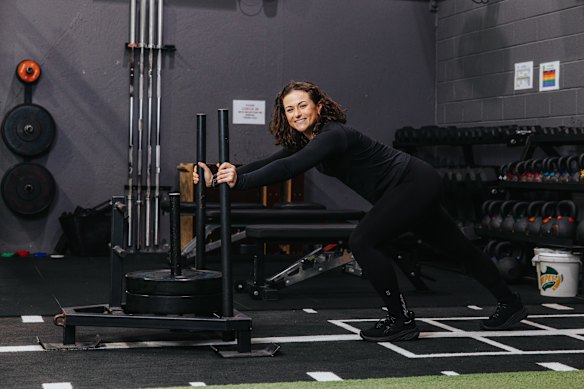
She also kept going to the gym for upper body work and single leg exercises: “I made it work.”
Three months later, scans showed her ACL had reattached, and her leg felt stable to move on. By the nine-month mark, alongside physio rehab, she had passed her return to exercise tests. Within 14 months, she was back playing premier division AFL and made it into the Sydney Swans reserve program.
Four years later, she has switched to triathlons and the trained radiologist has done her PhD exploring how to improve the MRI assessments of ACL injuries to optimise treatment.
Within five years, Cross anticipates it will get to the point where an MRI, combined with a deep learning AI model, will reveal the type of tear type, the propensity to heal, and whether the cross bracing protocol will improve the outcome.
Dr Marc-Olivier Dubé, an adjunct senior research fellow at La Trobe University, says it is a “promising intervention”.
Avoiding surgery removes the risk of adverse events like infection, blood clots, graft-site pain and numbness. It is also significantly more cost-effective.
A new review article, co-written by Dube, notes that about half of everyone who ruptures their ACL develops osteoarthritis within 10 years, regardless of the treatment option. But, notes that up to 50 per cent may avoid surgery altogether through progressive rehabilitation alone while having similar outcomes to those who have had surgery.
As for CBP, he says: “The jury is still out, and we need a lot more evidence.”
Adam Culvenor, head of the Knee Injury Research Group within the La Trobe Sport and Exercise Medicine Research Centre, agrees.
He says that the multiple randomised controlled trials underway around the world will shed important light on whether the cross bracing protocol is more effective than ACL reconstruction surgery or non-surgical care without a brace.
While the research trickles in, Mead says her outcome has been “wonderful”.
“I have had no issues with my knee since,” she says. “It feels stable, it feels good, I am stoked with it.”
Make the most of your health, relationships, fitness and nutrition with our Live Well newsletter. Get it in your inbox every Monday.
 Sarah Berry is a lifestyle and health writer at The Sydney Morning Herald and The Age.Connect via X or email.
From our partners
Disclaimer : This story is auto aggregated by a computer programme and has not been created or edited by DOWNTHENEWS. Publisher: www.smh.com.au