
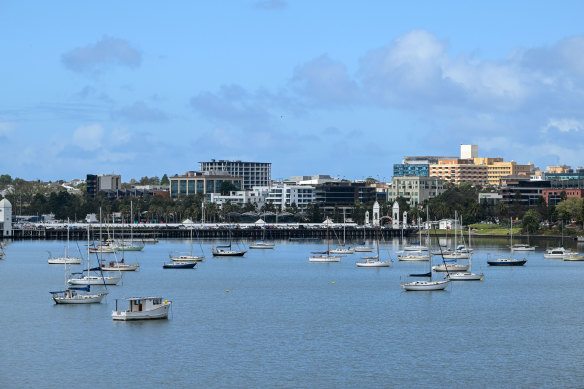

For well over a decade, growth in Geelong has been going gangbusters. The regional city’s outer suburbs have expanded rapidly, eating into previously open green space.
On the glittering waterfront, construction is almost complete on a new convention centre, which attracted more than $450 million in government funding.
There is healthy demand, too, for luxury apartments with bay views. Greater Geelong’s reputation as a destination for fine and casual dining is growing – particularly in its groovy laneways.
But parts of the Geelong CBD are barren and unloved, creating an urban hostility that has become a deterrent to business and people. There are long sections with empty shopfronts.
It’s why local civic and business leaders, with backing from the council, are urging the state government to create a special economic zone, providing tax incentives for developers in the city centre.
Committee for Geelong chief executive Michael Johnston said the city needed greater housing density to help absorb some of the rapid population growth.
“What needs to happen in the next phase is residential development,” he said. “What we’re seeing currently is market conditions are conspiring against that.
“That is the absolute silver bullet in our opinion to get things happening in central Geelong.”
The state government has a target of building more than 128,000 homes in Greater Geelong by 2051. But Johnston said construction in central Geelong was more expensive than Melbourne, making it unviable.
The City of Greater Geelong wants the state government to provide land tax reductions, stamp duty concessions and planning application fee waivers to encourage development.
They are also calling on the federal government to help fund priority projects and provide GST reductions. Geelong Mayor Stretch Kontelj said the council was willing to provide rate rebates on capital improved values and permits for new projects.
Greater Geelong’s population pushed past 295,000 last year, compared to almost 271,000 in 2021. But Kontelj said only about 2000 people lived in Geelong’s CBD, although it could accommodate up to 20,000 in residential buildings up to 20 storeys or even higher.
Kontelj said the CBD was “a little maligned”, but insisted more people living there would make it more attractive.
He cited council figures showing 17 permits have been granted for CBD developments, but said they were not being delivered due to the cost of construction.
Kontelj said major thoroughfares including Moorabool and Ryrie streets should be “magnificent boulevards” with boutique shopping, but instead there were many empty shops.
“On its face, it looks like it’s a crisis, but the reality is, it’s a transition because there are developments that are occurring, particularly in the hospitality area.”
Some of those problematic areas are clustered around Market Square, which has long been stubbornly resistant to redevelopment.
The state government’s Central Geelong Framework, released last year, said both Market Square and the nearby Westfield shopping centre could be transformed with maximum building heights between 42 and 60 metres.
In other central locations with heritage character, the framework suggested maximum building heights between 16 and 28 metres. But crime has been a persistent problem.
Earlier this month, Victoria Police reported an operation targeting retail theft and anti-social behaviour in the city’s centre resulted in 350 arrests in the past year.
Geelong Chamber of Commerce chief executive Jeremy Crawford allows his children to ride their bikes freely around his West Geelong neighbourhood.
“There are a couple of suburbs they can ride around,” he said. “The CBD is not one of them.”
Crawford said low pedestrian traffic and highly publicised instances of crime were among the issues, while vacant sites sitting undeveloped and sluggish presales on residential development were hampering growth.
“Without density and population in the CBD, it’s going to be very difficult for businesses to continue here.”
Crawford wants the state government to follow the lead of NSW and adopt a presale finance guarantee where the state government commits to buying some off-the-plan dwellings from developers so they can secure lenders.
If the developer cannot sell the apartments on the private market, the government has the option of holding and renting them or selling the dwellings.
A spokesman for the state government said it was already providing incentives to support development, including expanded off-the-plan stamp duty concessions for townhouses and apartments and lifting the payroll tax-free threshold.
“We’re making it easier to build more homes in places well-connected to public transport, jobs and services – including Geelong,” he said.
But Geelong-based developer Bill Votsaris, who has transformed the Little Malop Street area, argued inconsistent height limits in the town centre – some as little as five storeys – was a deterrent.
“If you’re developing a five-storey building in the paddocks on farmland, that’s viable, but construction in the inner city is much more expensive.”
He said the federal government would entice more people to regional Victoria by making rental payments on new residential buildings tax-deductible.
“It just means you remove congestion from Melbourne and create demand in regional Victoria.”
 Benjamin Preiss is The Age’s regional editor. He was previously state rounds reporter and has also covered education for The Age.Connect via X or email.
From our partners
Disclaimer : This story is auto aggregated by a computer programme and has not been created or edited by DOWNTHENEWS. Publisher: www.smh.com.au



