The principle of open justice is important to maintaining confidence in our justice system. Justice should not only be done, but be seen to be done.
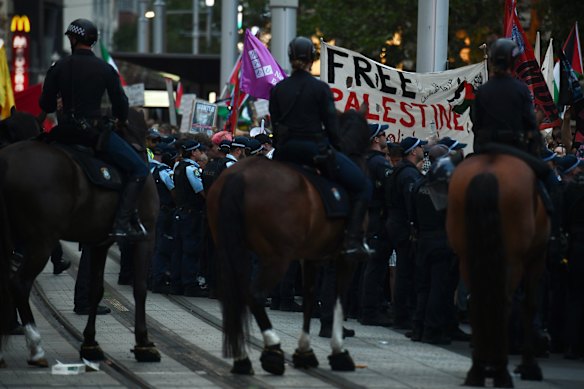
The same principle should be applied to the state’s police watchdog, particularly when it is probing an event as high-profile and politically charged as February’s protest against visiting Israeli president Isaac Herzog.
Instead, the opening address given on Monday will be the only public element of the Law Enforcement Conduct Commission’s inquiry before it embarks on five weeks of private hearings with junior police on the frontline as the February 9 protest descended into chaos.
The LECC is investigating the use of force by NSW Police while dispersing protesters. According to opening submissions from counsel assisting Kirsten Edwards, SC, it will also probe the deployment of capsicum spray on crowds that included elderly people, and the way policing decisions were made and communicated.
Edwards said in her statement that Operation Makalu is not a corruption inquiry, and the commission would work collaboratively with police on any recommendations needed to improve the way they respond to protest events.
“This is not an exercise in retrospective blame for its own sake,” Edwards said.
Senior officers will give public evidence in the weeks to come. However, LECC Chief Commissioner Peter Johnson, SC, has decided that police witnesses up to the rank of inspector would not be identified during proceedings, in part because of his view that conducting the hearing entirely in public could have a negative impact on social cohesion in Sydney.
While there is no doubt social cohesion has been frayed since the Hamas attacks on Israel on October 7, 2023, the Herald believes it is not aided by shielding police from public scrutiny.
There may be reasonable examples of when the LECC should hear evidence in camera, such as if it relates to classified information. However, beyond evidence that could have serious and legitimate national security implications, the hearings should not be behind closed doors.
A record 800-plus complaints were lodged over the way NSW Police handled the anti-Herzog protests. There is significant public interest in the events of February 9 and whether the police handled that difficult event appropriately.
NSW Police today is a vastly different organisation than the one hauled before the Wood royal commission in the mid-1990s, which found systemic and entrenched corruption in parts of the force. That hugely damaging inquiry resulted in the creation of the Police Integrity Commission (PIC), which has since been replaced by the LECC.
Both the PIC and now the LECC have been crucial in ensuring the public, and police, know that the NSW Police Force will never again be above reproach.
Thirty years on from the royal commission, the public must continue to have confidence in its police force. The LECC plays a key role in maintaining that trust. Transparency and fairness, through open hearings, are crucial to this, and the public should have full access to Operation Makalu.
Get a weekly wrap of views that will challenge, champion and inform your own. Sign up for our Opinion newsletter.
 The Herald’s View – Since the Herald was first published in 1831, the editorial team has believed it important to express a considered view on the issues of the day for readers, always putting the public interest first.
From our partners
Disclaimer : This story is auto aggregated by a computer programme and has not been created or edited by DOWNTHENEWS. Publisher: www.smh.com.au