
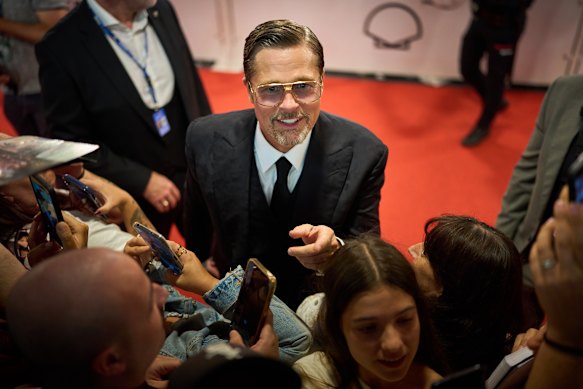

“Spending a day with a dog just makes things a little better, that’s for sure,” says Brad Pitt of his eagerly anticipated story of survival, Heart of the Beast.
Pitt, 62, plays James, a former soldier trapped in the Alaskan wilderness with his best war buddy, a retired combat dog called Odin. Uber the Alsatian, discovered by the production’s dog whisperer in New Zealand, is unquestionably the star of the show; Pitt described working with him as “a moving experience”. At the same time, he said “it wasn’t without its complications”.
He spoke at the film’s festival premiere in San Sebastian on Wednesday. Pitt’s arrival in the Basque town, home of the biggest film festival in the Spanish-speaking world, created a storm of excitement. Diversionary tactics to ease his arrival included booking runway space at three different airports and sending cars to all of them.
When he did eventually get to the Maria Cristina, where all the festival’s stars stay, he met dozens of local fans who had camped there since early that morning. For 20 minutes, he shook hands and smiled widely for selfies, a model of what a Hollywood star should be.
Pitt and the film’s director, David Ayer, were upbeat after the film’s screening to a 1000-strong public audience, ahead of the evening gala. Cinema had recently regained the strength it had in the ’90s, Pitt maintained, crediting the support of streaming services and the gradual return of audiences to theatres.
Ayer chimed in to say that a new generation of filmmakers was emerging from unexpected quarters, such as YouTube, with new ideas of how films could be made.
“What I love about what streaming has brought to us is so many more opportunities for actors, writers, directors,” Pitt said, answering a question about his role as a producer. “And because of that, we have a greater plethora of really interesting stories and really interesting talents, and that’s been amazing. We had a dip in theatrical and we’re seeing that come back. We’re seeing people embrace the communal experience again.”
He said he hoped this would renew support for middle-budget ($50 million to $80 million) films, which are less likely than tentpole blockbusters or small independents to make their money back. “Because that’s where I tend to end up – the middle,” Pitt added.
The mid-budget Heart of the Beast was shot in New Zealand, its forests doubling for Alaska, without the usual Hollywood frills. “We were out in this beautiful location,” said Pitt. “We’re wet, we’re cold, there are no trailers, we’re sitting out on logs, but everyone’s up for the task. And being out there with this beautiful beast was pretty special.”
Army advisers told the crew that they try to make life fun for combat canines, integrating them into the unit family. “So we tried to do the same, rolling up on set at 6am and there would be a dog trainer with Uber, just playing catch. It was such a beautiful sight in the field.”
“The dog had hair and makeup and wardrobe,” added Ayer. “He’s on a truck, with his own tent and his own stuff, so he’s like any other actor. But to be honest, once the dog came on set, the atmosphere would change. People just got happier.” Best of all, apart from chasing possums, Uber never behaved like a diva. Their greatest difficulties came when he behaved like a dog.
“We had a short time to shoot this film,” Pitt said. “The plan of attack David set forth was that rain or shine, we’re going to shoot the scene and that whatever the dog does, we’re going to follow it. We tried to make every day a play day for him – and there were times he did things that were just amazing that were not in the script. Then there were days when bees were buzzing, possums were coming down the hill, and things were just much more interesting in the woods than they were hanging round with his co-stars.”
 Stephanie Bunbury is a film and culture writer for The Age and The Sydney Morning Herald.
From our partners
Disclaimer : This story is auto aggregated by a computer programme and has not been created or edited by DOWNTHENEWS. Publisher: www.smh.com.au



