The clutch of young Roma boys in black bow ties were lined up beneath the ornate arches and royal frescoes of Hungary’s dazzling parliament. Moments after Péter Magyar was sworn in, bringing an end to Viktor Orbán’s 16 years in power, the young musicians launched into the unofficial anthem of Roma in Hungary, leaving many MPs wiping away tears.
It was an extraordinary moment – one that fused the nationwide hope for change with the longstanding aspirations of the country’s most marginalised community. Roma rights campaigners have seized the moment, calling on the new government to ensure that the symbolism of last weekendtranslates into real change.
As Hungary – which is home to one of the continent’s largest proportions of Roma, at about 8% – begins the post-Orbán era, many across Europe are watching closely.
There are encouraging signs, say observers. The new parliament includes a record number of Roma MPs: four in Magyar’s Tisza party and one with the rightwing nationalist opposition, Fidesz. Roma artists featured prominently during the daylong inauguration.
“Never before have Roma been such an integral part of a nation at a state or national event as they were at the ceremonial opening of the new parliament,” wrote Stephan Müller, an adviser on international affairs with the Central Council of German Sinti and Roma. “This gives cause for hope that it will not remain merely a matter of symbols, but that real change will indeed take place.”
A recent letter to Magyar, drafted by about 50 Roma professionals from various sectors in Hungary, urged the government to acknowledge the longstanding discrimination against Roma, take action to protect their rights, and ensure they have equal access to opportunities.
“We told them that the regime change can only be successful if they do it hand in hand with the Roma,” said Aladár Horváth, one of Hungary’s most prominent Romany rights campaigners and an architect of the letter.
During the past 16 years, as Orbán and Fidesz sought to conjure fears of an imagined “other”, their targets often included Roma.
“It was a situation of social Darwinism,” said Horváth, a former Liberal politician who in 1990, after the collapse of communism, became the country’s first Romany MP. “A fascist-like social and economic situation prevailed. And Roma were the ones who suffered the most as a result.”
Roma advocacy organisations were dismantled, state protections for the community were eroded, and the laws protecting them were trampled upon. A case in point was Romaversitas, founded by Horváth in 1996, which helps Romany youth acquire vocational skills and post-secondary schooling.
During Orbán’s time in power, the Roma-led group was classified as a threat to national sovereignty, leaving it wrestling with bureaucratic hurdles and contemplating whether it had a future in Hungary, said Ildikó Török, the organisation’s managing director.
“We were unable to secure funding domestically,” she said. “We worked under constant intimidation; it destroyed our mental health.”
Fidesz’s approach to Hungary’s 800,000-strong Roma population was often top-down, said Krisztián Kőszegi, a Roma Tisza MP who – in a first for the community – has become one of the deputy speakers of the national assembly.
Tisza would work to change this approach, he said. “We want to work in collaboration and address the issues facing Roma in every sector, from social policy to healthcare to education, housing and the justice system,” he added. “We are civilians, teachers and healthcare workers who lived the previous system and saw its shortcomings.”
Poignant hints of what could lie ahead were laced through Saturday’s inauguration as Kőszegi and another Roma MP took their oaths in Romany languages and the Roma singer Ibolya Oláh sang Magyarorszag, the patriotic song she had stopped performing years earlier in protest against attacks directed at her by Fidesz supporters and the extreme right.
But it was the Sükösd Roma Child Choir, with a performance of Zöld az erdő, known to many as the unofficial anthem of Roma in Hungary, who stole the show and epitomised the widespread hope that things could be different.
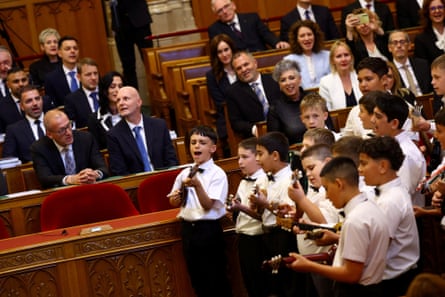
Magyar had met the choir during a visit in November to their village of 3,000 people, a two-hour drive south of Budapest. After one of the young musicians told Magyar that he hoped to visit parliament one day, the leader promised an invitation if Tisza won the election.
After Tisza’s landslide victory, the promise became an invitation to perform. As the country tuned into Saturday’s inauguration, and tens of thousands of people followed along outside parliament, the performance marked a bright spot in what has long been a fraught relationship between Roma and the Hungarian state.
It also, however, laid bare lingering discrimination: the six MPs from the extreme right Our Homeland party walked out of parliament just as the choir began.
Magyar later described the walkout as an “utterly unacceptable act” but the extreme-right party – which has been linked to a vigilante group accused of anti-Roma violence – insisted they had done so in protest at the decision to play the EU anthem in parliament.
For decades, civil society groups have flagged issues with deep discrimination, particularly around the segregation of Roma in schools. In 2024, as the EU announced an investigation into the matter, a spokesperson noted that Roma children were “disproportionately overrepresented” in schools for children with disabilities.
The consequences were wide-reaching and long-lasting, as Đorđe Jovanović, of the European Roma Rights Centre, has pointed out, saying the segregation “denies them the opportunities to succeed and traps yet another generation in deprivation and poverty”.
Anger over the issue has long simmered in the Roma community. But the political tipping point seemingly came earlier this year, when a senior Fidesz politician took aim at Roma when explaining why he did not see migration as a solution to the country’s labour shortage.
János Lázár cited Roma people, using a racist slur to refer to them, saying “someone has to clean the bathrooms on the inter-city trains”.
Roma responded with political force in the election, said Mensur Haliti, the vice-president of the Roma Foundation for Europe. “Roma in Hungary punished those who used them and exploited them, while offering a change to those who are seemingly new,” he said.
After the election, an analysis carried out by the Roma for Democracy Foundation looked at voting patterns in areas with significant Roma populations and found that Roma votes had appeared to play a role in flipping multiple seats from Fidesz to Tisza.
“They gave a chance to Magyar,” said Haliti. ”But this was not because they believe he will carry out miracles. They are very cautious.” How Magyar and his Tisza government respond, he said, “will set a precedent for the treatment of Roma minorities across Europe”.
This view was echoed by Müller, of the Central Council of German Sinti and Roma. “The real work, beyond the symbols and speeches, begins now, and it is a herculean task,” he said. “But I have hope, like almost everyone in Hungary, that things will get better.”
He added: “One first step that I really liked is that a group of Roma children managed to get fascists to leave the parliament. Keep it up.”
Disclaimer : This story is auto aggregated by a computer programme and has not been created or edited by DOWNTHENEWS. Publisher: theguardian.com