
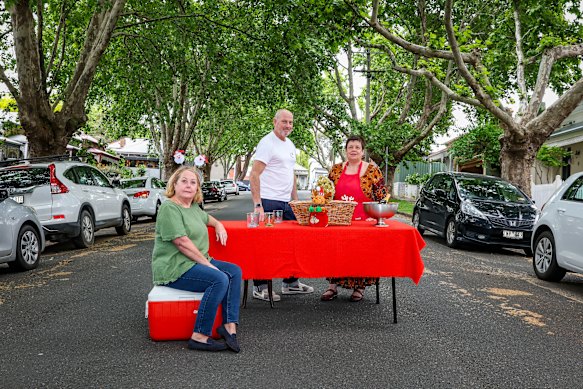

For 26 years, David and Lou Howie have celebrated Christmas with neighbours at a party on their tree-lined street in Flemington.
The couple love that the casual catch-up attracts such a diverse range of residents – along with extended family members and children who have since grown up and moved out.
“It’s the social event of the year. Everyone pretty much comes … there’s generally way too much food because everyone brings a plate,” David Howie said.
In the past, the City of Moonee Valley helped with the event, assisting residents by providing a road closure kit and reimbursing the cost of a public liability insurance premium.
But that support has been eroding. Last year, there were delays in securing reimbursement. And although residents previously picked up the road closure barriers, the council determined that they needed to be delivered for an extra fee.
This year, when David Howie applied for a party permit in late October, the council requested comprehensive event details, a traffic management plan and the hiring of an accredited traffic management company.
Howie described the changes as overreach.
“What problem is [the council] trying to solve? There’s never been an issue with traffic; pedestrians still have access … It’s just a bit of bureaucracy,” he said.
Howie is still working through the extra council requirements and is unsure of the final cost.
In the Moonee Valley local government area and beyond, red tape and convoluted event permits sought by Melbourne’s councils are preventing communities from organising small-scale street parties, popular around Halloween and Christmas.
This has left many wondering whether councils are providing appropriate support for the much-loved events, which act as an important source of local connection.
Of Melbourne’s 31 metropolitan councils, nine have dedicated street party permit programs. Banyule, Kingston, Maribyrnong and Merri-bek provide them free, while the rest charge between $100 and $210.
Other urban councils provide varying levels of support for community gatherings, generally through wider event permit schemes, which are also designed to cater for large-scale commercial events.
In June, the City of Darebin discontinued its free street party program for the 2026-27 financial year following budget discussions. But last week councillors voted to reverse this decision and allocated $10,000 towards funding community street party permits.
“Street parties are where neighbours become friends, kids play together and communities come alive. They’re a simple but powerful way to build connection, belonging and local pride,” Mayor Emily Dimitriadis said while introducing the motion.
A Darebin council spokesperson said the funding would pay for gatherings held between mid-December and mid-January.
“The decision follows feedback from local residents advocating for the return of council support for small-scale street events,” he said.
“The one-off funding will help reduce administrative and financial hurdles for residents seeking to organise neighbourhood events over the summer holiday period.”
In the City of Merri-bek in Melbourne’s inner north, there are already free “play streets and street parties” programs.
The two concepts follow the same application process – but play streets tend to be smaller and street parties tend to take place annually, often near Christmas.
Mayor Nat Abboud said the programs were some of her favourite council initiatives.
“It just really taps into that whole social cohesion piece,” Abboud said. “It helps to foster tighter communities and safer places for everybody who’s getting out on the street.”
An online toolkit provides instructions on staging an event, which can be held on council-owned roads for up to 100 attendees. At least 75 per cent of households must approve of the gathering.
Seven successful events had been held so far this year, Abboud said.
“They’re little events, and led by community but supported by us. And I just think that’s where council’s at its best.”
In Moonee Valley, some street parties have been forced to change the way they operate to ensure they can continue despite the increasingly complex and opaque event permit system.
Strathmore resident Matthew Galea said his local annual Halloween street party was a chance for children to go trick-or-treating and for parents to socialise. It was a drawcard for his family when they moved to the neighbourhood three years ago.
But council changes meant residents had planned on funding their own public liability insurance and traffic management to ensure the event could go ahead as scheduled.
A Moonee Valley council website post from August 27 said its street party temporary road closure program was under review to ensure “appropriate safety, traffic management and risk controls are in place”. Applications would be considered case by case and not all would be supported, it said.
The Age approached the council for comment.
Galea said he wasn’t surprised about extra bureaucracy that had been introduced by the council, calling it “typical of the processes they have in place”.
“[Halloween] is just a really good local event. We’ve never had an issue. It’s good to see so many local kids … come and experience it,” he said.
Start the day with a summary of the day’s most important and interesting stories, analysis and insights. Sign up for our Morning Edition newsletter.
 Gemma Grant is a city reporter at The Age. Contact her securely on Signal @gemmagrant.88Connect via email.
From our partners
Disclaimer : This story is auto aggregated by a computer programme and has not been created or edited by DOWNTHENEWS. Publisher: www.smh.com.au



