For years, golfers have been taught to shift their weight onto their lead foot at impact. With irons and most other shots, that advice still holds true. However, when we study how better players swing the driver, we see a noticeably different pattern — one that often contradicts traditional instruction and can be confusing when viewed on standard video.
The driver is a unique club. It is the only club in the bag that should launch the ball higher than its stated loft. While most clubs launch the ball significantly lower than their loft, a driver with approximately 10 degrees of loft will often launch the ball between 11 and 16 degrees. A 7-iron, by comparison, may have around 32 degrees of loft but typically launches closer to 16-22 degrees.
Because the driver is teed up rather than struck off the ground, the impact conditions required for optimal performance are fundamentally different. Simply moving the ball forward in your stance is rarely enough to create these conditions. Skilled players instinctively make additional adjustments to optimize launch, spin and speed. One of the most important involves pressure movement during the downswing.
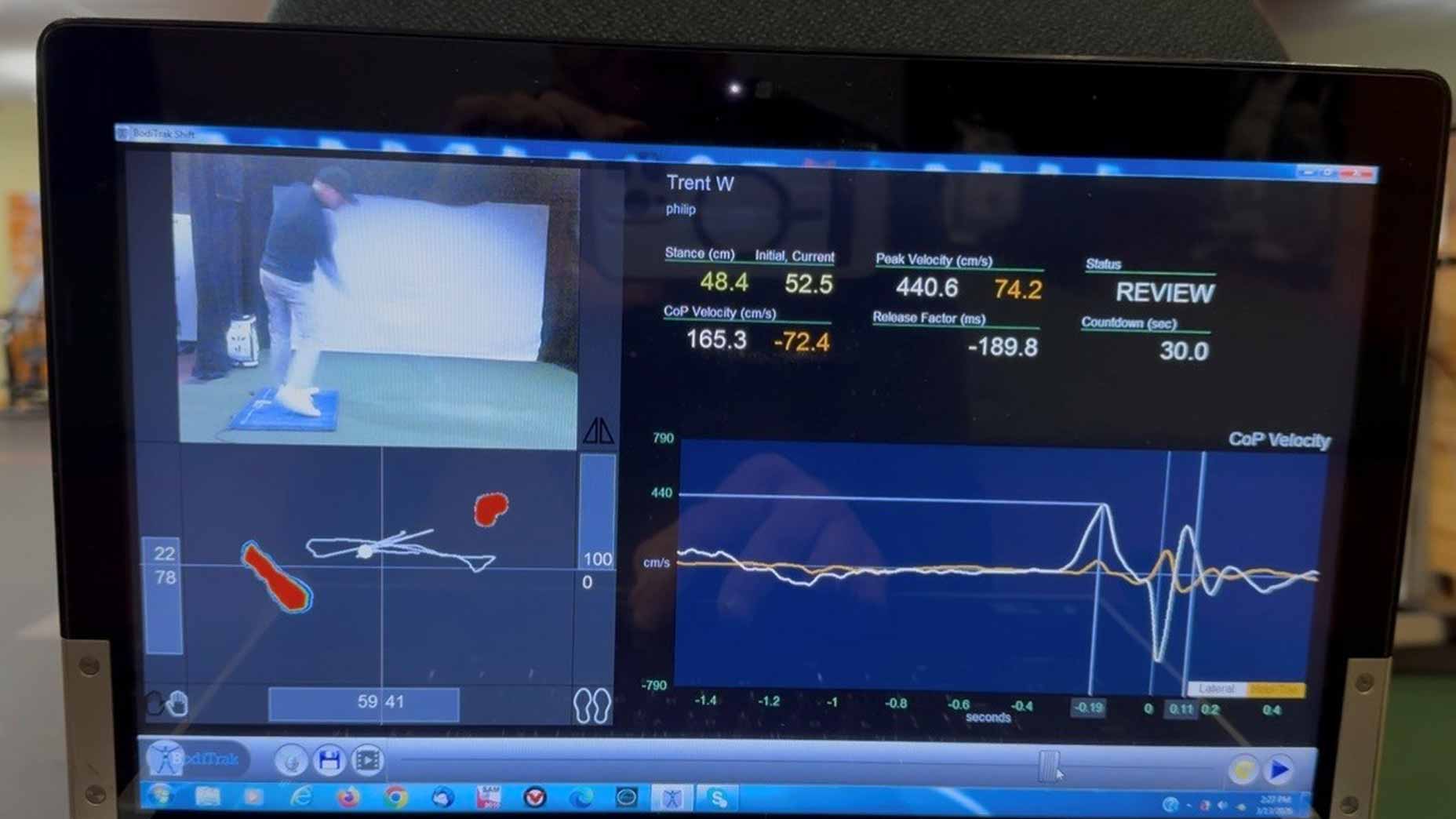
Force-plate data has shown that many high-level players initially shift pressure toward the lead foot early in the downswing, followed quickly by a move back toward the trail foot well before impact.
In the example below, the player shifts approximately 80 percent of their pressure to the lead side before moving 75 percent back toward the trail side — all before the club shaft reaches parallel to the ground on the downswing. At impact, the player is approximately 60/40 toward the lead side. Only well into the follow-through does pressure fully transfer to the lead side as the player completes the swing.
Trent Wearner
This pattern is often misinterpreted on two-dimensional video. When golfers see the trail heel lifting at impact, they assume the player has 80-90 percent of their pressure on the lead foot. In reality, a significant amount of pressure can still be present under the trail foot, particularly beneath the big toe, even when the heel is off the ground.
This pressure shift plays a major role in generating clubhead speed. As pressure moves back toward the trail side, the club effectively releases into the ball like a slingshot.
The motion also encourages an upward angle of attack, which is critical for optimizing launch and spin. When combined with a properly fitted driver, this upward strike can produce higher launch, lower spin and an improved smash factor — all key ingredients for maximizing distance.
Notice the difference in the photos at the top of the story. In the first image, showing the golfer at impact with a 7-iron, the entire lead leg and left hip are positioned against the vertical reference line, while the head has remained relatively still. With the driver, however, only the lead shin and perhaps the knee are against the line. The hip is three to five inches away from it, and the spine is tilted significantly farther away from vertical compared to the iron swing. As a result, the head has moved back from its original position.
It’s important to note that even though the trail heel is off the ground in the driver swing, a significant amount of pressure remains in the trail toes, helping support the player’s body throughout impact.
Stance width also supports this motion. Most players widen their stance by approximately three to six inches when moving from a 7-iron to a driver. This added width helps manage pressure shifts and allows the body to remain behind the ball at impact.
Launch monitor data consistently reinforces these principles. Comparing a driver struck with a five-degree downward angle of attack to one struck with a five-degree upward angle of attack can reveal a distance difference of 20 to 30 yards. That alone highlights why understanding pressure movement and angle of attack is so valuable.
Learning how to set up properly, manage your body movements and pressure, and embrace the unique demands of the driver can lead to significant improvements in your driving performance.
<figure class="youtube-facade" data-content="
“>
Disclaimer : This story is auto aggregated by a computer programme and has not been created or edited by DOWNTHENEWS. Publisher: golf.com