
Many of Patricia Piccinini’s artworks are long-term residents of the Uncanny Valley, the term coined by Japanese roboticist Masahiro Mori for the phenomenon of humanoid objects that look almost – but not quite – real, triggering unease or revulsion.
For the past two decades, Piccinini has created at once beautiful and disquieting sculptures, rendered in silicone and real hair, which at first glance appear lifelike. It quickly becomes clear that there’s something about them not entirely anchored in realism; there’s a push and pull between affection and repulsion.
But while they ultimately look purely fantastical, Piccinini’s works exploring the boundaries between the artificial and the natural are almost always rooted in real-life science and futuristic biotechnology.
Her first such silicone work was 2002’s Still Life With Stem Cells, a sculpture of a girl playing with strange, faceless creatures that challenge the viewer’s perception of what is real and what is artificial, or perhaps genetically modified. These blob-like creatures don’t look like animals, but the girl is cuddling one, and seemingly protective of the others.
Piccinini has had an interest in medical science since her teenage years, when her mother was diagnosed with cancer, and biotechnology and medical futurism has informed much of her work. Still Life With Stem Cells was created at a time when the technology was at a turning point. Research was well under way, but it was before the human genome project was completed. At the time, Piccinini described the piece as “a possible answer” to where that biotechological research was heading.
A quarter of a century later, stem-cell technology has advanced considerably, yet still feels almost from the realm of science fiction.
Which is why the acclaimed artist has revisited her original concept in a new commission for Science Gallery Melbourne’s EMERGENCE(Y) exhibition, showcasing artworks responding to a world shaped by climate crisis, and asking how humans and non-humans might need to adapt to survive.
As part of her artist residency with Science Gallery for the past year, Piccinini has spent time in the reNEW Melbourne labs at the Murdoch Children’s Research Institute, where she was able to witness stem cells growing in incubators and under the microscope, meeting the scientists working at the forefront of the technology.
Seeing the work being done there, she says when we meet at her inner-Melbourne studio, “was almost like science fiction”. She met teams all working on different organs, “and different kinds of ways of influencing the stem cells to create liver cells, heart cells, all kinds of incredible things,” she says. “It was just extraordinary.”
She describes learning about work being done with sheets of cells that can be wrapped around failing organs; clusters of cells that can help failing kidneys; the institute’s research using “organoids”, miniature, three-dimensional tissue cultures grown from stem cells; and research into using stem cells to create new hearts for children.
“Seeing it first-hand was an incredibly mind-blowing experience, these people all working very altruistically to help people, in a very positive, hopeful environment,” Piccinini says. “It was so inspiring, and I thought, how am I going to represent this shift in technology – and what this technology is for? How am I going to represent the beauty of this?”
Her thoughts went back to her 2002 work.
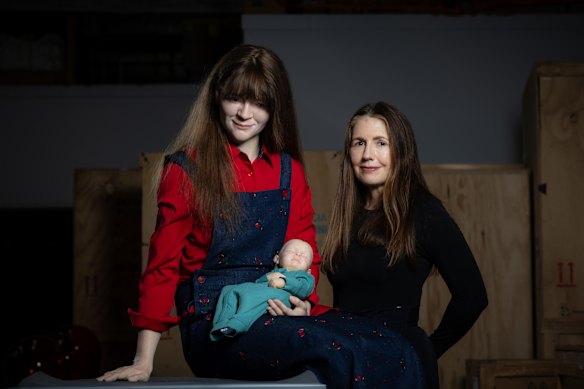
Celulas Madre (Spanish for “mother cell”, which is the same term as stem cell), reimagines her young girl from the original artwork as an adult who has had her own baby, and is living with an amorphous structure inspired by contemporary stem-cell research. The figure, dressed in an almost-identical ensemble (hand-sewn by Piccinini) to the girl in the first work, is holding her newborn baby, and in an oversized Petri dish nearby, there are some amorphous beings, presumably being nurtured.
“We have the cycle of life – that’s what this technology is for; it’s for families,” says Piccinini. “So here we have the girl from the original work grown up, and she’s next to a Petri dish and looking at this sort of … form. We don’t know what it is, we haven’t seen it before. It’s kind of like a plant … I wanted to think about how to represent an organoid that doesn’t look like anything.”
The form in the Petri dish looks almost like a kind of fungus, and is an echo of the way in which scientists cultivate cells. “The thing that I found about these scientists is that they are like farmers,” says Piccinini. “They cultivate cells; they bring them together, they nourish them, put them in their environment and … nurture them every day. They swirl them around, they’ve changed their nutrient, add the right liquids to keep them to grow and multiply and healthy.”
The blob-like forms in the work’s giant Petri dish are, she says, symbolic, a stylised expression of what we might actually grow one day.
“It’s different to my first work, which is very bodily – it’s a bit more simplified. You can’t see a spine inside or anything like that. It’s something that’s organically grown, and also it fits into evolution because we all evolved on this planet from the same stuff.”
Tilly Boleyn, head of curatorial at Science Gallery Melbourne, says EMERGENCE(Y) is about adaptation. “We’re looking at the incredible evolutions that we’ve done on being able to adapt ourselves in this time of rapid change.”
The climate crisis isn’t the only part of the changing world that the show’s artists are responding to, Boleyn says, but also human evolution, and how we interact with each other. “Right from the cellular to the interplanetary,” she says. “From stem cells to Mars and looking at [things] like, how do we adapt farming in a rapidly changing world? How do we cut out the food miles? How do we cut out refrigeration and storage and instead do urban farming.”
One work even imagines how we might adapt our fashion. Australian designer and academic Alia Parker has created (non) Combustible Clothing, a collection of fire-retardant garments from a blend of cotton textile waste and mycelium, the vegetative component of fungi.
“Alia has worked for many years on mycelium fabrics – mushrooms which have died, and aren’t sporing any more,” says Boleyn. “The substrate that they make is fire retardant. So her proposition was, with all these fires coming from bushland into the urban environment, we’re going to need different clothing because there’s going to be all these spot fires that we’re putting out. And so that clothing should come from mycelium, from sustainable hydrophobic material.”
German artist Marco Barotti’s work Coral Sound Resilience is an acoustic art and science project around acoustic ecology which explores how recorded soundscapes of healthy coral reefs can be embedded as sound sculptured in damaged reefs to help them regenerate. The sounds of a healthy reef attract marine life to start repopulating dying reef ecosystems.
Other installations include a vertical farm demonstrating sustainable food systems, which will grow fresh produce on-site; a video installation by Dr Wang Zhigang, a professor of information art and design at Tsinghua University in Beijing; a video installation built from e-waste that imagines a post-apocalyptic electronic wasteland where humans, animals and intelligent machine lifeforms coexist among the ruins of obsolete technology; and a work by US artist David Bowen, in collaboration with the NASA Jet Propulsion Laboratory, using live wind data collected from the Perseverance Mars rover.
While the works in the show speak to adaptation in a time of global panic, each also offers optimism for the future. “We’re not shying away from the challenging, scary topics,” says Boleyn, “but also there is so much capacity in us as a species of innovating and of changing the course of action”.
As Piccinini says of her updated woman and the “beings” in her Petri dish, it’s currently something abstracted, but “we have to imagine what it could be”. “Not right now, but one day probably, hopefully, we can have these kinds of abstracted growth forms,” she says. “And that’s something we can feel very optimistic about.”
EMERGENCE[Y] is at Science Gallery Melbourne in Parkville, June 6 to December 5. melbourne.sciencegallery.com
From our partners
Disclaimer : This story is auto aggregated by a computer programme and has not been created or edited by DOWNTHENEWS. Publisher: www.smh.com.au