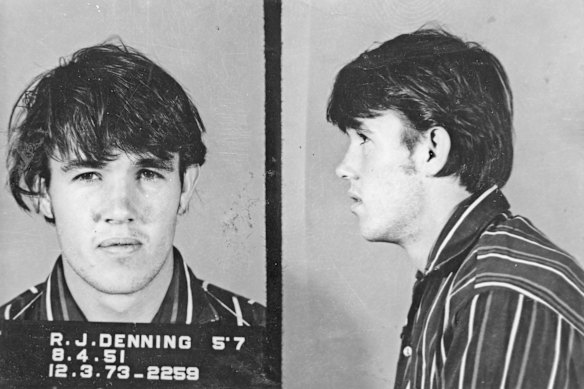

No one really knows why cult criminal and notorious escapee Raymond John Denning turned police informer, and no one really knows if that decision cost him his life.
For years the gunman was a counter-culture hero, blowing the whistle on the secret and brutal world behind bars.
There were good reasons Denning became a bad man. His dad, Jack “The Hat”, was a thief who physically abused his wife. When he was about to be released from prison to terrorise her, she chose escape by suicide. Ray found her. He was 10 years old.
At 13, he was living on the street and by 18 was an armed robber.
A headline act in NSW, Denning decided to try his luck in Melbourne after escaping from Goulburn Prison on July 15, 1988.
Through a network of sympathisers, he contacted the notorious armed robber Russell Cox, who was on the run since escaping from Sydney’s Katingal jail in 1977.
Cox was born in Queensland and did most of his jail time in NSW, but to understand his criminal journey, you must understand his connections to Melbourne’s criminal royalty.
Master armed robber Ray Chuck and Cox were close – they married sisters – and when Chuck was planning Melbourne’s 1976 Victoria Club Great Bookie Robbery he wanted Cox on the team.
Cox tried to escape from his NSW prison to join Chuck, but failed in his attempt. When he did escape the following year, he eventually teamed up with one of the Great Bookie robbers, Ian Revell Carroll, only to later kill him in a shootout. (A Melbourne magistrate dismissed murder charges against Cox, ruling it was not clear who shot first.)
A week after his escape from Goulburn, Denning met Cox at Doncaster. Cox tried to book his mate into a local motel, saying the escapee couldn’t stay at his safe house because he was looking after a wounded associate.
Denning could not have known that the associate was Santo Mercuri, who had been shot in the hand a few days earlier by wounded security guard Dominik Hefti when Cox’s team raided an Armaguard crew at Brunswick. Hefti would die from bullet wounds.
The murder of Hefti sparked a deadly domino effect culminating in the October 12, 1988 ambush murders of Steven Tynan and Damian Eyre in Walsh Street, South Yarra.
What we now know is that a rats’ nest of criminals connected with Cox deliberately laid a false trail to blame another armed robber, Graeme Jensen, for the Hefti murder.
Two major underworld figures who hated Jensen and liked Cox deliberately blamed the wrong man.
When police tried to arrest the innocent Jensen in Narre Warren on October 11, 1988 – 38 years ago this month – he attempted to flee and was shot dead. The Walsh Street ambush 13 hours later was a payback by Jensen’s gang.
We would never have known this if Cox and Denning had not been arrested at what was then Doncaster Shoppingtown casing another Armaguard job.
When armed robbery detectives searched the crooks’ two cars they found gloves, binoculars, beanies, three sawn-off semi-automatic rifles, shotgun cartridges, maps, bullets, a revolver, hair dye and a manual for a hand-held police scanner. They also found Denning’s prison library card. Fines for late book returns were the least of his problems.
In December 1988, Cox and Denning were chatting in prison. Denning said Cox was laughing and “gloating” that Jensen was blamed for the robbery and Hefti’s murder. He apparently didn’t care that two young cops were killed in the fallout.
Two months later, Denning said he wanted to talk to armed robbery detectives.
And talk he did.
“Russell Cox told me that this murder and armed robbery committed on Dominik Hefti had been done so by himself with Sam Mercuri and a person named Mark Moran,” Denning told police.
“In December 1988, Russell told me that he had set up the Armaguard job on Hefti at Brunswick and that he, with Sam and Mark, had been watching the premises for a couple of weeks before the robbery.
“He said that this was the same way as the job he had done with Laurie Prendergast on the security guards at Myer in Melbourne.” Prendergast was one of the Great Bookie Robbers.
Denning’s confessions highlighted not only Cox’s crimes but the underworld world of betrayal.
Russell Cox’s best friend had been Ray Chuck. Standover brothers Les and Brian Kane wanted a piece of Chuck’s Bookie Robbery money. It would later be alleged that in 1978 Chuck, Prendergast and another Bookie robber, Vinnie Mikkelsen, murdered Les Kane in his Wantirna home. The three were charged and acquitted of murder.
Brian Kane threatened to cut the head off one of them and deposit it on defence barrister Colin Lovitt’s front door mat.
In November 1979, Chuck was shot dead in the Melbourne Magistrates’ Court, where he was facing a hearing over an armed robbery charge.
In 1982, Brian Kane was gunned down in the Quarry Hotel in Brunswick by two gunmen once believed to be Cox and serial hitman Rod Collins.
Collins was also close to Chuck.
Mark Moran’s brother, Jason, married Les Kane’s daughter, and days after Brian Kane’s murder, placed a death notice to “Uncle Brian”, signed by “Your little mate, Jason Moran”.
Yet, Mark Moran was committing stick-ups with the man who allegedly killed his sister-in-law’s uncle. And Cox was happy to work with the family who had killed his best friend.
Denning was telling police information that had come from Cox that was true. Years later, DNA would prove Mercuri killed the security guard Hefti, with X-rays showing the bullet damage.
Denning told police: “Deane (Helen Deane, Cox’s partner and a nursing aid) bandaged Sam’s hand. Russell also told me that later on Sam’s hand was still in a bad way and that Russell said that he would kidnap a doctor to fix the hand. Mark then said that it wasn’t a good idea and Russell was dirty on him for saying that.”
The wounded Mercuri carjacked a woman’s vehicle to escape from the Brunswick armed robbery and Denning told police that Cox, Mark Moran and Mercuri were planning to find her.
“It was decided amongst the three of them that they would try and find her home address because she was the only one that Sam believed had identified him. They still had the car keys to the car and on them was a key tag with the registration number,” Denning told police.
Denning said Mark Moran was to approach his stepfather, Lewis, who had a contact at the Motor Registration Branch to provide the owner of the carjacked vehicle but not to say it was on behalf of Cox.
When police found Cox’s Doncaster safe house, there was a page of the phone directory with the woman’s home address. She was moved into witness protection.
Then there was a fascinating line in Denning’s statement that didn’t go anywhere – until now.
Cox “told me that they also had a hole already dug for a bloke that they were going to knock by the name of Rod. He told me that this Rod was pinched with Peter Lawless over a bank robbery.”
That was Rod Collins. So why did “they” allegedly want to kill Collins?
Perhaps Collins was a secret police source who had deliberately fed them the false story that Jensen killed Hefti to protect his mate Cox.
And perhaps “they” had worked out that if he was close enough to police for them to believe his false story, then he was a danger if he passed on real information. This masthead is not suggesting Cox planned to kill Collins, who had many enemies in the underworld.
We will never know how many people Collins killed, but he was acquitted of the murder of a man he shot at a party, and convicted after a cold case investigation into the 1987 murders of Ramon Abbey and his wife Dorothy.
Collins suspected Ramon was a police informer. In a similar crime, Collins was charged over the 2004 murders of Terence and Christine Hodson in their Kew home.
This time he took the contract to kill in order to silence Hodson, who was preparing to testify against allegedly corrupt police.
Homicide detective Sol Solomon visited Collins in prison to try to get him to talk. One day, Collins volunteered one of the names of the men who shot dead Brian Kane. He claimed it was Russell Cox.
(The case was reopened and in 2010, detectives questioned Cox for three hours before releasing him. Cox was never charged nor convicted over Kane’s death. Kane’s murder remains one of the Melbourne underworld’s great unsolved cases.)
Collins was a manipulative rat and proven liar who liked to play games with police, once telling Solomon, “I hold all the aces.”
Serving time for the Abbey murders, he was moved from maximum security to mainstream prison only to be bashed. The initial word was this was because he was suspected of being an informer. Turns out it was because he used another inmate’s toothbrush, which was a breach of both prison etiquette and dental hygiene.
Becoming an underworld informer is a dangerous path, one Denning was unable to navigate successfully. In the crime world, a snitch is known as a dog. When he testified in NSW, a man in the gallery threw a bone towards him and yelled: “You forgot your lunch, Denning – here it is.”
But it was the Melbourne underworld Denning feared.
Days before he was to testify against Cox for a series of armed robberies, he was found dead of a drug overdose.
Mercuri was convicted of murdering Hefti and died in jail. Collins died in jail. Lewis, Mark and Jason Moran were shot dead in Melbourne’s underworld war. Prendergast went missing, and his body was never found. Cox did his jail time for other crimes and slipped into quiet retirement with his partner Helen Deane.
John Silvester lifts the lid on Australia’s criminal underworld. Subscribers can sign up to receive his Naked City newsletter every Thursday.
From our partners
Disclaimer : This story is auto aggregated by a computer programme and has not been created or edited by DOWNTHENEWS. Publisher: www.smh.com.au