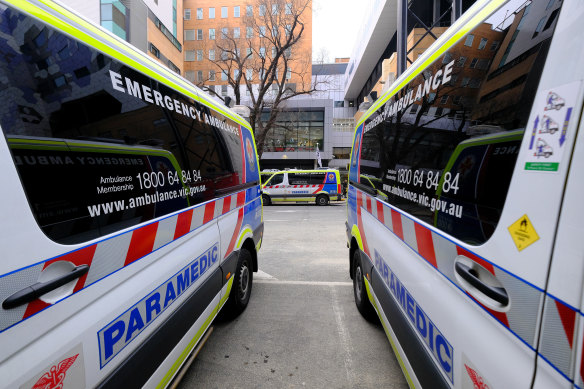
Victorian public hospitals are using secret “not welcome lists” to ban aggressive patients in a move paramedics argue is putting them and patients at risk as they are turned away from emergency departments.
Despite Ambulance Victoria making repeated requests for access to the lists so it can better protect paramedics, streamline care and ensure patient safety, the state’s health department has refused to hand them over.
The measure means unwitting paramedics are unloading violent or aggressive patients at hospital emergency departments for care, only to be turned away. The paramedics must then load the patient back into their ambulance and take them elsewhere.
The only exception to the policy for banned patients is if the circumstances are deemed immediately life-threatening – but even then, when the patient is no longer in imminent danger they are transferred to another facility.
In some circumstances paramedics have attended multiple hospitals before they could hand over increasingly unwell patients. In regional areas patients have been driven up to an hour away to find medical care, with paramedics forced to spend long periods confined with a person deemed too dangerous for treatment by hospital staff.
Five sources in the hospital and ambulance sectors, speaking anonymously to protect their employment, have confirmed the increased use of exclusion notices – commonly referred to as “not welcome lists” – at hospitals despite their existence not being widely known or publicly acknowledged.
The hospital ban lists are kept so secret that paramedics and dispatchers are not allowed to know the details, meaning there are no red flags about possible security concerns relating to those they are called to treat, nor where the paramedics can take them for treatment to minimise the time confined in an ambulance.
Following a string of dangerous incidents, Ambulance Victoria made official complaints to Victoria’s Department of Health in 2025 and again this year, however there has not been any action.
The incidents included:
- A patient on banned lists at multiple hospitals who assaulted a paramedic while they tried to find the patient treatment.
- A woman turned away from Eastern Health after calling paramedics about an unrelenting headache, who was eventually treated by Monash Health and found to have a legitimate medical concern.
- A paramedic who reported being turned away 15 to 20 times from the same metropolitan hospital over the past three years.
One of the confidential ban orders, issued to a patient by a regional hospital and seen by The Age, states the person has been banned for a year for threatening and racially vilifying staff, and police will be called if the person presents to the hospital and refuses to leave immediately.
The next closest 24 hour emergency department for that person is a 45-minute drive away.
“[Name removed] Hospital has now decided that you are to be excluded from treatment. You will not receive care from [name removed] Hospital for the next 12 months,” the notice reads.
“You will not be able to receive treatment on any premises, other than the emergency department and only for immediate lifesaving care, for example cardiac arrest, respiratory arrest or exsanguination [extreme blood loss]. Your condition will be stabilised and you will be sent to another hospital.”
Hospital chief executives can legally ban a person from their premises under a patient management plan after repeated behavioural issues, though they cannot override access to lifesaving care.
However, the “not welcome lists” are kept secret by hospitals, and staff are only alerted when a banned patient’s file is opened on an internal computer system which then issues a warning that they are not to be treated.
Michael Georgiou, Ambulance Victoria’s executive director of regional and clinical operations, said the organisation was working with hospitals to develop “solutions” for better patient outcomes while maintaining the safety of paramedics.
“Occupational violence remains a significant issue and concern for all health services, including Ambulance Victoria, and we continue to work together across the health system to ensure the safety of our patients and our people,” Georgiou said.
Victorian Ambulance Union secretary Danny Hill commended hospitals for taking measures to protect staff and stamp out violence, but said paramedics also needed to have access to records of dangerous patients, and where they could be taken.
“Some of them must have quite an extensive list,” Hill said. “It means our members are loading [patients] completely none the wiser and go to hospital only to find out once they arrive.
“There have been assaults of our members where you have a person they [hospitals] know is dangerous and that information is not passed on to ambos, and ambos have been assaulted.
“We are hearing of genuine assaults that have occurred that would have been preventable, had information been shared.
“Everyone else gets a warning that these patients might be a problem. If hospitals are unwilling to take them because they’re dangerous, why the hell shouldn’t paramedics at least have an awareness?”
If ambulance dispatchers were provided with the same information as hospital staff and police, Hill said, paramedics could be guided to call for support, or minimise the risk of having to load and unload increasingly frustrated patients multiple times.
Pierce Tyson, a spokesman from the Ambulance Managers and Professionals Association, said the “not welcome” lists should be shared with paramedics.
“Although Ambulance Victoria have internal systems, they do not directly match hospitals’ exclusion lists,” Tyson said.
“If paramedics don’t know that a not welcome notice applies, they have to reload to another hospital. That increases the risk for everyone involved.
“Not welcome notices protect staff at one hospital, but then transfer the risk to paramedics and staff at other hospitals.”
Revelations of the secret not welcome lists come after a rise in attacks on paramedics has forced the state government to review laws that were supposed to make jail mandatory for people who assault emergency services workers.
However, as revealed by The Age in February, loopholes in the laws mean they have failed to protect paramedics due to the definition of when they are considered “on duty”.
In February, a man had charges of assaulting paramedics were withdrawn despite allegedly hospitalising a female paramedic as she was not treating a patient when she was attacked.
Last month, a man was charged with attempted murder after allegedly stabbing a paramedic in the face and neck outside a Melbourne cafe, where the paramedic had stopped to buy a coffee.
Crime Statistics Victoria data shows there were 2430 assaults against emergency services or other authorised officers in 2025. Since 2016, there have been 20,412 recorded assaults against emergency workers, though nobody has yet been convicted under the special emergency worker assault laws following an attack on a paramedic.
The ambulance union has since been lobbying the Victorian government to close the loophole.
After inquiries from The Age, a spokesperson for the Allan government spokesperson said it was working with health services, Ambulance Victoria and the union to find new ways to keep the workforce safe.
“Everybody has a right to feel safe at work – we are actively looking at how this data can be shared with Ambulance Victoria,” the spokesperson said.
A Department of Health spokesperson said there was no excuse for aggression towards healthcare workers.
“Our health services have a zero tolerance approach to violence, harassment and abuse,” the department spokesperson said.
“Patients with life-threatening conditions will always receive care when and where they need it. In some circumstances, a patient with a non-life-threatening condition may be redirected to another service better equipped to manage their needs safely.
“It’s our expectation that health services ensure these arrangements are applied consistently and that care is safe, coordinated and appropriate across the system.”
Start the day with a summary of the day’s most important and interesting stories, analysis and insights. Sign up for our Morning Edition newsletter.
From our partners
Disclaimer : This story is auto aggregated by a computer programme and has not been created or edited by DOWNTHENEWS. Publisher: www.smh.com.au