
Jeremy Wilson
Seven hours after achieving sporting immortality, a door was closed behind Sabastian Sawe at his hotel on Edgware Road, and he could finally reflect with his inner circle on what he had achieved.
“Remember what happened when you arrived here on Wednesday,” said one. “You took the shoes out of the bag and said, ‘On Sunday, these will make history’.”
Sawe nodded. “I did, we came to win, but fortunately, we got a world record,” he said, smiling at this reminder, in a rare moment of outward swagger.
The only other time that Sawe grins so broadly during our interview is when the subject turns to growing up in the Kenyan village of Cheukta.
The son of a maize farmer, Sawe was brought up by his grandmother Esther at a home 2000 metres above sea level. The house had mud walls and no electricity, and Sawe would run daily to primary school where his talent flourished once he overcame a timidity which sometimes made him hide to avoid races. “At school was the first time I realised that I wanted to run,” he says.
“When I go home, they always ask about my training and preparation. I haven’t shared with them my ambition to run a world record because, in our culture, we don’t talk about such things in advance. Only when they happen.”
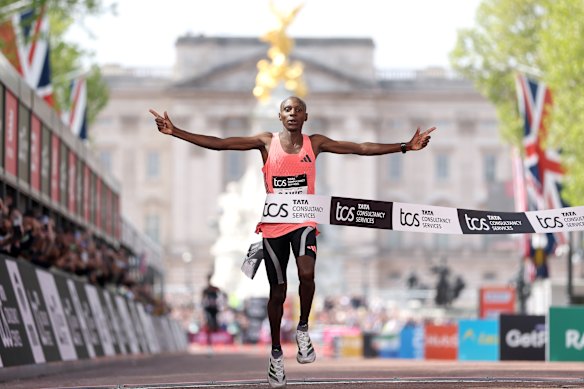
And what happened was so much more than a world record. On the streets of London, Sawe became the first person to race the iconic 26.2-mile (42.2-kilometre) marathon distance in under two hours.
Here is how he did it.
Spartan training camp
Sawe might have just completed one of the great feats of human endurance, but you would hardly have known. Nicknamed “the Silent Assassin”, he was still walking on Sunday night with a spring in his step before quietly outlining the simplicity of the training camp he now shares with 30 other runners in Kapsabet, a town in Kenya’s Rift Valley.
Despite being able to afford a more lavish and individual set-up, Sawe still shares a room with bunk beds with another marathon runner called Sila Kiptoo and they all muck in with the same everyday tasks and communal living.
“It works well,” says Sawe. “In each month preparing for this race, I have one or two weekends with my family.” He is married to Lydia. “And we have three boys,” he says proudly.
Sawe’s running mentor, Claudio Berardelli, also joined us for the interview, and he then explains how the environment – and the surrounding hills and dirt tracks – are ideal for the repeatable routines that are the foundation for any great runner.
“It is, for me, a little paradise in the middle of nature,” explains Berardelli. “If a visitor comes into our camp, you might meet roughly 20 athletes at any time, and you might not know which one is Sabastian. They are physically similar, eat together in the canteen, and have a sitting room to relax with darts, pool and a TV. We have a gym, and a nice physio area. They have to feel at home but, at the same time, it is a place they can rest without feeling the need to leave and be distracted.”
The runners are typically all up by 6am. They then head out for their first run before the sun rises. That can be anything between 10 and 25 kilometres. They will then shower, eat breakfast, have some physio or head for the gym before lunch, an afternoon nap and then their second run. That is generally a more specific workout with some form of hills or intervals before returning around 5pm, drinking tea together, a communal dinner and then lights out by around 9pm.
“That’s it, seven days a week,” says Berardelli, with Sawe running between 200km and 245km each week during the final months of his London preparation. And what was his pre-race routine? “I woke up at 5am – then organised all my kit for myself,” says Sawe, who, after a 6am breakfast of two slices of bread, honey and tea, then boarded the London Marathon bus that took the elite athletes to the Blackheath start. “Then we changed, four kilometres warm-up, and then we started,” he says. “I was feeling good, I was well-prepared. Even though the race was so fast I felt so good and strong.” Did it hurt? “Of course.”
It all sounds incredibly simple, but Sawe is also the first to underline the importance of innovation and science in his success.
The featherlight carbon shoe
Many of the Kenyan greats have gone from barefoot running to the apex of shoe technology with sportswear giants like Adidas and Nike. Sawe was wearing a pair of 97-gram carbon-reinforced “super shoes” on Sunday – the third version of Adidas’s now multiple world record-breaking Pro Evo range – and they are already secretly testing a fourth iteration that they expect to be even quicker.
“Next season, I think faster than today is possible,” says Sawe, who first believed that he could break Kelvin Kiptum’s record after winning last year’s London Marathon. “I then tried in Berlin to run a world record; we were ready, but the weather was not so good for the world record [the heat was 25 degrees Celsius in the second half of the race]. But, that day, I had that imagination to try to run a world record.”
The wider planning for something so spectacular actually started around two years ago when Berardelli began mapping Sawe’s step-up to marathon following his victory in the 2023 world half-marathon championship. The first Pro Evo shoe was also about to be launched, with word soon sweeping the athletes that this was genuinely a bit different.
“They probably thought: ‘Huh, another racing shoe’,” said Charlotte Heidmann, Adidas’s senior product manager, who had arrived in Kenya with a prototype in her backpack. “But I said: ‘Wait until you feel it’. I handed over the shoe to Benson Kipruto and he was the first tester. He couldn’t believe his eyes – he said, ‘but is there something missing?’. He did 25 kilometres the next day and then ran away with the shoe, hid it in his room, and didn’t want to give it back.”
“There was a lot of data to build on, and we thought there was something special,” says Patrick Nava, general manager of Adidas running.
“Sabastian’s input was at the heart of the development. We launched the new shoe on Wednesday, and we expected Sabastian to do well. But this was beyond our dreams. It is not a finishing point. It’s a milestone in the journey to see how fast humanity can get.”
For Adidas, whose team spend a significant amount of time in Kenya with the runners, the goal is to merge practical feedback with the possibilities that have been conceived by scientists at their base in Herzogenaurach, Germany.
This latest shoe, which was also worn by second-placed Yomif Kejelcha as well as the women’s race winner Tigst Assefa, has a different carbon plate to the previous iteration. The special Lightstrike Pro Evo foam, which measures 39mm at the heel, is made from a still undisclosed compound.
Sawe says that the new shoe is “very light and stable” and he had no hesitation in switching, judging it to be a significant upgrade on the Pro Evo 2s he had worn while winning in London and Berlin last year. “It’s much different to Evo 2s,” he says.
Anti-doping regime
Knowing that they had an athlete in Sawe who was capable of rewriting the record books, Adidas also took the decision last year to tackle head-on the inevitable questions about doping, particularly in Kenya. Recent anti-doping violations have included the current women’s world record holder Ruth Chepng’etich, who ran the first women’s sub 2 hour 10 minute marathon in 2024 before testing positive for a banned substance the following year. Ahead of last year’s Berlin Marathon, Adidas paid $50,000 to the Athletics Integrity Unit to conduct 25 unannounced tests on Sawe at any time of the day and have since funded the same commitment through 2026.
In practice, it meant that testers were coming to the camp in Kapsabet every three days on average, usually very early morning, before sometimes returning later in the day. Sawe’s team believes that he continues to have more blood and urine tests than other elite marathon runners. “It’s to showcase that there is truly human potential that can break that barrier; we have no doubt that this is done within the regulations to promote a clean sport,” says Nava. Sawe himself says that he wants to “prove that I am clean when I set foot at the start line” while Berardelli says that the testing was “super important to prove a point” about what is now possible.
“There is no doubt we are in the new era of marathon running because of the shoe, but I would say also because of proper fuelling,” says Berardelli. “So we are super glad for Adidas. And we are super glad for Maurten. They have [both] come to Kenya so many times to support us, because I believe all of us realise that Sabastian was not just a good one, but a special one.”
Hydrogel super fuelling
Maurten are the Swedish sports nutrition company whose scientists have designed a new hydrogel for bypassing the gut while taking the sort of carbohydrate gels that even most serious recreational runners will recognise. The key difference with the hydrogel is that it bypasses the gut in digestion, helping athletes to fuel more while avoiding gastro issues. It has also meant that athletes can take on bicarbonate sodium – a household substance also known as baking soda and used in cakes – which was long known to enhance performance (by buffering hydrogen ions) but often interferes with the gut.
Sawe has also spent months practising his intake of carbohydrate fluids and it was found that, with exposure, the body actually improved at absorbing carbohydrates while on the move.
“Anyone who’s seen Sabastian run knows he’s an extraordinary athlete – once-in-a-generation,” says Josh Rose, Maurten’s head of sports tech. “What is perhaps not as well-known is that he’s also one of the best fuellers the marathon has ever seen.”
Following numerous tests after 32 days embedded with the camp, Maurten, Sawe and Berardelli came up with their plan for London that began with carb-loaded drink mixes two days out before bicarb just under three hours before Sunday’s 9.30am start. There was then a carb gel five minutes before the race, and then between 130ml and 160ml of their carb drink mix every 5km (around 14 minutes 10 seconds for Sawe) as well as a caffeine gel at half distance. It all meant that he consumed around 230 grams of carbohydrates during the two hours of running. Between 50 and 100 grams was once thought to be the limit. It was certainly notable that, with his fuelling strategy, Sawe actually finished the race much faster than he started, with respective splits of 60 minutes 29 seconds at halfway and then 59 minutes 1second for the extraordinary final 13.1 miles (21 kilometres).
Family values
Unlike Kejelcha and Jacob Kiplimo, who were respectively second and third in times that also beat the existing world record, Sawe actually came to elite running relatively late. As a boy, he had prioritised his schooling while also working on the family maize farm and attended weekly church services at Cheukta Catholic Church. Ethics of discipline and gratitude were instilled by his grandmother, who passed away last year and to whom he dedicated his victory in Berlin. The competitive spirit was evidently extracted by a teacher called Julius Kemei. “The boy was timid, sometimes hiding from races near the school kitchen,” Kemei told Runner’s World. “But I refused to let him shrink back. I told him, ‘Running is not just talent – it’s your fortune and your future’.”
Sawe eventually took the decision in 2017 to move to Iten, the Kenyan home of distance running, when he was 22. It was where his uncle Abraham Chepkirwok, an Olympic 800m runner, had been based. There are thousands of running hopefuls in that area and, after suffering injuries, he contemplated giving up on his dream at the time of the COVID pandemic in 2020. Yet, it was here that Sawe was also recommended to Berardelli, already a renowned endurance coach, who had his 2Running team of athletes in Kapsabet. Six years on, and the best marathon runner in history has been developed.
“My wife always tells me that, after 22 years coaching in Kenya, Sabastian was a gift for me,” says Berardelli. As well as physiology, he highlights Sawe’s character and the simple discipline to never miss even the smallest aspects of his training and recovery. “All the pieces come together perfectly, because of his attitude, because he is an exceptional human being.
“He has such a positive energy, but he’s so humble at the same time. In 22 years, I’ve been coaching in Kenya, I thought I’d seen pretty much everything, but then Sabastian started to show me something which I thought was almost impossible.”
Berardelli adds: “I would now say, yes, sub 1:59 is possible. Sabastian hasn’t reached his maximum potential. Thank God, he didn’t give up. [But] let me make a joke: I’m happy that no one noticed him before.” Being noticed was certainly no longer a problem – once our chat had finished Sawe made his way through the hotel lobby, stopping patiently to fulfil every selfie request among fans who would barely have known his name 10 hours earlier.
It was also striking that Kejelcha, having a coffee with some friends in the same room, could sit virtually unnoticed despite finishing only 11 seconds behind to become the second man inside two hours. Like Sir Roger Bannister before him, it was a ruthless reminder that sporting greatness is invariably only bestowed upon the first to a particular achievement.
Telegraph, London
From our partners
Disclaimer : This story is auto aggregated by a computer programme and has not been created or edited by DOWNTHENEWS. Publisher: www.smh.com.au


