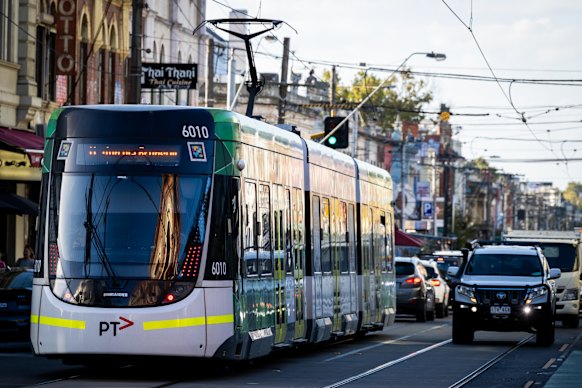
Brunswick Street in Fitzroy may be one of Melbourne’s trendiest shopping and nightlife strips, but it now has another claim to fame: the slowest trams anywhere outside the CBD.
Analysis of tram speed data, obtained by The Age, reveals route 11 trams crawl along the southern end of Brunswick Street, between Johnston Street and Victoria Parade, at an average speed of just 11.8km/h during the morning peak.
That makes it the slowest section of Melbourne’s tram network outside the Hoddle Grid, where congestion and the huge number of passengers boarding and alighting slow things down even further.
Along Swanston Street, where eight routes converge along the world’s busiest tram corridor, trams have an average speed of 7.3km/h between Flinders and Lonsdale streets.
Melbourne has the world’s largest tram network, spanning 250 kilometres of double tracks and carrying about 475,000 passengers each weekday. But it is also one of the slowest because roughly three-quarters is mixed with road traffic.
Monash University’s chair of public transport, Graham Currie, said sharing road space with traffic was the biggest impact on speeds. He said trams and vehicles should be separated with bollards where possible, as has been done in the CBD over the past decade. In congested areas like Brunswick Street, that could mean removing on-street parking to free up road space.
“We should be providing separate rights of way for trams – they are carrying hundreds of people. They are the most efficient use of space. Parking is a very inefficient use of that space,” Currie said.
The Age obtained tram speed data from the state transport department through a freedom of information request. It divides the network into 509 segments and lists the average travel speeds along each segment in the morning commuter peak (7am to 9am) between December 2024 and August 2025. The Age excluded sections shorter than three stops from the analysis.
The data shows Swan Street, Richmond – another car-clogged corridor – is the second-slowest section of the network, with commuters on the route 70 and 75 travelling at 12.2km/h from Church Street to Richmond Station.
Route 16 trams meander through St Kilda at 12.4km/h along Carlisle Street (the third-slowest segment), and 12.9km/h from St Kilda Junction to the intersection of Fitzroy Street and Canterbury Road.
Glenferrie Road to Kew Junction (route 109), Mount Alexander Road through Ascot Vale (route 59), St Kilda Road between Commercial Road and Anzac Station, Chapel Street in Windsor (route 78) and parts of route 57 in Flemington and North Melbourne round out the slowest 10 sections of the network.
Commuters enjoy much faster travel where trams have been separated from traffic, the data shows.
A one-kilometre stretch of route 64, down the centre of Dandenong Road in Armadale and Caulfield North, is the fastest section of the network, recording average speeds of 30.6km/h.
Route 59 alongside the Tullamarine Freeway in Airport West, route 11 down St Georges Road in Northcote, route 64 down Hawthorn Road, and route 96 from St Kilda Station to Middle Park were all close behind, with average speeds of around 28km/h.
The fastest overall is route 64, from Melbourne University to East Brighton, clocking in at 16.9km/h.
Route 78, which travels the length of Chapel Street from North Richmond to Balaclava, has the slowest average morning commute speed overall – 13.3 kilometres an hour.
Public Transport Users Association spokesperson Daniel Bowen said traffic light signalling could be better automated to ensure trams are given green lights.
“It’s important to make public transport quicker and more convenient and more time-competitive with driving,” he said. “That helps attract people onto public transport, knowing they won’t be on a slow trundling tram that has to stop at every traffic light.”
Currie said many tram stops were close together, compared to other tram networks, which also slowed down travel speeds. He said building raised “super stops” not only improve accessibility and safety, but also speeds by making it quicker for all passengers to board and alight. Disability advocates have repeatedly criticised the state Labor government for the slow pace of tram stop upgrades.
“They shouldn’t be waiting at the curbside and walking across roads with traffic in it, which unfortunately is happening everywhere outside the CBD,” Currie said.
A Department of Transport and Planning spokesperson said trams were given priority at “key intersections” to improve speeds, and it was currently working to combine some close-together stops along routes 57, 59 and 82.
A Yarra Trams spokesperson said the presence of traffic, pedestrians and cyclists in busy areas also affected travel speeds.
“In shared, high-density sections of the network, slower speeds are necessary to protect pedestrians and keep everyone sharing the road safe,” they said.
“Yarra Trams works with the Department of Transport and Planning to continuously review operational performance.”
Start the day with a summary of the day’s most important and interesting stories, analysis and insights. Sign up for our Morning Edition newsletter.
 Patrick Hatch is transport reporter at The Age and a former business reporter.Connect via X or email.
From our partners
Disclaimer : This story is auto aggregated by a computer programme and has not been created or edited by DOWNTHENEWS. Publisher: www.smh.com.au